 almotamar.net Google
 - MOGADISHU, Somalia - U.S. helicopter gunships attacked Islamic militia targets in southern Somalia against Tuesday, a day after U.S. Special Operations forces launched at least two air attacks against the militia, reportedly causing heavy casualties.
Spokesmen for the U.S.-backed Somalia government said many Islamic fighters were killed in the air strikes, but witnesses spoke of heavy civilian casualties.
Both the White House and the Pentagon have been silent on the U.S. military intervention, but a U.S. defence official, speaking on condition of anonymity, claimed the attacks were aimed at al-Qaida linked extremists. Earlier, Somalia’s president had said the U.S. was hunting suspects in the 1998 bombings of two U.S. Embassies in East Africa, and had his support.
The helicopter strikes took place Tuesday morning in Afmadow, 350 kilometres southwest of the capital Mogadishu. Witnesses said 31 civilians, including a newly wed couple, were killed. The claim could not be independently verified.
On Monday, U.S. AC-130 warplanes killed what Somali officials said were large numbers of Islamic fighters in Hayi, 50 kilometres from Afmadow, while a second strike was launched on remote Badmadow Island, 250 kilometres away on the southern tip of Somalia, close to the Kenyan border. U.S. officials say the area, known as Ras Kamboni, is the site of al-Qaida-linked terrorist training camp.
“We don’t know how many people were killed in the attack but we understand there were a lot of casualties,” said Somali government spokesman Abdirahman Dinari. “Most were Islamic fighters.”
Witnesses said at least four civilians, including a small boy, were killed in the Hayi attack Monday. “My four-year-old boy was killed in the strike,” Mohamed Mahmud Burale told The AP by telephone. “We also heard 14 massive explosions.”
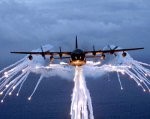
The AC-130, a four engine turboprop-driven aircraft, is armed with 40 mm cannon that fire 120 rounds per minute and a 105 mm cannon, normally a field artillery weapon.
The plane’s latest version, the AC-130U, known as “Spooky,” also carries Gatling gun-type 20 mm cannon. The gunships, which have long ranges and take off from land, were designed primarily for battlefield use to place saturated fire on massed troops.
The attacks were the first overt military strikes by the U.S. in Somalia since it led a UN force in the 1990s that intervened in Somalia in an effort to fight famine. The mission led to clashes between UN forces and Somali warlords, including the “Black Hawk Down” battle that left 18 U.S. servicemen dead.
In a further escalation of U.S. involvement, the U.S. military said Tuesday that the aircraft carrier USS Dwight D. Eisenhower had arrived off the coast of Somalia to join three other U.S. warships - two guided-missile cruisers and an amphibious landing ship - conducting anti-terror operations.
U.S. warships have been seeking to capture al-Qaida members it claims are attempting to flee Somalia after Ethiopia, with Washington’s blessing, intervened Dec. 24 in Somalia’s civil war. The Ethiopians quickly overwhelmed the country’s lightly armed Islamic militia and put the interim government in power.
The interim administration was set up with UN help in 2004 amid ongoing warfare between clan-based warlords in the Horn of Africa country.
Last summer, the Islamic militia, known as the Council of Islamic Courts, subdued the warlords in the capital, Mogadishu, and most of southern Somalia and seemed poised to take over the entire country when Ethiopia stepped in.
Leaders of the Islamic movement have vowed to launch an Iraq-style guerrilla war in Somalia.
European Union foreign policy chief Javier Solana said he told UN Secretary General Ban Ki-moon on Monday that a UN peacekeeping force may be needed to guarantee security and stability in Somalia. He said Ugandan forces may be the first deployed to replace Ethiopian troops.
In Brussels, European Commission spokesman Amadeu Altafaj Tardio said the U.S. air strikes would not contribute to bringing about long-term peace.
However, Abdullahi Yusuf, president of the interim Somali government, told journalists in Mogadishu that the U.S. “has a right to bombard terrorist suspects who attacked its embassies in Kenya and Tanzania.”
Deputy Prime Minister Hussein Aideed told The Associated Press the U.S. had “our full support for the attacks.”
But others in the capital said the attacks would only increase anti-American sentiment in the largely Muslim country. Already, many in predominantly Muslim Somalia had resented the presence of troops from neighbouring Ethiopia, which has a large Christian population and has fought two brutal wars with Somalia, most recently in 1977.


 U.S. attacks Islamic militia in Somalia



