 almotamar.net Google News
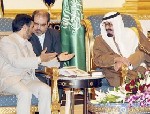
 - Riyadh: Iranian President Mahmoud Ahmadinejad arrived in Riyadh yesterday on his first official visit to Saudi Arabia, a trip that many in the region hope will help calm sectarian tensions threatening the Middle East as well as conflicts in Iraq and Lebanon.
Saudi King Abdullah Bin Abdul Aziz received Ahmadinejad at the airport.
"In the meeting with King Abdullah, we will discuss those issues that should be carried out jointly in the Islamic world and also the region," the official Irna news agency quoted Ahmadinejad as saying before leaving Tehran.
Iranian state radio said talks would also cover "Iran's nuclear case", adding that Foreign Minister Manouchehr Mottaki and other senior officials were accompanying the president.
This is Ahmadinejad's first official trip to the kingdom. The Iranian president visited the kingdom in December 2005, but only to participate in an Islamic summit in Makkah.
Ahmadinejad's trip comes amid rapid developments that threaten to further isolate his country and step up international sanctions against it because of its refusal to suspend uranium enrichment.
Yesterday, top diplomats from the United States, Russia, China, Britain, France and Germany were due to resume talks on new sanctions against Iran. A US official predicted the session would lead to a "substantive resolution."
The State Department on Thursday reported the six countries had made progress towards reaching consensus on a new, tougher text against Iran for its refusal to give up uranium enrichment work that Washington fears could lead to a nuclear bomb.
US officials said only a few issues remained to be nailed down and expressed hope that UN ambassadors from the six countries could begin drafting a new resolution next week.
At the same time, the US has been beefing up its military presence in the Gulf in the past two months.
Although Washington has said it has no plans to strike Iran, it has also refused to rule out any option.
Regionally, most Arab governments have signalled impatience and worry over Iran's backing in Iraq and Lebanon, saying such support can only destabilise the region.
Optimism
Iran is a strong backer of Lebanon's Hezbollah, which is striving to bring down the US-and Saudi-backed Lebanese government. Iran also has close ties to Shiite political parties in Iraq, and Washington accuses it of backing Shiite militias there.
Arab officials have pointed out that while Shiites are a majority in Iran and Iraq, they make up only 15 per cent of the world's Muslim population, and sectarian tensions could ultimately work against the groups which Iran supports.
Dawood Al Shirian, a Saudi journalist and analyst, said "the visit should be viewed with optimism," especially since it culminates weeks of talks between the two countries.
He said that if Riyadh was not sure that the talks will be successful, it would not have held it now.
"Saudi Arabia is not a politically bankrupt country looking for a show for its foreign policies," he said.
"If it didn't know that the visit would add to its political achievements, it wouldn't have been enthusiastic about it."
Saudi newspapers struck a welcoming tone in editorials, saying they hoped Ahmadinejad's visit signals an Iranian willingness to revise its regional policies and work with, rather than against, Arab governments.
Ups and downs of relations since late 1980s
Iranian President Mahmoud Ahmadinejad yesterday left on his first official trip to Saudi Arabia, where the crises in Iraq and Lebanon and Iran's nuclear programme are expected to top the agenda.
Here are some details on the ups and downs of relations between the two countries over the last 20 years.
1987 - Makkah
Relations between Saudi Arabia and Iran, severed by King Fahd in April 1988, were strained almost to breaking point in July 1987 when 402 pilgrims, 275 of whom were Iranian, died during clashes in the holy city of Makkah.
In the next year there were few signs of a cooling of tempers as Riyadh frequently warned Tehran it would not tolerate a repeat of violence at the holy shrine.
Protesters took to the streets of Tehran, occupied the Saudi embassy and set fire to Kuwait's embassy. A Saudi diplomat, Mousa'ad Al Ghamdi, died in Tehran of wounds sustained when he fell out of an embassy window and Riyadh accused Tehran of delaying his transfer to a hospital in Saudi Arabia.
1997 - Islamic summit
Then-Crown Prince Abdullah visited Iran for an Islamic summit in December 1997, becoming the highest-ranking Saudi to do so since the 1979 Islamic revolution.
1999 - Better times
King Fahd congratulated Iranian President Mohammad Khatami on his election victory in 2001, saying it was an endorsement of his reformist policy.
Khatami, a Shiite cleric, worked for rapprochement with Saudi Arabia after winning his first poll landslide in 1997 and ending two decades of tense relations that followed Iran's 1979 Islamic revolution.
Khatami visited Saudi Arabia in 1999 on the first visit by an Iranian president since the revolution. The two countries sealed better relations with a security pact in April 2001.
2007 - Regional fears
Saudi Arabia told an Iranian envoy in January that Iran was putting the Gulf in danger, in a reference to the Islamic republic's conflict with the United States over Iraq and its nuclear programme.
Gulf countries, led by Saudi Arabia, fear a resurgence of Iranian revolutionary zeal in the region under President Mahmoud Ahmadinejad, elected in 2005. This would clash with the close relations Gulf Arab rulers enjoy with the United States and they fear it could also politicise their Shiite minorities.
Gulf countries fear the environmental and economic fallout of any US or Israeli strike on Iran; its nuclear plant at Bushehr lies directly across the narrow Gulf waterway.


 Iran and Saudi leaders in key talks



