 Almotamar.net Christian Science Monitor
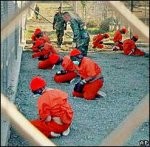
 - WASHINGTON - A sharply divided US Supreme Court has declined to take up one of the thorniest legal issues in the Bush administration's war on terror – whether detainees at Guantánamo Bay, Cuba, are entitled to federal court hearings to challenge their open-ended detention.
Instead, in a significant victory for the White House, the nation's highest court on Monday let stand a Feb. 20 appeals court ruling that the detainees are not entitled to immediate access to US federal courts.
Lawyers representing 45 of the 385 detainees at the terror detention camp at the US Naval base at Guantanamo had asked the justices to take up the case on an expedited basis. They wanted the high court to hear arguments during a special oral argument session in early May so a decision could be released by the term's end in late June.
But the court refused to wade into the controversy at all. Instead, the detainees must now exhaust the legal and other avenues established by Congress and the military at a federal appeals court in Washington before bringing their cases to the nation's highest court.
Four of nine justices must vote to take up a case. In issuing the denial on Monday, three justices, Stephen Breyer, David Souter, and Ruth Bader Ginsburg dissented, saying the court should have taken up the cases.
The decision means that detainee review procedures and military commission trials will move forward this spring without the threat of an adverse Supreme Court ruling hanging over military prosecutors and other Defense Department officials.
But two justices, John Paul Stevens and Anthony Kennedy, issued what appeared to be a warning to the Bush administration. They said legal analysts should not see the high court's refusal to take up the case as an endorsement of the government's treatment of the detainees. They said that Guantánamo detainees could file future appeals to the Supreme Court if their cases were subject to unreasonable delays.
"Alternative means exist for us to consider our jurisdiction" in the cases, Justice Stevens writes in a brief statement.
In the two companion appeals denied on Monday, lawyers for the detainees challenged President Bush's expansive view of his war powers and asked the justices to clearly delineate what rights, if any, are owed to terror suspects under the US Constitution.
"What ultimately is at stake here is America's commitment to its core values and the rule of law," wrote Washington lawyer Thomas Wilner in his brief to the court on behalf of the detainees.
"That commitment requires ... that this court make clear that our government cannot evade the core constitutional limits on its authority – and the fundamental values of fairness for which our country is known – simply by placing its prisoners in areas beyond our technical sovereignty," Mr. Wilner said.
The two consolidated cases, Boumediene v. Bush and Al Odah v. United States, would have presented the first opportunity for the high court to assess the constitutionality of a 2006 law that sought to strip the federal courts of jurisdiction to consider the detainees' plight.
At issue was whether the Military Commissions Act (MCA), passed by the prior Republican-controlled Congress, violated the constitutional right of prisoners under habeas corpus provisions to ask a neutral judge to assess the legality of their detention.
A federal appeals court panel in Washington ruled 2 to 1 on Feb. 20 that the new law did not violate the habeas safeguards. The Constitution does not confer rights on noncitizens being held at a military base outside US territory, the court ruled.
Lawyers for the detainees said the appeals court was wrong. They said the Supreme Court ruled in June 2004 in a case called Rasul v. Bush that habeas protections historically extended beyond sovereign limits to any place under the government's control. Thus, federal judges have jurisdiction to hear the detainee cases at Guantánamo, the lawyers said.
Some 385 detainees are being held at Guantánamo Bay and many have been in US custody for more than five years without charge. US officials say under the law of war and the MCA they can be held indefinitely as enemy combatants.
It is unclear how the court might have ruled had it accepted and heard the cases. Since the Rasul decision, two justices have left the court and been replaced by new justices appointed by President Bush. They include Chief Justice John Roberts and Associate Justice Samuel Alito.
Lawyers for the detainees said that Congress overstepped its authority when it attempted in the MCA to strip federal court jurisdiction to hear detainee cases.
The Constitution says that the right to habeas corpus review "shall not be suspended, unless when in cases of rebellion or invasion the public safety may require it."
Banning federal court review of detainee cases is the equivalent of suspending habeas review, detainee lawyers said. But the US is not facing a rebellion or an invasion, they said.
Government lawyers countered that detainees at Guantánamo do not have a constitutionally protected right to habeas corpus. The Supreme Court recognized a potential statutory right to habeas in its Rasul decision, not a constitutional right, said US Solicitor General Paul Clement in his brief to the court.
But since the 2004 Rasul decision, Congress has amended the habeas statute to withdraw federal court jurisdiction. In its place the Defense Department and Congress established a military review and appeals procedure.
The new procedure provides detainees a legal mechanism to challenge their detention both at Guantánamo and in federal court in the US that fully satisfies the habeas requirements, Mr. Clement said. Under Pentagon rules, detainees are brought before a panel of military officers called a combat status review tribunal (CSRT). The detainee is permitted to present any information that he is innocent and being wrongly held. The panel then weighs that information against evidence presented by the government justifying the individual's detention as an enemy combatant.
Such CSRT reviews must be conducted for each of the detainees at Guantánamo. Any final decision by a CSRT panel can be appealed to the federal appeals court in Washington.
Recent highly publicized statements by alleged 9/11 mastermind Khalid Sheikh Mohammed were made during his CSRT hearing on March 10.
Although Mr. Mohammed admitted many of the charges against him, he nonetheless told the panel that many other detainees at Guantánamo had no connection to Al Qaeda, terrorism, or hostilities against the US. He said they had been wrongly arrested and were being wrongly detained.
Lawyers for the detainees have been making a similar argument for more than four years.
"The government claims an immense power unprecedented in our history: to imprison foreign nationals, without bringing criminal charges or providing fair process, for an indefinite period," writes former US Solicitor General and Washington lawyer Seth Waxman in his brief filed on behalf of detainee Lakhdar Boumediene and others. "It is difficult to imagine a public controversy more in need of this court's guidance."
Mr. Boumediene is one of six Algerian immigrants to Bosnia arrested as terror suspects in 2001 by Bosnian authorities. The arrests came at the urging of the US. After an investigation, Bosnia's supreme court ordered the six released because of a lack of evidence of involvement in terrorism.
The six were released, but were then turned over to the US and flown to Guantánamo Bay where they have been held since January 2002.
Mr. Wilner represents Fawzi Al Odah, a Kuwaiti, and 38 other prisoners at Guantánamo, all of whom say they never engaged in combat against the US and are innocent of wrongdoing.
All 45 of the detainees in the two appeals were asking for the same remedy. They want a hearing before a neutral judge to decide the legality of their detention.


 Little redress in US courts for detainees



