 almotamar.net Google news
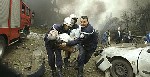
 - Al-Qaeda affiliate claims responsibility after dozens die in twin bomb blasts Two suicide blasts in Algeria, one heavily damaging the Prime Minister's Office in the country's capital and the other hitting a suburban police station, killed at least 24 people yesterday, raising fears that al-Qaeda-affiliated violence is spreading throughout North Africa.
Algiers last resembled a war zone during the country's bloody civil war in the 1990s, and residents clearly do not want to return to that era.
"I thought explosions in Algiers were over," Leila Aissaoui, 25, tearfully told Reuters. "I made a big mistake and I can't accept this."
The attacks in Algiers, which also injured more than 200 people according to the official Algérie Press Service, came a day after three terrorist suspects being pursued by police blew themselves up in neighbouring Morocco.
Arab broadcaster Al-Jazeera said a purported spokesman for the al-Qaeda Organization in the Islamic Maghreb claimed responsibility for both incidents.
"It's very easy to see the possibility of violent Islamist organizations regaining some of their momentum of years past, especially if the aim is beyond Algeria," Azzedine Layachi, a political scientist specializing in North Africa, said in an interview.
"I would expect that this is the beginning of a new wave," said Prof. Layachi, who teaches at St. John's University in Staten Island, N.Y.
In Casablanca, Moroccan Interior Minister Chakib Benmoussa said yesterday that the Moroccan bombings were not the work of the al-Qaeda group, Reuters reported.
"What happened . . . has nothing to do with the terrorist acts that neighbouring countries have seen," Mr. Benmoussa told reporters. He said the Casablanca bombers used primitive means to blow themselves up, proving theirs was a "desperate terrorist act."
Officials said the four men were members of a gang that police had been hunting since March 11, when their suspected leader detonated an explosives belt in a café to avoid arrest.
The al-Qaeda Organization in the Islamic Maghreb is the new name of the Salafist Group for Preaching and Combat, which was created in 1998 as an offshoot of an earlier Islamist group that had been fighting the government in a decade-long civil war that claimed the lives of some 200,000 people.
"This is a crime, a cowardly act," Algerian Prime Minister Abdelaziz Belkhadem said, speaking on national radio shortly after the explosion outside his offices. "It can only be described as cowardice and betrayal. At a time when the Algerian people are asking for national reconciliation and extend their hands, these criminal acts are taking place."
With a resurgence of violence also in Morocco and Tunisia, there is mounting fear that the rebranded group is forming into a regional terror movement. Jean-Louis Bruguière, France's leading anti-terrorist magistrate, has warned that Muslim terrorist groups throughout North Africa are unifying under the banner of al-Qaeda and that the ingredients exist to create an "Islamic arc" of extremists.
Mona Yacoubian, a North Africa specialist at the Washington-based United States Institute for Peace, said there is ample cause for worry that Algeria could be propelled backward to the bloody 1990s. That civil conflict began after the army stepped in and cancelled the second round of an election an Islamist party was expected to win.
"Obviously what we've seen in the last few months is an up-tick in violence, which is concerning to those of us who watch Algeria," she said in an interview. "Today's bombings give one cause for greater concern with regard to short-term issues of stability in Algeria."
Like Prof. Layachi, Ms. Yacoubian argued that a security crackdown alone on Islamic insurgents is a woefully inadequate means to dampen violence and create stability.
"There are deeply rooted socio-economic ills, unemployment in a disproportionately young population with little hope for jobs and the future, and housing shortages that remain despite Algeria's great hydro-carbon wealth."
Ms. Yacoubian said the Algerian government's response to yesterday's violence may be even tighter security, more repression and less willingness to open up politically.
"In the long term many, myself included, believe the latter is the kind of measure that is necessary for lasting stability in a country like Algeria."
Prof. Layachi said that the Algerian government must adopt a comprehensive approach in face of the increasing insurgency.
"If the state response is limited to security, it's not going to solve it," he said.
At a glance
The group aims to establish an Islamic state within Algeria and target Westerners.
Founded in 1998, it eclipsed the Armed Islamic Group in Algeria and is currently thought to be the most effective remaining armed group in the country. In October of 2003, the group offered its support to the al-Qaeda network.
Its leader is currently Abdelmalek Droudkel, also known as Abu Mus'ab Abd el-Wadoud, who opposed a six-month amnesty offered under a peace and reconciliation program promoted by President Abdelaziz Bouteflika and aimed at ending years of political violence. The amnesty expired in August of 2006.
The group's strength is believed to be about 500. Its claims of having some 5,000 guerrillas are seen as an exaggeration. Its weaponry includes AK-47s, explosives and land mines.
The group is thought to be financed through criminal activities, including smuggling of items such as vehicles, cigarettes, drugs and arms.
In 2003, the group kidnapped 32 European tourists in the Sahara. All were freed except for one who died of heatstroke.
In late January, the group changed its name to al-Qaeda Organization in the Islamic Maghreb after gaining the approval of Osama bin Laden, according to an Internet statement.


 Suicide attacks spark fear in Algeria



