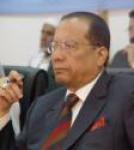
 Issam al-Sufyani Almotamar.net
 - Secretary General of the General People's Congress (GPC) Abdulqader Bajammal said Monday the political dialogue between Yemeni political parties and organisations represented in the parliament must not be locked inside four walls but should be expanded and to go to the streets where the people and their issues are and those issues are related to subjects of the dialogue.
The GPC's secretary General added the judicial and constitutional reform must not be separated from each other. It must be a comprehensive, interrelated and integrated in its parts, details and main titles. He said article 125 of the constitution puts the Shoura Council at the same footing with a Council of Notables that does not have complementary legislative or constitutional job and there is no full close connection between all systems of the legal and constitutional process.
At the conclusion of the symposium on the system of reforms organised by Al-Mithaq Institute in Sana'a Bajammal affirmed the constitution needs reconsideration because it is a human act and because of that it bears political inclinations of those humans, indicating that the Yemeni constitution had a historical task, i.e. the achievement of the Yemeni unity but this constitution came to be based on accord and in the end underwent bargaining and bidding on topics that were still in the north and south division system. He said the question of public and party freedoms or the multi-party system came later and were not stipulated in the constitution, they were dictated by the circumstances and conditions pertaining to the unity. The system of the political life is also administrative and judicial life and all the legislative system needs cohesion rather than selection.
With regard to the issue of bi-cameral system the secretary general said "I am sure the subject will be disturbing for some members of the Shoura Council and the essential question is that we will include another chamber in a direct democracy."
Bajammal added the GPC as a partisan and civilian establishment should not necessarily be identical to the governmental establishment otherwise the GPC will be nothing if it does not possess a slogan that it is a genuine pioneer in thinking and managing.
On the law of the local authority Bajammal said President Ali Abdullah Saleh did very well when he announced the necessity of amending the law of the local authority and added " We do not deem the this project as political wrangle but rather we want it to be a real project in the serious national dialogue and not political advertisements." He has drawn the attention that regarding the law of the local authority and the issue of elections the parties of the political process in the GPC and the JMP are tied to totalitarian tendencies. He affirmed the issue of the local authority is bigger than election of a governor or head of a district it is rather to take away centralization from the content of the local authority because centralization is part of the totalitarian mentality. Bajammal said that there was a need for a new law on political parties giving more spacious horizon to the concept of partisanship in its modern civilized meaning.
Concerning the pres and publication Bajammal said it is a complicated topic and it is our understanding of democracy, freedom and responsibility. He called for establishment of newspapers according to institutional structure because it is unbelievable to have a newspaper far from establishment and talk about people, the society and the rights. He said all should consolidate the ethics of the profession.
Concerning elections and the election commission Bajammal said " We in the GPC suggested that instead of making the Supreme Commission for election a share among the political parties it should be composed of judges as long as judges are not party members," expecting that dialogue on the nature of the Supreme Commission of Elections to be a judicial body or formed from judges.


 Elections committee supposed to be composed of judges: Bajammal



