 CBC News
 -
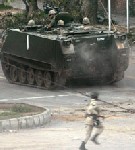
Government troops stormed a besieged mosque early Tuesday in Pakistan's capital, killing 50 militant students and eight soldiers, officials said.As explosions were still being heard from Islamabad's Lal Masjid, or Red Mosque, Gen. Waheed Arshad described the operation as a "slow process" with soldiers battling room by room.
But he told reporters government forces now controlled 70 per cent of the labyrinth-like complex.
As commandos attacked the mosque from three directions, some 20 children who rushed toward the advancing troops were brought to safety, he said.
Twenty-four others fleeing were captured, Arshad said, but would not give further details about those trapped inside. Contrary to local media reports, no nerve gas was used, he said.
"These terrorists are well-armed and well-trained they have all kids of weapons," he said.
He also said several women and children were being held hostage inside.
'My martyrdom is certain now'
About five hours after the assault began, resistance remained in parts of the compound. Gunfire and explosions still boomed over the city.
The assault began before dawn, just minutes after a delegation led by a former prime minister left the area declaring that efforts to negotiate a peaceful end to a week-old siege had failed.
Clashes this month between security forces and supporters of the mosque's hardline clerics prompted the siege. The religious extremists had been trying to impose Taliban-style morality in the capital through a six-month campaign of kidnappings and threats. At least 67 people have been killed since July 3.
Abdul Rashid Ghazi, the mosque's deputy leader, told the private Geo TV network that his mother had been wounded by gunshot. There was no immediate official confirmation of his claim.
"The government is using full force. This is naked aggression," he said. "My martyrdom is certain now."
Negotiator slams Musharraf
On Monday, President Gen. Pervez Musharraf assigned ex-premier Chaudhry Shujaat Hussain to try to negotiate a peaceful end to the standoff.
But Hussain and a delegation of Islamic clerics returned crestfallen from the mosque before dawn Tuesday after about nine hours of talks with Ghazi via loudspeakers and cellphones.
"We offered him a lot, but he wasn't ready to come on our terms," Hussain told reporters waiting at the edge of the army cordon.
Rehmatullah Khalil, a senior cleric who was part of a 12-member delegation of mediators, accused Musharraf of sabotaging a draft agreement to end the siege.
He said Hussain had prepared an agreement under which Ghazi was to be briefly held in protective custody, and the government would agree to free the students. Only those being sought by police were to be detained.
"We were happy and hoping that the nation will hear a good news, but the government changed almost all clauses of the draft agreement," he told the Associated Press. "We were stunned on seeing changes in the draft agreement, and we don't know why the government did so.
"The government is responsible for today's bloodshed."


 At least 58 killed as Pakistani troops storm mosque



