Almotamar.net, Saba - The Crown Prince of Qatar Sheikh Tamim Bin Hamad Al Thani received on Wednesday vice president Abid Rabu Mansour Hadi who handed over a letter from President Ali Abdullah Saleh to the Emir of Qatar Hamad Bin Khalifa al-Thani.
In his message President Saleh expressed thanks for the Qatari support for the unity of Yemen. The letter dealt with issues of common interests as well.
The vice president reviewed the current political situation in Yemen under the unification, freedom of expression and multiparty system as well as impact of terrorist acts on the country, pointing out the position of Qatar against the attempt of separation in 1994.
He also highly appreciated position of the crown prince toward security and stability of Yemen, saying that Qatar was strong support for the unity of Yemen.
The crown prince welcomed the vice president and his accompanying delegation, highlighting deep- rooted Yemeni-Qatari relations.
He renewed the Qatari stance which supports unity and stability of Yemen; He confirmed concern of Qatar to do everything to support the unity and stability of Yemen.
The vice president has arrived at Doha international Airport on an official visit as part of his tour of countries of Gulf Cooperation Council (GCC).
He was welcomed by the crown prince of Qatar and other top Qatari officials.
The United Arab Emirates acknowledged on Tuesday that two of its pilots were killed when their military aggression plane crashed over Jawf province, a military official said
The official added that the aggressive crashed plane was an apache that was
Artillery of the army and popular shelled a gathering of Saudi-paid mercenaries in al-Moqadra area in Serwah district of Marib province, a military official said on Tuesday.
Meanwhile, dozens of Saudi-paid mercenaries were killed and others injured in Wadi al-Theek in the district, the official added.
The army and popular forces carried out on Monday unique military operations in Taiz province.
A military official said that a number of Saudi-paid mercenaries were killed at the hands of the army and popular forces in al-Jazami Hill in al-Kadaha area in al-Ma'afer district.
A Saudi aggression fighter jet targeted a citizen's car driving in Fara area of Kutaf district in Saada province overnight, killing the driver and injuring his friend, a security official said on Monday.
The army artillery and popular committees launched a fierce attack on Saudi-paid mercenaries' sites in Jawf province, a military official said on Monday.
The attack destroyed a military vehicle belonging to the mercenaries and killed all on board in Sabran area in khab and shaaf district.
Scores of Saudi enemy soldiers were killed and injured on Sunday when the army and popular forces repelled a Saudi military attempt to sneak into Shurfah site in the border province of Najran, a military official said.
The operation was accomplished successfully against the Saudi
The army and popular committees have killed a total of 18 Saudi-paid mercenaries in sniper operations over the past hours in the central province of Marib, a military official said on Sunday.
Ten mercenaries were killed in Nehm district and eight others were killed in Serwah district, said the official.
Saudi aggression warplanes have launched more than 49 airstrikes over the past hours on several residential areas across Yemen, a security official said on Sunday.
The airstrikes targeted the areas of Malahiz and Husama in Dhahir district, and areas Thuban, Masahif and Sdad in Bakim district of northern Saada province.


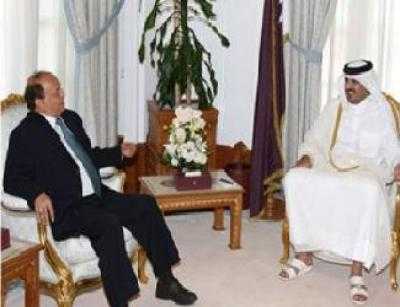
 Qatari Crown Prince renews Qatar’s support for Yemen & its unitary



