 google alerts
 - Over eighty experts including biologists, conservationists, researchers and government officials from the region will take part in a historic initiative to formulate the region's first joint marine conservation strategy focused on preservation of endangered marine turtles and coral reefs.
The four-day Marine Conservation Forum 2006 will be inaugurated tomorrow by Dr. Mohammad Saeed Al Kindi, UAE Minister of Environment and Water Resources. Leading marine conservation experts from the GCC, Iran and Yemen will attend the Forum in Abu Dhabi. The Forum is being organized by EWS-WWF (Emirates Wildlife Society - World Wide Fund for Nature) under the patronage of the UAE Ministry of Environment & Water.
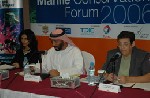
Addressing a press conference on the eve of the Forum, Dr. Salem Al Dhahiri, a senior representative of the UAE Ministry of Environment & Water and Director General of the Federal Environment Agency, said: 'It is a matter of great pride for us that the UAE has been chosen as the venue for the prestigious Marine Conservation Forum. The conduct of this conference here in Abu Dhabi reinforces the message of the UAE being a strong supporter of environmental initiatives'.
'We are pleased to extend our patronage to the Marine Conservation Forum. We believe that a regional approach to marine conservation is the only approach that is workable in the long term given the unique nature of the marine environment that countries in the region share' he added.
Razan Khalifa Al Mubarak, Director, EWS-WWF, said: 'The Marine Conservation Forum 2006 was born out of our conviction that there is an urgent need for regional cooperation. The EWS-WWF is pleased to lead this effort to emphasize the value and importance of regional cooperation to protect and conserve marine life'.
Stating that the Forum would cover environmental, economic and social aspects related to marine conservation and explore sustainable solutions for regional marine conservation, she said. 'The Forum marks a milestone in the growing recognition and acknowledgement of the need for a cohesive, collaborative effort in tackling the key issue of marine conservation in the region'.
Dr. Susan Lieberman, Director, WWF-International Species Programme and the lead facilitator of the Forum, said: 'This is the first forum of its kind for governments of this region-and I am optimistic that we will have excellent, cooperative discussions in the next four days'.
Elaborating on the need to protect coral reefs, Dr. Lieberman explained: 'Coral reefs provide close to US$30 billion each year in goods and services from tourism, fisheries and stopping coastal erosion. Although they occupy less than one quarter of one per cent of the marine environment, coral reefs are home to more than 25 per cent of all known marine fish species. Properly managed, coral reefs can yield an average of 15 tons of fish and other seafood per square kilometer each year.'
Dr. Lieberman also noted that worldwide, six of the seven species of marine turtles are listed as Endangered or Critically Endangered. 'The outlook is increasingly grim. The conservation of marine turtles requires multilateral cooperation and agreements, as well as commitments of governments sharing these species, to guarantee their survival. In this way, we are playing a part in guaranteeing the future and health of communities and economies in the region'.
The first two days of the Marine Conservation Forum 2006 will be dedicated to coral reef conservation followed by two days of presentations focused on turtle protection. Areas of discussion over the four days will include habitats, legal aspects, management, protected areas, population assessment, threat assessments and mitigation strategies. Local conservation efforts in each participating country will be reviewed and best practices assimilated into a Regional Conservation Action Plan.


 Top experts to participate in region's first joint marine conservation initiative



