SABA - The general committee of People's General Congress(PGC) held on Thursday its weekly meeting headed by
President Ali AbdullahSaleh.
They discussed a number of issues concerning the current preparations to hold the 7th general conference in Aden.
The committee approved the executive guide for the 7th conference, the first round meeting of committee and the documents that would
present inthe conference.
The executive guide defines the missions for every committee.
The general committee briefed the efforts in preparing the 7th conference assuring the conference's outcomes have to improve the
party structure and support the PGC role in political life and serving the people.
The PGC would continue to help the society and support freedom, justice, woman empowerment, and human rights, the committee guide
states.
The committee discussed a number of national investment, and economic issues reviewing the latest regional , international ,Arab and
Islamic developments.
TD/AA
Resource: SABA |
| |
|
 SABA
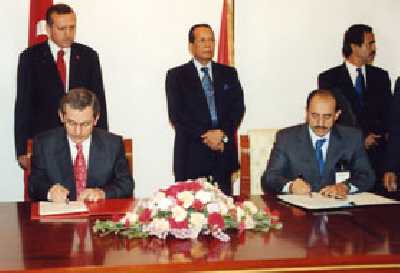
SABA - In a press conference, the Prime Minister Abdul Qader Ba-Jammal and Turkish Prime Minister Recep Tayyip Erdogan
that thejoint talks between the two countries were successful.
They said in the conference, which was held in Sana'a International Airport Wednesday that the talks resulted in signing three agreements
to organizecooperation between the two countries in double taxation, oil, gas andprotection of environment in addition to signing memorandum of understandingto establish a joint council for Yemeni-Turkish businessmen.
Ba-Jammal said that the talks discussed political, economic and cultural issues of common concern as well as positions of the two
countries towardthe latest regional and international development.
The talks also emphasized importance of supporting Islamic work through organization of Islamic Conference and gathering efforts to
fight terrorism,he said.
For his part, the Turkish Prime Minister said that the visit was good opportunity for evaluating economic and political relations between the two countries.
"We feel that there is a real desire from the Yemeni side to develop relations of cooperation in diffident arenas," he said, adding that
the two sidesagreed to sign agreement of the civil aviation during the coming meeting of the Yemeni-Turkish joint committee in Ankara
next February.
He said that the joint talks with the Yemeni officials indicated to
theregional issues of common concern such as the current situations in Iraq, Palestine and Cyprus , confirming the positions of the two countries were in these issues were identical.
He said that his talks with The President Ali Abdullah Saleh were fruitful, adding that he listened from the President Saleh to desire of Yemen to enhance economic, political, trade and cultural cooperation with Turkey.
AH/AA
Resource: SABA |
| |
|
almotamarnet - SANA'A, Oct. 25 - Prime Minister Abdul-Qader Ba-Jammal met on Monday with the Director-General of the Islamic Relief Organization Hani al-Bana who is currently visiting Yemen.
The two men discussed the cooperation between Yemen and the organization in the charitable fields.
The meeting highlighted the need for public awareness about the importance of discriminating between charitable handouts as voluntary and Zakat paying as a compulsory religious demand and a humanitarian act.
Source:SABA
|
| |
|
AlmotamarNet - SANA'A, Oct. 25 - Parliament speaker Sheikh Abdullah bin Hussein al-Ahmer and Shura chairman Abdul-Aziz Abdul-Gani will participate in the declaration of the Pan-Arab Parliament.
The new parliament will be staged in the opening of the Arab League meeting in Cairo on 27-28 December.
Source: SABA
|
| |
|
Ahmed Ibrahim Almass - By Ahmed Ibrahim Almass GS, Yemen Human Rights Guard
Almassinter@yahoo.dk
The idea of establishing an organization for Human Rights in the early �80s in the Middle East was considered an act of a big crime. This included our beloved Yemen. This was the atmosphere and the circumstances then.
Whenever you called for a proposed foundation committee, with the idea of establishing a Human Rights organization, a lot of questions were asked by most attended. But, unfortunately, all questioned were concentrated on financial recourses. Which country would give the organization financial assistance?
And some of the attendants believed that such activities were against the government. While some of the learned men were scared to death, although they knew that is was a right to do it, according to the constitution.
A lot of explanations were made to those who believed that there must be financial assistance from outside country, and they also expected good monthly salaries to carry out the Human Rights activities in our Yemen.
They won�t digest our explanation to them that all Middle East regimes - the rich and the poor � considered such activities, at that period, criminal acts. They won�t assist financially for such activities. In short, we tried hard to convince them the usefulness of depending upon ourselves, but, it was useless.
During these great difficulties and circumstances, partly mentioned, we held a general meeting and founded the first Human Rights Organization in Sana�a. And we named it at that time Human Rights for former South Yemen.
But after the unity of Yemen, we renamed it to the Yemen Human Rights Guard, which (the name) was taken as a loan to what so called opposition party Mowj, then.
We are very much proud and pleased with the changes happening and in particular in Human Rights activities. It is worth mentioning here, as a great change, the formation of the Ministry of Human Rights, headed by highly qualified and well experienced minister.
The Yemen Human Rights Guard has rearranged its activities, giving priority to prisoners, prisons and detention centers. In addition to this activity, we are studying about how to be involved with social welfare affairs to the effected families - children and old folks in connection to prisoners with the cooperation of other organizations.
We write this article inviting all learned Yemenis, Human Rights Organizations, headed by The Minister of Human Rights, to participate to build modern Yemen.
|
|
| |
|
by TONY DEYES -
The author is Director of The British Council, Wales.
Strong ties between Wales and Yemen derive from the times when Welsh coal was stockpiled in Aden to provide fuel to British ships going out to the Far East. From that time the Yemeni community in Wales stands as one of the oldest ethnic communities in the UK. Friends of this community and of the Yemen celebrated these links with the Yemeni festival in Wales in i997, and then in 2001 approached British Council Wales with a request for support for further artistic exchanges between the two countries.
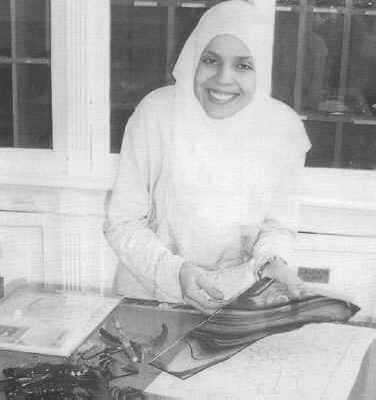
It was decided to set up a three-year residency exchange using the conduit of the British Council offices in the two countries to identify and administer the programme. The programme was to be not only artistic but also academic; host institutions in the two countries would be centres where teaching could benefit from the enrichment of a new source of artistic thinking and production. The University of Wales Institute Cardiff, Department of Art and Design, and the Swansea Institute of Higher Education, School of Art and Design, both expressed interest in acting as hosts in the exchange programme. So, after an exploratory visit from Sana�a in 2002, Najween Al-Atef from the Aden Institute of Art was identified as the first artist to start the residency programme. Welcome support was provided for the visit by the British- Yemeni Society as well as generous accommodation and materials by the two Institutions concerned.
Najween Al-Atef arrived In the UK on 30 March 2003 and spent her first three weeks at the University of Wales Institute Cardiff. She worked there in the silk screen paint section as well as in ceramics. In both departments she was able to work with specialists in those fields and produce pieces of work which she was able to take back with her to the Yemen as well as leaving prints and copies in the UK. At Swansea Institute of Higher Education she extended her own expertise in design to transfer some of her ideas on to glass - one of the major strengths of the Institute. She also worked on photography, one of her major interests, coming as she does from a background of industrial design (one of her major projects in Yemen is to produce more attractively designed support equipment for the disabled such as wheel chairs and appliances).
Through the good offices of Anis Shamsan, a Yemeni who has lived in Britain for some years and has himself worked with disabled minority groups in both Cardiff and Birmingham, Najween was also able to visit galleries in Birmingham, Liverpool and London. In London she was guest of the British- Yemeni Society at a lunch on Friday 9 April attended by the Yemeni Ambassador to Britain.
The success of this first leg of the residency exchange can be largely attributed to the wide range of skills that Najween brought to her work in Cardiff and Swansea, but also to her charm and adaptability on what, it was hard to believe, was her first visit outside the Arab world. As an ambassador for Yemen she proved delightful, as an artist she was skilled and perceptive and alert to the potential application of arts from the two countries to her own sector of interest. The next leg of the residency programme will take place in Yemen in late 2003/early 2004 with an artist chosen from the two Welsh Institutes.
Bill Heber Percy, Pat and Charles Aithie, Jennifer Spencer-Davies, Douglas Gordon and Julian Paxton are all to be thanked for contributing to the success of the visit, and most especially, of course, Chris O�Neil and John Howes at the two Institutes. A special mention too for Kim at Cardiff and Andrea Liggins at Swansea as well as Khadija and Adrian at the British Council in Sana�a.
We all look forward to the next stage - an outward visit from Wales to Yemen later this year or early next.
|
|
| |
|
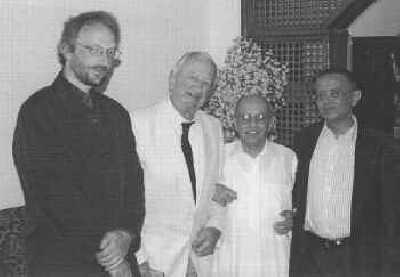
by DAVID SMILEY - During the civil war in Yemen in the 1960s, Colonel Smiley, LVO MC OBE, served as military adviser to Imam Al-Badr and senior members of the Yemeni royal family. Before retiring from the British Army in 1961 he spent three years in Oman as Commander of the Sultan�s Armed Forces. He published an account of his experiences in Oman and Yemen in his book, �Arabian Assignment� (1975). He returned to Yemen, after an absence of thirty-five years, in late February 2003.
When I left Yemen in 1968, I never expected to go there again. Imagine my surprise when in October last year I received a note from the Yemeni Ambassador, Dr Mutahar Alsaeedi, asking me to contact him as he had a letter for me. It was from his government inviting me to go out to Yemen, an invitation which I knew I would find hard to resist.
In due course, over lunch with the Ambassador, I learned that the invitation had come from two very distinguished Yemenis: Dr Abdul Karim Al-Iryani, the former Prime Minister, now Presidential Adviser and Secretary-General of the ruling GPC party; and Dr Hussein Al-Amri, the previous Yemeni Ambassador in London and now a member of Yemen�s Majlis al-Shura. However, the reason for their invitation only became clear to me later: a number of Yemeni historians were engaged in writing an official history of the revolution; they required my help in telling them all I could about the civil war which raged between the Royalist forces of the Imam and the Republican forces led by Colonel Sallal and heavily supported by the Egyptians. Following the military coup against Imam Al-Badr in September 1962 and his flight from Sana�a to a cave in the mountains of northern Yemen, I was appointed to serve as his Military Adviser, and continued in this capacity until 1968 when the Imam finally left the country. During this period I paid thirteen visits to Yemen and was therefore in a position to give an eye-witness account of events from the Imam�s side.
I was very keen to accept the invitation conveyed to me by Dr Mutahar, but a number of people were against my going. Some thought that I was too old (I am 87) and too disabled (being deaf and lame) and probably senile! Others stressed the potential security dangers, citing Foreign Office advice against travel to Yemen. However, both my wife and my doctor approved of the idea, provided that I had a companion to help me. A young volunteer was found in Alexander Brittain-Catlin who throughout the trip proved an excellent companion and ADC. Meanwhile, the Ambassador and his staff did everything possible to facilitate our journey.
On 26 February, Alex and I set off from Heathrow on a Yemenia flight, arriving at Sana�a airport the following morning. There we were met by Colonel Mohsin Khosroof and Derhim Assaidi, a Yemeni diplomat, who were both English speakers and were to accompany us on all our visits and expeditions. From the airport they whisked us to the Taj Sheba Hotel. We were shown into pleasant rooms with views of the mountains from where, in 1966,1 had looked down on Sana�a which the Royalists were then bombarding.
It was perfect weather, and, after we had enjoyed a good sleep, Colonel Mohsin and Derhim took us on a tour of the old city. We walked down narrow streets, between tall, tapering buildings of stone and brick, their windows framed in a tracery of white stucco, into a labyrinth of alleys with stalls selling spices, qat, jambiyyas, shawls, shoes, jewellery ... The desire to capture something of this vibrant, tumultuous world kept our cameras in constant motion.
The following day, being the Friday weekend, was also spent sightseeing; we drove to Wadi Dhahr to see the Imam�s multi-storeyed summer palace, Dar al-Hajr, spectacularly perched on a rocky outcrop. While Alex, Mohsin and Derhim climbed to the top, I sat in the car and watched the passers-by. Every man and boy had a jambiyya in his belt, but I was surprised to see the number of men who also carried a rifle - usually a Kalashnikov - which, apparently, is quite legal. On the way back to the hotel we called at the home of Dr Abdul Karim Al-Iryani who gave us a warm welcome and questioned me about my past in Yemen. With him I met Dr Abdulla Abdul Wali Nasher, Chairman both of the International Bank of Yemen and of the Yemeni-British Association in Sana�a. Dr Abdul Karim told me that he had arranged a meeting for me the next day to discuss the civil war; and I mentioned that I had brought with me from London, as a present for him, an album with some of the many photographs which I had taken in Yemen during the 1960s. Next morning I was driven to the Moral Guidance Department of the Ministry
of Defence and taken to the office of Brigadier-General Ali Hassan Al-Shater. With him were four other officers and Dr Muhammad Qubati, Chairman of the Political and Foreign Relations Committee of the GPC, who spoken excellent English and acted as interpreter. I was shown an Arabic translation of my book, Arabian Assignment, and warned that the next day I would be expected to attend a round table conference.
That afternoon we were taken on another tour, driving for a while along the road running east of Sana�a towards Marib. I was struck by the number of qat plantations; and throughout the whole journey our driver, while steering with his left hand, kept scooping fresh leaves of qat into his mouth with his right! I had previously tried chewing but did not like it, nor did Alex when he tried. Most foreigners disapprove of this nation-wide habit, mainly on economic grounds, but it does mean that Yemen, unlike other societies in the West and elsewhere, has no serious drug problem.
The following morning�s round table conference at the Department of Moral Guidance was chaired by Dr Hussein Al-Amri who introduced me there to Dr Abdullah Barakat and Mahmoud Ibrahim Al-Saghiry. I was asked to give a resume of my time in Yemen in the 1960s, and then answered questions, mainly on details in my book. It was a friendly meeting despite the fact that I had been in the service of the Republicans� enemy; but I emphasised that our real enemy at the time had been Egypt�s quasi-colonial military presence.
During my week in Sana�a I had two evenings out, The first was at the home of Dr Abdul Karim Al-Iryani, a most charming host, where I also met the author and Arabist, Tim Mackintosh-Smith, and, once again, Dr Abdulla Abdul Wali Nasher the second was at the residence of the British Ambassador, Frances Guy. She kindly arranged a dinner for me, which was truly gallant of her, considering that I had visited Yemen against Foreign Office advice! The other guests included Dr Hussein Al-Amri, Dr Nasher and his delightful wife, Ilham, and Professor Yusuf Abdullah the Deputy Minister of Culture. Earlier that day Alex and I were taken to the Military Museum whose diverse array of exhibits includes the car said to have been used by the last British High Commissioner in Aden. The Museum is a handsome example of Ottoman architecture and well maintained, but its interpretation of Yemen�s revolutionary past struck me as more than a little tendentious. We were also taken on a shopping expedition to the suq in the old city where Derhim and Mohsin, ever helpful and generous, insisted on buying presents for my wife, including scarves and jewellery of silver and agate, the locally mined semi-precious stone.
During our last afternoon, General Al-Shater and Dr Abdulla Abdul Wali Nasher called at the hotel to say that they had a present for me from President Saleh who regretted being unable to receive me because of his absence at an Arab Conference. They then produced a wonderful collection of presents for Alex and myself which included a silver jambiyya, boxes of jewellery for my wife, and about six kilos of Yemeni coffee; we felt overwhelmed by this generosity.
Our return flight to London went via Aden, which I had last visited some forty years ago!
Before leaving Sana�a I promised my Yemeni hosts that I would gather together and send them as much material as possible - from my own personal records and from public archives - relevant to our discussions on the civil war. This absorbing task has included reproducing and annotating the nearly seven hundred photographs which I took during my visits to Yemen in the 1960s.
I am proud to think that this material, dormant for so many years, may make a useful contribution to the historiography of modern Yemen.
I look back on my week in Sana�a with immense gratitude for the kindness and hospitality which I received there. It was a moving and invigorating experience. At no time did I have any doubts about my security, and can only confirm the truth of the Yemeni proverb that �Sana�a is a must, however long it takes to get there�!
|
| |
|
AlmotamarNet - SANA'A, Oct 26, (Saba) � More than 300 international and Arab participants will partake in the conference of the Arab woman rights that will be held here during 3-5 December.
The deputy minister of human rights Ali Saleh Taiseer said that the conference participants represent all the Arab countries, some European countries, USA and the international organizations.
The government established a preparatory team, including some representatives from official agencies, with the purpose of ensuring that the conference would conclude with positive results efficiently contributing to the interest of woman and her issues.
|
| |
|
 AlmotamarNet
 - SANA'A, (Saba) - The President Ali Abdullah Saleh will start
his visit to Japan, the USA and France on 5th November.
In his visit to Japan, President Saleh will hold talks with the
Japanese Emperor and prime minister about the bilateral cooperation
relations and the means of developing them, in addition to the
current international issues especially the developments in the
middle east, revamping the UN and the fight on the terrorism.
The discussion will address topics related to development
partnership, attraction of investments, Japanese aid and elimination
of poverty, informed sources said.
The sources spoke highly about the improvement in the
Yemeni-Japanese relations in the last years and the Japanese
contribution to supporting the development programs and reducing the
debts.
|
| |
|
 AlmotamarNet
 - SANA'A - The general committee of General People's Congress(GPC) held on Thursday its weekly meeting headed by
President Ali AbdullahSaleh.
They discussed a number of issues concerning the current preparations to hold the 7th general conference in Aden.
The committee approved the executive guide for the 7th conference, the first round meeting of committee and the documents that would
present inthe conference.
The executive guide defines the missions for every committee.
The general committee briefed the efforts in preparing the 7th conference assuring the conference's outcomes have to improve the
party structure and support the PGC role in political life and serving the people.
The PGC would continue to help the society and support freedom, justice, woman empowerment, and human rights, the committee guide
states.
The committee discussed a number of national investment, and economic issues reviewing the latest regional , international ,Arab and
Islamic developments.
source: Saba
|
| |
|
AlmotamarNet - SANA'A - Yemen is to take part in the international conference on minimizing the use small arms and light weapons, which
well be heldin Geneva next November.
Official sources told 26sep.net that the conference would review experiences of the participating countries in curbing the spread of small arms andmunitions.
The participants will discuss means of enhancing cooperation between participating countries to fight arms smuggling that might reach hands of terror groups.
In 2003, Sana'a hosted an international conference on fighting the spread and use of small arms. The conference, attended by foreign and Arab experts,discussed the small arms problem in six countries including Yemen.
source:Saba
|
| |
|
 AME Info
 - Yemen has reported total oil revenues of $1.9bn during the first nine months of 2005 compared with $1.4bn in the same period of 2004. The announcement came as the government said it was not renewing a product concession operated by Hunt for 25 years which would be transferreed to a Yemeni company.
|
| |
|
Yemen Observer - Global efforts to �make poverty history� will fail unless world leaders act now to end gender discrimination, according to The State of World Population 2005 report, released on October 15 by UNFPA Yemen.
The report, �The Promise of Equality: Gender Equity, Reproductive Health and the Millennium Development Goals�, calls upon world leaders to fulfill promises made to the world�s women and young people in order to meet poverty reduction goals agreed to at the 2000 Millennium Summit and reaffirmed by last month�s World Summit in New York.
Investing in women and young people�who constitute the majority of the world�s population�will accelerate long-term development. Failure to do so may entrench poverty for generations to come.
�We will not make poverty history until we make gender discrimination history�, said UNFPA Representative Hans Obdeijn during the launching of the report on October 15, 2005.
�We cannot make poverty history until we stop violence against women and girls.
We cannot make poverty history until women enjoy their full social, cultural, economic and political rights.�
The Minister of Public Health and Population, Deputy Chairman, Prof. Mohammed A �Noami, said, in line with the report:
�Yemen is committed to engaging women in the development of our country.�
�Investing in women and girls makes sound economic and social sense. This is because discrimination leads to lower productivity and higher health costs. It also results in higher death rates among mothers and children and significantly threatens efforts to reduce poverty.�
Nevertheless, despite new laws and programs to improve the condition of impoverished women, the pace of change is far too slow.
Intimately associated with poverty is lack of access to family planning and reproductive health. While Yemen is working to close gender gaps in education and improve health-care access for women and adolescents, statistics continue to tell a troubling tale.
Today, the population of Yemen at almost 20 million and is expected to reach approximately 45 million in 2050.
This projection is predicated on whether men and women will continue to have the means to decide when and how often to have children.
The biggest threat to the lives of women between the ages of 15-45 in Yemen is pregnancy and childbirth. Every year 365 per 100.00 women die in Yemen from pregnancy-related causes.
These deaths are preventable if access to reproductive health services and modern contraceptives are more widely available in rural as well and urban areas.
Investing in political, economic and educational opportunities for women and girls, on the other hand, yields quick wins and high pay-offs that lead to improved economic prospects, smaller families, healthier and more literate children, lower HIV prevalence rates and reduced incidence of harmful traditional practices. Furthermore, studies show that when women control the family purse strings, they are more likely than men to invest a higher percentage of their earnings in family needs.
Reaching the gender equity goal requires men�s involvement. UNFPA�s work in the field shows that men are valuable allies in striving for changed practices, while seeking to increase men�s understanding and participatory role in promoting gender equity, equality and women empowerment.
Increasingly, governments in the Arab region have proceeded to redefine national population and development policies and strategies in light of the goals articulated in the ICPD (International Conference on Population and Development in Cairo 1994) and the Millennium Development Goals.
These goals provide challenges and opportunities for governments, as they incorporate strategies on reproductive health, gender equality and poverty reduction into national policies.
�And I can assure you that women all over the world are tired of promises, promises, promises,� said Ms. Thoraya Obaid, the Executive Director of UNFPA, at the launching of the Report in London.
�The time has come; we have the means, we have the commitment. Now we need action.� UNFPA is an international development agency that promotes the right of every woman, man and child to enjoy a life of health and equal opportunity.
UNFPA supports countries in using population data for policies and programs to reduce poverty and to ensure that every pregnancy is wanted, every birth is safe, every young person is free of HIV/AIDS, and every girl and woman is treated with dignity and respect.
Copyright (c) 2004 - 2005
Yemen Observer Newspaper
|
|
| |
|
Yemen Observer - The Turkish Prime Minister Recep Tayyip Erdogan said his visit to Yemen last week had succeeded in boosting trade relations between the countries.
In a joint press conference on Wednesday, Yemen�s Prime Minister Abdul-Qader Bajammal and his Turkish counterpart said three agreements had been signed.
Deals were struck on taxation, oil, gas and environmental protection, while a memorandum of understanding was also signed to establish a joint council for Yemeni-Turkish businessmen.
Erdogan said his visit had allowed him to evaluate the economic and political relations between the two countries. �We feel that there is real desire from Yemen to develop relations in many different areas,� he said. He added that plans had also been made to sign an agreement on civil aviation at a meeting of the Yemeni-Turkish joint committee in Ankara next February.
Erdogan described his talks with President Ali Abdullah Saleh as fruitful, and said he had been encouraged by Saleh�s ambitions to increase economic, political, commercial and cultural links with Turkey.
The leaders discussed partnerships on joint investments in both air and sea transportation, and tourism and industry - especially in the Aden Free Zone.
Saleh said he welcomed the Turkish investments in Yemen which he hoped would encourage broader cooperation in trade exchange. Bajammal, speaking at Sana�a International Airport before Erdogan left Yemen, said the talks had covered issues of common concern to the countries, including the situation in Iraq and Palestine.
�The talks also emphasized the importance of supporting Islamic work through the Organization of Islamic Conference and gathering efforts to fight terrorism,� Bajammal said.
The anti-double taxation agreement between the two countries would help smooth business procedures, he added. Both countries stressed the importance of stronger bilateral business, trade ties and joint investments.
�Trade exchange increased by 25% in 2004,� Erdogan said, adding that he hoped to develop trade links further in the future.
Erdogan invited Turkish companies to invest in tourism in the 130 islands on the Red Sea and Arabian Sea.
Last September, the Yemeni-Turkish Joint Committee held its third session in Ankara.
The foundation of the committee was in accordance with a trade agreement singed between the two countries in 1991. The session resulted in signing several agreements such as agreement of avoidance of double taxation and agreement of maritime and transportation cooperation.
The committee also discussed future cooperation in field of small and medium enterprises.
Yemen, Turkey and Italy are government cosponsors of the Democracy Assistance Dialogue of the G-8 forum for the future allows three countries to achieve the necessary coordination for approaching Middle East issues for a common standpoint.
Copyright (c) 2004 - 2005
Yemen Observer Newspaper |
| |
|
 Almotamar Net
 - SANA�A � The government of Yemen has taken strict measures to prevent the purchase of arms through the mediation of arms brokers and traders, a well-informed source said today.
The source added that the strict measures are to include banning the purchase of arms for defence and interior ministries through middlemen. All arms purchases are to be restricted to direct country-to-country deals.
�Any trader importing and bringing arms into the country will be held accountable as a criminal offender and law-breaker,� he concluded.
Ambassador Gasem Al-Aghbari, Head of the Europe Directorate of the Ministry of Foreign Affairs, told a newspaper in a previous interview that the government had spent more than YER 8 billion (more than US $ 41 million approx.) in purchasing weapons from members of the public in recent past years.
source:Yemen Observer
|
| |
|
 Yemen Times
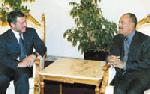
 - President Saleh and King Abdullah the2nd of Jordan, confirmed their desire for strengthening bilateral relations between the two countries. This came in their meeting in Sana�a last Sunday. The two leaders pointed out to the available opportunities for progress of relations in the fields of economy, commerce and exchange of experiences. It also pointed to the prospects of increasing trade exchange between the two countries.
The meeting agreed that the Joint high Yemeni � Jordanian committee will meet at the beginning of next year in Sana�a, to discuss the promotion of all fields of cooperation.
Cooperation in developing transportation was also discussed during the meeting of the two leaders. A committee will be set to establish a sea transport line between the two countries.
It was also agreed to allow the Jordanian Red Sea Company to fish in Yemeni territories.
Concerning the immanent conditions in the Middle East, the two leaders confirmed that the continuation of efforts to incite peace efforts and help Palestinians and Israelis to resume negotiations after pull out from Gaza.
King Abdullah had paid a short 8 hours visit to Yemen during which he held talks with President Saleh. The visit was concluded by closed session of talks between the two leaders.
|
|
| |
|
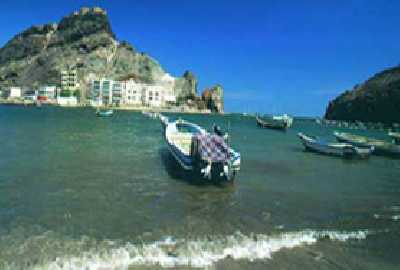
Yemen Observer - A number of historians have written of the history of Aden and the origin of its name. Among the most famous are Bamakhrama in his History of Taiz and Aden, Ibn Al-Majawir�s Al-Mustbser History, Al-Hamadani in his Al-Aklil, and Al-Jundi in his The Behavior.
There are many places named Aden in Yemen, some uninhabited villages, others isolated dwellings. There is one in north Lahj, and north of Mount Radfan there are ten Adens. Each is characterized by specific features like Hummad Aden, Ahwer Aden, Ghair Aden, Arwd Aden, J�ashan Aden, Raaha Aden and so on. The name Aden would appear not to be a proper noun.
Some have noticed that these Adens are located away from main roads, offering protection and security. Some of these places have expanded to include the whole mountain like Abyan Aden and Taiz Aden. Some of these Adens have disappeared like La�ah Aden in the governorate of Lahj, Manaseb Aden, and others.
The impression that one gets from the names is that the name Aden referred to a settlement and settling down, well-being and felicity. Some Yemeni inscriptions interpret the same meaning for the word.
It is said that the name Aden also referred to a man named Aden bin Adnan and who was the first person to be imprisoned in an Aden in Abyan. It�s also said to derive from Addn, meaning settlements, or from M�and, mineral
The explorer Yaqoot Al-Hamawi said that the Abyssinians gave the name to where ships passed by, saying adonah, meaning, �we passed it�.
Copyright (c) 2004 - 2005
Yemen Observer Newspaper |
| |
|
 Almotamar Net
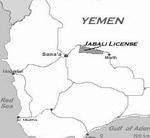
 - Britain's ZincOx Resources plc on Tuesday announced that its 60% subsidiary company, Jabal Salab, had signed an Exploitation Contract with Yemen's Geological Survey and Mineral Resources Board (GSMRB) to mine and process zinc at the Jabali deposit. The Jabali zinc oxide deposit is located 110km north east of Sana�a, the capital of Yemen, and contains a resource, calculated in accordance with the JORC code of 12.6 million tonnes of ore at a grade of 8.9% zinc, 1.2% lead and 68grams/tonne silver.
Andrew Woollett, Managing Director of ZincOx, commented: �The Jabali deposit was discovered in the early 1980s but it has not been developed until now because of the complex mineralogy. Once again it is the metallurgical expertise at ZincOx which will allow us to realise the potential of this attractive resource for the benefit of our shareholders, our partners and the people of Yemen.�
The Exploitation Contract is subject to the approval of the Cabinet and Parliament, which is expected during the first quarter of 2006. It will then be ratified by the President of Yemen and incorporated in law. It sets out the terms under which Jabal Salab can mine and process zinc from the deposit. These include a 20 year lease, a 1.5% net smelter return Royalty, a tax holiday of six years and repayment of past costs incurred by the GSMRB of US$5million commencing in the fourth year. The terms do not differ materially from those assumed in the Feasibility study completed earlier this year (see Press Release dated 15 March 2005).
|
| |
|
Almotamar Net - New York-WABC- New York police are looking for the men who shot and killed a young clerk at a bodega in Queens.
The victim -- a 19-year old from Yemen who moved here just a month ago.
It happened on Farmer's Boulevard in Springfield Gardens in the same store where another person was shot last week.
Eyewitness News reporter Marcus Solis is there with more.
Police say the two cases are not connected but speaks to the increase in violence in this community. This one was particularly vicious robbery. Faisal Hassal, victim's cousin: "Not even one word. They shot him and that was it."
If Faisal Hassal seems shaken up, it's because he's working the bullet-pocked counter where his cousin was killed less than 24 hours ago.
Around 9:30 last night a group of men walked into Farmer's Deli in Springfield Gardens and shot Yaser Saleh at point blank range.
The 19-year old native of Yemen had just started working at the bodega a month ago but was already well liked.
Crystal Byas, neighborhood resident: "He was funny, nice"
This is the second recent shooting at the deli. Just last week, an off-duty police officer was held up at gunpoint as he left the store. The officer ended up shooting one of the suspects in the leg, and four people were arrested.
As police offer a reward and ask for information in this case, detectives are reviewing surveillance video tapes from the neighborhood store.
Rhaleek Walker, neighborhood resident: "You see him everyday. You go in and get what you need, go about your business. These guys had no reason."
|
| |
|
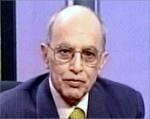 Dr. Abdulkarim El-Eryani
 - Dear friends and colleagues. It is my greatest pleasure to be one of the speakers in this very important Symposium: "Windows on the Cultural Heritage of Yemen", which is the first of its kind in the history of Yemen-American relations.
I believe that I speak for all my colleagues from Yemen who are present with me today. Very special thanks to H.E. Abdulwahab AI-Hajjri, Yemen ' s Ambassador in Washington, DC; to the Smithsonian Institution and its Director, Mr. Thomas Lentz, who was gracious enough to give the welcoming speech on behalf of the Smithsonian Institution; and to Dr. Julian Rubin, Director of the Freer Gallery, who was not able to be with us for health reasons. I must also express my personal appreciation to Mr. Ray Irani, CEO of Occidental Oil Co., for his graceful introduction of Yemen's achievements during the 25 years of President AH Abdullah Saleh�s leadership. I must thank him for his flattering remarks about me.
However, I must say that Mr. Ray Irani symbolizes the pinnacle of a Lebanese-Arab immigrant, who came to the U.S.A. with very few American dollars in his pocket. Today, he is the CEO of one of the largest oil companies in the U.S.A. That is why I call the U.S.A., �The Land of Opportunities.� Please greet with me Mr. Ray Irani. I wish I could call him Mr. Ray �Eryani�. That will be a source of great pride for me.
I must also express special thanks and appreciation to the wonderful people who have been active for almost two years preparing for this great event, under the guidance of Ambassador Al-Hajjri. They are: Boushra Almutawakel; Dr. Brigitte Boulad-Kiesler; Dr. Maria deJ. Ellis (Ria), Director of the Yemeni-American Institute in Sana'a ; Mrs. Amal Hull, wife of H.E. Ambassador Edmund Hull, American Ambassador in Yemen; and the many private and official partners who have made this great symposium possible.
Ladies and Gentlemen, the title I have chosen for this talk is: �Cultural Links or Cultural Divides"! I feel that this title may be suitable after the tremendous havocs brought by the tragedies of September 11, 2001 � not only to Arab-American relations and perceptions, but also to the Arab-European relations. I hope that I, and all participants in this symposium will be able at the end to persuade our American friends and colleagues who are attending here with unprecedented number (as Mr .Lentz noted in his opening statement), that after that horrendous tragedy of Sept. 11, 2001, the only way out is to promote cultural links, and to minimize (but not deny) cultural divides as they exist in all human societies.
We should admit that these cultural divides may lead sometimes to disagreement and eventual conflict, but can never be used to explain the tragedies of Sept 11, 2001 � because they have gone beyond any human conflict in time of peace and stability in the world at large. That does not mean that conflicts in our region are non-existent; but they can�t be used to justify or explain the crimes of Sept 11, 2001.
Dear friends, I believe that most of you are familiar with the book written by Professor Samuel Huntington of Harvard University, �The Clash of Civilizations�, published in 1997. This widely acclaimed book was described by Dr. Henry Kissinger as �one of the most important books to have emerged since the end of the Cold War�. However, the book was severely criticized by almost all Arab intellectuals inside and outside the Arab world. They all sensed, in 1997, an appeal by Huntington to the Western world to get ready for a Clash with Islamic Civilizations. Unfortunately, in my limited reading of Arab magazines and periodicals, I never read a single article which dealt objectively with that book.
For me, I am not here to analyze, refute or accept Huntington's arguments. I have come from afar to promote cultural links. Therefore, the question is: did that book signal the dawn of cultural divides between the East and the West in general? � and between Islam and Christianity, in particular? Tragically enough, it was only four years after publishing the �Clash of Civilizations�, that the horrific crimes in New York and Washington, DC were perpetrated by a group of fanatics embracing the Islamic Faith. That crime was condemned by all Muslims who understood how tolerant Islam was, with all faiths during the past 1400 years. Nevertheless, one can't deny that the murderous attacks on Washington, DC and New York City have made millions of Americans (and even Europeans) claim that these crimes are a vindication of Samuelson�s "Clash of Civilizations".
The question, is, shall we allow these terrorist acts to obliterate a brilliant history of cultural links and religious tolerance between Islam, Christianity as well as Judaism � which has lasted for almost a millennium despite periods of conflict between these three religions which have so much in common?
Ladies and Gentlemen, to make my point, I would like to refer you to a wonderful book just published this year (2003) by Professor Maria Rosa Menocal of Yale University under the title: �The Ornament of The World: How Muslims, Jews and Christians Created a Culture of Tolerance in Medieval Spain�. The Washington Post wrote the following about this book: �The enthralling history of widely hailed as a revolution of a (lost) golden age, bringing to vivid life the rich and thriving culture of Medieval Spain, where for more than seven centuries Muslims, Jews and Christians lived together in an atmosphere of tolerance where literature, science and art flourished� .
Dear colleagues, due to time limitations, I will explore (briefly) how Arab/Islamic cultural links were with Europe during medieval times, not only in Spain but also with the many centers of Arab/ Islamic learning centers such as Baghdad, SamarKand in central Asia, and Sana 'a,Yemen. It is very important to say that many scholars agree that these cultural links sowed the seeds of European Renaissance that lead to the �Industrial Revolution� � which also led to our modem digital age.
In Spain, I will talk about one of the greatest Muslim scholars (who was widely known in medieval Europe as Avirroes), Ibn Rushd, and his Jewish contemporary Ibn Maimoun, the founder of Maimonids Philosophy. Some scholars call him the �second Moses�.
From Sana'a, I will speak about a great Yemeni geographer, astronomer, scientist and historian � Abu Mohammad Al-Hasan Ibn Ahmed Al-Hamdani � whose books were known in Spain because he lived over 200 years before Ibn Rushd. Admittedly, Al-Hamdani was not as well known in Europe as other Arab/Islamic scholars were.
Ibn Rushd, who was known in Europe as Avirroes, was born in 1126 AD, and died in exile in a small Spanish town in 1201 AD. He was buried in his birth place Cordoba, Spain. Avirroes studied and debated in some European schools, most prominently in Paris � which eventually became the bastion of Avirreism philosophy, during the second half of 13th century. His most important book (which was taught in European universities until the late 17th century), was his commentary almost line-by-line on the writing of the world�s greatest philosopher, Aristotle. Ibn Rushd did not only produce the most accurate text of Aristotle's monumental work, but he made many important comments and even corrections based on his own understanding of Aristotelian philosophy.
This book and other works of Ibn Rushd arrived in Europe during the 13th century. Suddenly, the Latin World was divided into parochial dogmatists and liberal followers of Avirroes. The parochialists in both Spain and Europe, considered Avirroe�s theory about the relation between philosophy and theology heretic. Just as Avirroes received a public trial in the presence of Almohad (Al Mowahid), Caliph of Spain, and was sentenced to exile. The Roman Church in Paris issued a decree in 1277, which banned studying Avirroes.
Nevertheless, rationalism prevailed, and Avirroes was studied until new philosophers such as Kant and Descartes took the stage. So what was Ibn Rushd' s philosophy, and how did he see the relationship between philosophy (Science) and theology? Ibn Rushd considered the mind as rational and creative, and theology as instructive. Therefore, if the mind leads to a logical conclusion (which seems to contradict theology), we have to reinterpret our understanding of the theological text to fit new facts of philosophy (Science).
However, Avirroes was a great judge and deeply religious. This very brief presentation of Avirroe's revolutionary thinking turned his life in Andalusia into misery. Ibn Rushd was one of the most important people in the court of the Almohad Caliph; but the religious zealots launched a campaign against him � not only because of his apparent heresy (in advocating the need to adapt theology to scientific facts), but also because he wrote a devastating critique of one of Islam's most prominent theologians, Imam Al-Ghazali (Al-Gazel), a sophist who condemned philosophy and philosophers.
Those vicious campaigns brought him (and his disciples) to a trial in front of the Caliph. Eventually, he was exiled to a village in southern Spain. Now what was the significance of Avirroes new theory? I believe that in addition to promoting rationalism, it was the primordial theory which led to the greatest reform in the history of Christianity; that is, the Protestant Revolution, of separation between the State and the Church.
In essence, Avirroes called for the separation between philosophy (science) and theology, but he only advocated re-interpretation of theology. In medieval Europe, theology was the only science which should overrule any new scientific theory, and the church made sure to perpetuate it. A contemporary of Avirroes was born also in Cordoba. He was Ibn Maimoun (known as Maimonides). Although he was Jewish, he was an Arab educated intellectual. He wrote his most important book, �Guide to the Perplexed�
(Dalil Al-Hairanin), in Arabic.
Like Avirroes, he was deeply religious, but he believed in the supremacy of mind. Sadly, he was persecuted during an anti-Jewish movement. He and his family left Spain, to Morocco; to Palestine; and spent most of his productive life in Alexandria, Egypt �
where he was a respected intellectual.
Dear colleagues, since this great Symposium is about Yemen�s cultural heritage, I would like to present a great Yemeni geographer, astronomer, historian and scientist. He was Abu Muhammed AI-Hasan Ibn Ahmed AI-Hamadani. He was born in Sana'a, in the year of 893 AD, and died around 976 AD. Therefore, he preceded the most well known Arab contributors to European renaissance, such as Ibn Al-Haytham, Al-Bairouni and
Ibn- Sina (Avisina), respectively.
Just as Aristotle was the inspirer of Avirroes (in Philosophy), one may say that Al-Hamdani was inspired by Ptolemy in Astronomy. In his most well known book, �Description of the Arabian Peninsula�, he devoted the first few pages to Ptolemy's famous book on geography. Based on that, Al-Hamadani says: �Beware that the earth is a globe (sphere). It is not flat like a spread piece of cloth.� Then he goes on presenting what we may call an experimental evidence for his theory. He cited as an example a very famous star, known to the Arabs as Suhail Al-Yamani (Copus). As he explained, this star is seen in Sana'a in the centre of the sky. However, in Mecca (north of Sana'a), it appears at the edge of the horizon; and in Baghdad (further north), it is not seen at all.
Al-Hamadani continued to talk about stars seen from the North Pole, but not seen from the South Pole; and seen from the Equator, but not seen form either north or south of the earth.
I believe that Hamdani's most original contributions to Arab Islamic science are three additional scientific observations: The first one is his disagreement with Ptolemy, which said that the temperature of the planets was generated by their rotation. He said that this is impossible because it means that their temperature should rise constantly. How did Hamdani arrive at this (far-reaching) conclusion?
I believe that he arrived at it from the universally accepted theory in his time; namely, that the universe was geocentric. Therefore, if the sun rotated around the earth, the earth's temperature must rise constantly. The same theory of geocentrism led Hamdani to a more far-reaching conclusion: If the earth is a stationary sphere, and the planets rotate around it, it must have �ups� and �downs�. Theoretically, people and objects �down�, must fall. His answer to this was that the earth has �Jathebyah�, the Arabic word for gravity; and that this gravity has equal effect on movement �up� and �down�.
A third theory (which I think was exclusively arrived at by Hamdani�s powerful intellect) is his theory of �the role of breeze� (Arabic nasseem), in sustaining the burning phenomenon which was most puzzling to his predecessors. Hamdani cited an incident which happened in his time. He says a group of people came to the ruler of Sana' a and informed him that a great cave had been discovered in Wadi Dahr (about five KM north west of the city). They believed that it may contain a great treasure which was guarded by devils. The ruler sent his own expedition to the cave. Hamdani said the following: �These men entered the cave using candle lights. As they penetrated deeper and deeper, their candle lights turned off, and they started feeling pressure on their chests. They concluded that the devils must have done all that�! Then, Hamdani explained in the clearest terms how those people were wrong, saying �that the reason for what happened was the disappearance of the breeze (nasseem)� � (oxygen?!). Then, he stated that �burning fire and living things exist only in the presence of (nasseem)�.
Significantly enough, Hamdani proceeded to describe what is perhaps the oldest scientific experiment to prove the rule of (nasseem) in the burning phenomenon. He said �if you take a candle which is well supplied with burning oil and put it on a flat surface, then take a pot and put it over the candle, and seal the edges of the pot with mud; if you lift the pot after few minutes, you will find that the candle has turned off because of the disappearance of (nasseem)�.
Ladies and gentlemen, doesn't Hamdani precede La Voisre by many centuries? Interestingly, Hamdani described steam cooking on the basis of this theory. He said �when you prepare an oven for cooking meat, you usually let the wood burn and then put the meat in the oven on top of the fire. Then the top of the oven is covered and sealed with mud. Similarly, you seal the fire-eye at the bottom. When you open the oven after few hours you will find that the fire is dead and the meat well cooked.� He then explains that fire died because of the disappearance of (nasseem), and the meat was cooked by the steam (heat waves from water in the meat).
Dear friends, in my concluding statement, at the end of this wonderful symposium, I promise those who have asked for the full text of my opening speech to put its full length on our Embassy's website. Now we have to ask where do we go from here? I believe that promoting cultural links and minimizing cultural divides must be promoted in every way possible. We have to hold more symposia like this. The announcement of the Smithsonian that it will host Yemen's exhibition (which is now in Spain) during 2005, is a great step in the right direction.
The establishment of the Yemen Society for Preservation of Cultural Heritage by the private sector of Yemen is another great step. I think we must also promote academic exchange. The number of Arab students has declined significantly since September 11, 2001. This will only promote cultural divides. I myself, am a product of a student exchange programs, sponsored by the International Institute of Education started in Yemen in 1958. I was, in fact, no.3. Many graduates from the U.S.A are now in high positions � not only in Yemen but also in many Arab countries. I look forward to USAID resuming that program in Yemen. Promoting business links and joint investment between Yemeni and Americans is another important objective.
Finally, (before H.E. Edmund Hull makes the closing statements), I must express my deepest appreciation and gratitude for all those who have worked for almost two years to make this symposium a success. My deepest appreciation also goes to The Government of the Republic of Yemen; the U.S. Department of State; the Board members of the Foundation for the Protection of Antiquities and Cultural Heritage (Sana�a); Consolidated Contractors International Company SAL; Hunt Oil Company; Occidental Petroleum and Gas Corporation; the Social Fund for Development (Sana�a); the World Bank (Sana�a); Yemenia [Yemen Airlines]; and Contrack International, who contributed to finance the cost of the Symposium.
Finally, thanks and much appreciation must go again to the Management of the Smithsonian Institution � and particularly to Dr. Julian Rubin, the Director of the Freer Gallery.
Thank you very much |
| |
|
 Almotamar Net
 -
By Cihan News Agency
Published: Thursday, October 27, 2005
.com
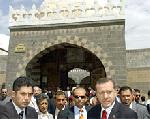
Turkish Prime Minister Recep Tayip Erdogan visited a military museum full of historical artifacts remaining from the Ottoman period and also Bekiriye Mosque built by Ottoman Empire in Sana, the capital of Yemen.
Erdogan examined the Ottoman artifacts in detail during his visit with his wife and cabinet minister Abdullatif Sener after making connections in Kuwait and arriving in Sana in the evening.
Erdogan met with his Yemeni counterpart Abdulkadir Bajamal besides his contacts in Yemen. After an hour's meeting, three different agreements were signed; providing the prevention of double taxation between two countries, cooperation in natural gas and oil and corporation in the protection of environment.
Erdogan said the current 215 million-dollar foreign trade volume is not enough and should be increased, in the press conference held after the meeting. Yemen Prime Minister Bajamal said, "we support Turkey's access to EU. Turkey will play an important part in bridging Europe and the Arabic world," adding there are a lot of areas of corporation between the two countries. Erdogan later met with Yemeni president Ali Abdullah Salih.
|
| |
|
 Almotamar Net
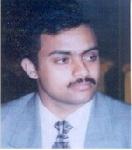
 - SANA�A - The People�s General Congress (PGC), Yemen�s ruling party, may consider in its upcoming conference the nomination of a woman for presidency.
The move will only be taken should President Saleh not run for a new term, said Yasser Al-Awadhi, deputy head of the PGC parliamentary bloc.
Al-Awadhi said that the conference would be full of �surprises� concerning political reforms, including amendments to the election laws to allow all local council members, including governors, to be elected.
The same measure would be applied to some Shura Council members. Al-Awadhi said the moves reflected the PGC policy of continually renewing itself. The party, he said, would name a woman to run in the coming presidential election only if the Islah Party officially announced a female candidate, Mohammed Qahtan had said.
Qahtan had called upon the opposition to agree on naming a woman for president during the 2006 election.
�If Islah is to nominate a woman,� declared Al-Awadhi, �in an official statement either by itself or within the framework of the Joint Meeting Parties (JMP), before the PGC, the latter would consider the matter and might adopt nominating a woman as one of its options.� Ahmed Obaid bin Dhagher said that talk of local or presidential elections is premature.
Qahtan said that the opposition had not discussed its presidential nominee and that it would unite its views when official procedures commenced.
�We haven�t decided who our nominee will be, but all options are open: we can either boycott or compete in the election, but no decision has been made yet.�
Al-Awadhi said that his party was determined to restrict 10% constituencies to women nominees as a unilateral step that was not shared by the opposition.
He said that the so-called reform initiatives were not even eligible to be discussed as they were unrealistic, and did not adhere to national values, particularly those suggesting a division of the country into regions. Al-Awadhi added that if such initiatives were directed at the PGC, it was the latter who had called for dialogue which was suspended by the opposition. But if they were meant for the public, they should be refined and included in the opposition parties� election programs and left to the public to judge.
While the opposition presented what it called a framework for political reform, the Nasserite Unionist Party put forward its own reform initiative. Meanwhile, the Yemen Socialist Party (YSP) Secretary General, Yassin Saeed Noman, said that his party did not have its own initiative and that it would settle for what was stated in its fifth conference political report, considering it the party�s political initiative.
Nevertheless, Noman emphasized the importance of continuing dialogue between his party and the PGC along the terms agreed by the two sides. As for the postponing of the two parties� dialogue committee meeting that was scheduled for last Sunday, Bin Dhagher said that it was due to the YSP wanting more time to present a working paper and not waste time with protocols and courtesies.
He said his party�s suggestions concerned the effects of the 1994 war. �By removing those effects,� Bin Dhagher continued, �we mean to create a new state of relations between the two parties, and then put an end to the oppression that had been exerted on areas in which the war had taken place.�
He denied that the meeting had anything to do with the JMPs, adding that it was the first time since 1994 that such a profound dialogue had been held between the two parties, in view of their strained relations. It would be natural, he said, to start with issues that could thaw relations in order to then build upon them.
�We cannot imagine any possible success for the dialogue while the YSP local headquarters out of its control,� he said. The YSP was working with other JMPs, Bin Dagher continued, to reach a mutual view of the reforms, but that would take time.
�We in the JMPs believe that now is the time for critical political, social and economic reforms in the country. Reforms should strengthen unity and democracy and move the country forwards.� Qahtan said that should the YSP and PGC find common ground, it would be for the good of political life, adding that the Islah Party would not be isolated if the JMPs were dissolved as a result of YSP and the PGC coming together, because the Islah always had a secure position in any pluralistic political system that attracted rather than discouraged alliances. �When you have political weight, you are a magnet that continually pulls others towards it.�
source:Yemen Observer
|
| |
|
 Almotamar Net
 - Asharq Alwsat- By Hussein al-Jirbani
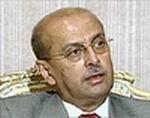
Yemeni Foreign Minister Dr Abu Bakr al-Qirbi has expressed displeasure with US Ambassador Thomas Krajeski's description of democracy in Yemen as coming to a halt. In an interview with in Sana'a, Al-Qirbi said the US ambassador was not successful in his description of democracy in Yemen. He stressed that democracy is a Yemeni matter.
Al-Qirbi warned of Somalia becoming an arena where terrorists and extremists gather, especially if the Somali leadership is unable to exercise its control over all Somali territory. He said the Gulf Cooperation Council (GCC) states and Yemen are seeking to hold a dialogue that aims to qualify Yemen to become a full member of the GCC. He said the exchange of information between Saudi Arabia and Yemen has led to great successes in combating terrorism.
Yemeni Foreign Minister Abu Bakr al-Qirbi said Yemeni President Ali Abdullah Saleh will visit the United States, France, and Japan in November 2005, and said that efforts to support sustainable development in Yemen is on the visit's agenda. He said relations with Iran are excellent now that the facts about the rebellion of (Badr-al-Din) Al-Huthi in the governorate of Sa'dah and the fact that the group's agenda was political and not confessional have become clear to the Iranians. He called on the Arab states and the international community to seek to avoid the outbreak of civil war in Iraq and to acknowledge the Iraqi people's right to self-determination without external interference, not even from the coalition forces. Following are the issues and questions raised during the interview:
(Q) You had warned of the gravity of the situation in Somalia. What are the present facts that give rise to such a warning?
(A) There are two aspects of the warning. When talking about Somalia, the states of the Horn of Africa must avoid going back to the situation that existed prior to the Nairobi agreement. Before the Nairobi agreement was concluded some Somali factions that were politically inclined, some factions were tribally inclined, and other factions were trade inclined. Each of those factions had its own agenda. After the Nairobi agreement, however, the situation became different with the election of a Somali president and a parliament. A government was formed. Thus the states that are interested in the Somali question must concentrate all efforts on enabling the Somali authorities to exercise their control over Somalia, disarm the militias, build the Somali state, and not succumb to the attempt by many sides to blackmail in order to obstruct the return of security and stability to Somalia.
There is also the aspect that interests us in Yemen, namely that if the situation remains as it is Somalia could become a center in which the forces of extremism and terrorism gather. That will not threaten the Horn of Africa alone but will threaten the entire Arabian Peninsula. We see scores of boats carrying refugees who may include elements whose aims are other than seeking humanitarian refuge and whose scores of victims we can see. In this regard, the international community should exert efforts -- within the framework of the OAE, the Arab League, and IGAD (Intergovernmental Authority on Development) -- to enable the Nairobi agreement see the light and to be implemented on the ground in Somalia.
(Q) What about coordination with the Americans in the Horn of Africa?
(A) Existing coordination with the United States and a number of Arab and European states is primarily within the framework of the exchange of information. Yemen does not intervene militarily in the North of Africa and it is not allowed to interfere in it in terrorism issues. Thus our responsibility in that area is how to coordinate the efforts of the states in the Horn of Africa with the United States, Italy, and Germany in order to control the flow of refugees, prevent the smuggling of arms, and watch out for any terrorists groups that may be present in Somalia or elsewhere.
(Q) What about Djibouti?
(A) There is cooperation in the intelligence with Djibouti. That is one of the issues we discussed with Djibouti's foreign minister during the meeting of the joint committee in Sana'a. The situation in the Horn of Africa makes it incumbent on us to coordinate and cooperate in the face of terrorism.
(Q) How do you view coordination with Ethiopia, Eritrea, and the states of East Africa in combating terrorism?
(A) I believe all the states in the region are agreed on cooperating to combat terrorism. It is a priority in our relations with those states, for terrorism threatens the stability of the region. It is terrorism that has led to the presence of foreign forces in the region, and it is terrorism that has impeded development and investment. All those consequences were among the results of the terrorist action that occurred in Yemen and the region, because what happens in the region has indirect effects on the states surrounding the country in which a terrorist attack occurs.
However, the problem lies in the differences that exist among the area countries, such as the Sudanese-Eritrean dispute and the Ethiopian-Eritrean dispute. Moreover the situation is not stable in Somalia. Those factors together hinder a number of states in working within the framework of one integrated system to combat terrorism.
(Q) Can the Sana'a Grouping (Tajammu Sana'a) play a role in this issue, in view of the signs that Djibouti is joining the grouping?
(A) The Sana'a Grouping may play a role in that regard. It is in fact carrying out such a role within the framework of the founding states: Yemen, Sudan, and Ethiopia. There is excellent cooperation among the three states in combating terrorism. We hope that if matters settle down in Sudan, and that if both Ethiopia and Eritrea resolve their disagreements, then the grouping will be expanded to include Eritrea and Somalia which has shown a desire to join the grouping during the Sana'a Grouping summit (Third Summit of the Sana'a' Grouping for Cooperation) that was held in Khartoum in (December) 2004. We believe the elimination of tension among the area countries will strengthen their cooperation in combating terrorism.
(Q) The states in the Horn of Africa region, including Yemen, suffer from economic crises. What are the incentives for creating economic activity?
(A) The states of the Horn of Africa and Yemen -- and if we include Sudan and Ethiopia - represent a human mass of 150 million people. Therefore, the elements for an economic-trade grouping among the area countries exist. There is also of course the geographic and economic structure that could achieve a great deal of economic integration among the area countries. When we look at Sudan with its water resources and agricultural land, and to Somalia and Ethiopia with their animal wealth and mineral resources, and the important location of Yemen and Djibouti on the Gulf of Aden, we see factors which as a whole create a depth that could make those states an influential economic grouping in the world economy because people today are looking for markets and locations in which to invest.
(Q) How are relations with Eritrea at present?
(A) Yemeni-Eritrean relations are experiencing further stability and an increased desire in developing economic and trade relations. Foremost among those matters is the establishment of the Joint Fishing Company which can contribute toward strengthening the economic resources of the two countries, for fish resources have become one of the issues that are of interest to all world countries. We still have differences with the brothers in Eritrea over the traditional fishing issue which was included in the verdict of the international arbitration commission that adjudicated between Yemen and Eritrea. The disagreement is over the interpretation of the article on traditional fishing. We interpret that article in accordance with our view, while the Eritrean brothers interpret it according to their view. However, we are continuing our dialogue with the aim of reaching agreement on an interpretation, because that will alleviate the suffering of the fishermen who are being subjected to a great deal of harassment when fishing in the Red Sea.
(Q) There are those who say that Yemen has opted for the establishment of the Sana'a Grouping as an alternative to joining the Gulf Cooperation Council (GCC)?
(A) No, that is not true. On the contrary, Yemen's position in the Arabian Peninsula and its relationship with the Horn of Africa render Yemen a bridge that links the peninsula with the Horn of Africa and enable the states of the Arabian Peninsula to benefit from that relationship in marketing their products and investing in those states.
(Q) Yemen still cherishes the hope of joining the GCC. Will Yemen join new channels so as to complete its GCC membership?
(A) I believe that for Yemen to join the GCC it is necessary for the area countries. It is necessary for both Yemen and the GCC states, with their geo-political and economic factors. I believe the GCC states today are aware of the strategic depth that Yemen provides them. We in Yemen and the GCC states strive for a transparent dialogue over Yemen's full membership of the GCC. As you know there were views regarding qualifying Yemen for joining the GCC. We were not sensitive about the proposal on qualifying Yemen, for we knew that Europe sought to qualify European states when many of them applied to join the EU. Consequently, what we want now is to agree on that qualification, and how to work together to achieve that matter and define the role, which both Yemen and the GCC states must undertake.
(Q) The word qualify can be interpreted in many ways. What do you mean by qualify?
(A) Look at the economic aspect of qualifying and how the GCC states can contribute to strengthening the Yemeni economy so that it can add to the GCC economies when the GCC joins it, and how we can create economic integration. Yemen with its geography has density in population, and it has beneath the ground mineral and oil resources that are yet to be discovered. Tourism can be developed in Yemen, for there are areas that have better tourist attractions than the places GCC tourists visit. These areas of the economy require an infrastructure, and here comes the role of GCC investments. What we are now discussing with the brothers in the GCC states is the laws and creating compatibility between laws in Yemen and laws in the GCC states, so that there will be no problems in enforcing the laws in Yemen and in the GCC states.
(Q) President Ali Abdullah Saleh visited Saudi Arabia recently. What are the issues he discussed with the Custodian of the Two Holy Mosques, King Abdullah Bin Abdulaziz?
(A) The relationship between the brother president and the Custodian of the Two Holy Mosques has a special character, because it was they who signed the treaty on the demarcation of the border and ended a border dispute that lasted 60 years. Their responsibility now is to develop relations between the two countries so that there will be further cooperation and economic and political partnership between them. The primary aim of the visit was to congratulate the Custodian of the Two Holy Mosques, King Abdullah Bin Abdulaziz, on his assumption of the reins of power in the Kingdom of Saudi Arabia, and also to consult and chart the future features of relations between Saudi Arabia and Yemen. The two leaders are anxious that those relations should be distinguished, not only in the protocol aspect, but also in the special partnership between the two countries in combating terrorism, encouraging Saudi capital to invest in Yemen, and opening Saudi markets to Yemeni products.
(Q) What is your assessment of the joint coordination against terrorism?
(A) The security services in the two countries have achieved great successes and that has bolstered confidence. The success is due to the exchange of information between the Yemeni and the Saudi security services.
(Q) What in your view are the manifestations of confidence that have been bolstered?
(A) The manifestations of confidence have been embodied in the exchange of information on security matters and in the reciprocal visits by the leaders of the two countries, the most prominent of which was the summit in Jeddah between the Custodian of the Two Holy Mosques and the Yemeni president. I believe what is more important than all of that is that the Kingdom of Saudi Arabia encourages Saudi investments in Yemen.
(Q) President Ali Abdullah Saleh will be visiting Washington in November 2005. What is the nature of the visit?
(A) The visit is within the framework of the brother president's diplomatic moves. The visit is an almost annual visit during which the president meets with heads of state in Europe, Asia, and the United States. In the coming tour he will visit Japan, France, and the United States. The importance of the visit stems from the talks he will hold with the heads of those states. The visit is also an opportunity to assess relations between Yemen and those states, whereby each side puts forward its aspirations for the development of bilateral relations. It is also an opportunity to eliminate much of the perhaps wrong information that is relayed about Yemen to the United States, France, or Japan. Thus the visit is within the framework of strengthening confidence and removing any blemishes in relations. It is also an opportunity to put forward Yemeni concerns with regard to the economy, investment, development problems, and combating poverty. Those states are among the donor states that contribute to supporting development in Yemen. The role of those states is not confined to giving direct support to Yemen, but also involves pushing international institutions such as the World Bank and the IMF to give further aid to Yemen. Moreover, terrorism is a priority on the agenda of the visit for it is one of the pillars of international cooperation, and a criterion of the continuation of such cooperation among states. The cases of Yemenis detained in the United States are also raised during the visit, and Yemeni demands for the need to release those detainees are stressed. We have done that from the time they were arrested.
(Q) Sheikh Abdul Majid al-Jirbani, a leader in the Yemeni Reform (Al-Islah) Party, viewed the Government demand to remove his name from the US list on terrorism as having come late. Will his case and the case of another Reform Party leader -- Sheikh (Muhammad Ali) Al-Mu'ayyad -- who is jailed in the United States -- be raised with the Americans during the visit?
(A) The Yemeni demand to remove the name of Sheikh Abdul Majid al-Zindani from the terrorism list came some time after the name was included in the US list. However, the request to provide information and evidence justifying the inclusion of his name on the list was made as soon as we heard about the matter. Perhaps because we worked calmly, that was depicted as though we had not done anything. Certainly the cases of sheikhs Al-Zindani and Al-Mu'ayyad and the issue of Yemenis who are subjected to US measures such as imprisonment, detention, or the inclusion of their names on lists without supplying evidence to Yemen will be discussed, because we are concerned about such matters.
(Q) The situation in Iraq is on the verge of civil war which could determine the future of the region. How does Yemen view such a situation?
(A) The situation in Iraq is very worrying for the Arab nation. That worry was clear at the meeting of Arab foreign ministers in Cairo which resulted in the formation of a committee of the states neighboring Iraq, in addition to Egypt, to consider what role the Arab states can play, the restoration of security, and ending the violence that is claiming the lives of thousands of Iraqis.
We have seen the action that took place in Riyadh with the meeting of the foreign ministers of the states neighboring Iraq and the foreign minister of Egypt, and the visit of the Arab League assistant secretary general to Baghdad. We hope an Arab stand will evolve and will contribute toward resolving the Iraqi issue. We in Yemen believe that any solution must be based on the principle of allowing the Iraqis to determine their destiny without outside interference, including interference by the coalition forces. The Iraqi brothers must also realize that the present stage must nor rely on the flexing of muscles or on the concept that is based on the wishes of the majority, because the present complicated circumstances require that the Iraqis agree on a formula of national accord that strengthens confidence and respect for every sect and every ethnic group in Iraq and protects the interests of all sections of the population. Then the march of democracy will be easier. The Arab states and the international community must play a role in initiating a dialogue among all the Iraqi sides so as to agree on bases for relations built on democratic principles in accordance with a Constitution that preserves the unity of Iraq and protects it from the partition which some people are perhaps seeking to bring about through a civil war. Once the Iraqis agree on such mechanisms they will be able to evacuate the coalition forces.
(Q) Yemen has good relations with the Palestinian Authority (PA) and HAMAS. What can Sana'a do to help the Palestinians?
(A) Yemen's position is clear on that issue. The brother president has intervened more than once and called for a meeting between the two leaderships to be held in Sana'a. He emphasized that Palestinian weapons must not be directed at any other Palestinian faction. The Palestinians must adhere to this principle. All the Arabs must adopt such a stand. That is because for the Palestinians to use weapons against each other will achieve for Israel what it wants, and will render the victory that was achieved in the Gaza Strip a loss for the Palestinians who very much need to have a political approach to events through dialogue and for the factions to adopt a democratic line in putting forward their political program. Ultimately, the Palestinian factions must unite in order to end the occupation, find solutions to the suffering of the Palestinians, unite the Palestinian forces, and reach a common understanding that any Israeli withdrawal from any Palestinian territory is a victory for all the Palestinians. It is true that Israel promotes the notion that such withdrawal are carried out as a result of an Israeli wish and are in implementation of the road map. However, the truth is the opposite: it is that Israel is withdrawing because it has been defeated in the face of the Palestinian resistance. Consequently, the Palestinian concept should be to bring about further withdrawals, while such withdrawals must be within the framework of Palestinian action and Palestinian unity.
(Q) A number of Iranian delegations have visited Yemen. What is your assessment of relations with Iran and what is Yemen's stand on the Iranian nuclear file?
(A) Yemen's stand on the Iranian nuclear file, as well as on weapons of mass destruction, is clear. We in Yemen are opposed to any nuclear weapons. We want the Middle East to be a zone free of nuclear weapons. That does not apply to Iran only, but it also applies to Israel, because we cannot have double standards. It is the right of Iran and area countries to use nuclear energy for peaceful purposes, be it in scientific research, generating electric power, or in other peaceful applications.
As for Yemen's relations with Iran, those relations are excellent. We believe the repeated visits by Iranian officials and envoys to Sana'a have shown that Iran is anxious to maintain its relations with Yemen, and that with regard to the misunderstanding that occurred with respect to the Al-Huthi rebellion in parts of the governorate of Sa'dah, it has now become clear to Iran that Al-Huthi's group had a political agenda and the matter was not a confessional issue. Therefore Iran is anxious -- just as we in Yemen are anxious -- to keep relations between the two countries free of mistaken information and influences that reach any side.
(Q) The US ambassador described democracy in Yemen as having come to a halt. Why were you annoyed by that description?
(A) We were annoyed by those remarks because such a description of democracy in Yemen is incorrect. I do not believe that democracy has come to a halt at all. The march of democracy is proceeding with democracy taking root. The assurances of President Ali Abdullah Saleh to give more power to local councils, and for the governors to be directly elected by citizens, confirm that the political motion that is taking place in Yemen for the 2006 presidential elections shows Yemen's desire to have the international community see elections that are more transparent than previous elections. I believe the US ambassador was not successful when he said democracy in Yemen has come to a halt. Perhaps what he said was mistranslated.
(Q) Will the remarks of US Ambassador Thomas Krajeski have a negative effect on relations with the Americans?
(A) Not at all. We in Yemen accept (another) point of view, and they should accept our point of view. Definitely, as much as Yemen welcomes support for the democratic march, and as much as it welcomes the views and advice that are proffered to us by friendly countries, ultimately the march of democracy and its protection are above all a Yemeni responsibility.
|
| |
|
Almotamar Net - Some 12,000 infiltrators and illegal residents, including 600 women and children, were arrested and will be deported, official sources said yesterday.
Ninety per cent of those who were arrested over the period from January to mid- October this year were arrested on the eastern coasts of Shabwa, sources added.
"A total of 11,250 of those held were Somalis, 650 Ethiopians and 155 others were from different nationalities," the state-run newspaper 26 September quoted an unidentified official as saying.
"During the first half of this month the security forces, in cooperation with the Coastguard Authorities, detained 350 infiltrators," the official said.
|
| |
|
Almotamar Net - Yemen is planning to establish a $24 million monitoring system to combat terror activities along its 2,500-kilometre coastline.
The recently-created Yemen Coast Guard Authority (YCGA) on Monday invited tenders for implementation of the first stage of the National Yemeni Vessel Traffic System (NYVTS).
The YCGA said the initial stage included the preliminary design of the entire vessel traffic system which covers the whole Yemeni national coastline. It will cover the national control centre in Sanaa, the area control centre in Aden, two mobile units, six local control centres and as many remote sites as needed to fulfil the system performance requirements in the area from Al Khokha ( Hodeidah province in the west) to Shuqrah ( Abyan province in the east).
The first stage will also include installation, commissioning, training and an option for a three-year renewable maintenance contract. The maximum available budget is 20 million euros ($24 million).
The work will take two years. The deadline for tenders will be January 15, the announcement said.
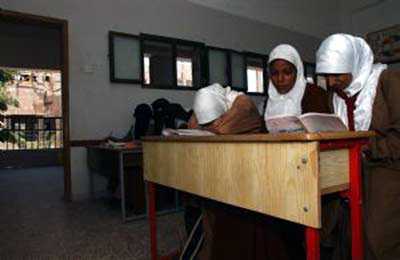
|
|
| |
|
Almotamar Net - Story By: USMC Sgt. Brian E. McElaney
ADEN, Yemen - Young women from the local community, here, will have better educational opportunities and increased ability to take part in their society thanks to a $256,000 expansion and renovation of the Darshaad Girl's School by the Combined Joint Task Force - Horn of Africa.
The project will add much needed facilities for the school, which currently enrolls 1100 students attending ninth through 12th grade. A new third floor is being added to the current structure to allow for more classrooms - allowing class sizes to be cut in half. Additionally, new science labs are being added on the second and third floors.
"You have noticed how the school is overcrowded," said Hamida Ali Mohammed, principal of the Darshaad Girl's School. "After the completion of this project, the students will have much more room than before."
Secondary education is rare for young women in Yemen. While there are six primary schools available for girls in Aden, Darshaad is the only secondary school. When the school first opened in 1998, enrollment was low, but in recent years more families are allowing their daughters to continue their education, said Hamida.
"Of course my school is very specific and different than the other schools in this district," said Hamida. "But it is necessary for the girls here to be educated so that the other half of the population can be activated. It is becoming a symbol that families in Yemen are now able to depend on their daughters."
The project is part of a series of schools, clinics and medical and veterinary assistance programs coordinated by CJTF-HOA's 96th Civil Affairs Battalion detachment as part of Operation Enduring Freedom.
"There is an obvious kind of impact you can have when you build something like a school," said Capt. Todd Svacina, team leader, Civil Affairs Team 624. "It makes the area more stable and really helps people. We all think we have the greatest job in the world, we get to fight the war on terror by building things instead of tearing things down"
Yemen currently has three times as many illiterate females than males, said Svacina. However, both local and national Yemeni government organizations have called on the United States Embassy, Sana'a, CJTF-HOA (in which several Yemen military officers have participated) and other organizations to help increase education in several areas throughout the country. CJTF-HOA units are often a perfect fit to bring help to those who need it most because many remote areas of Yemen are considered dangerous for foreign travelers.
"Once you've been in the country, you learn that it's a country of peace loving people," said Svacina. "But we have quite a higher level of security, so we can get into areas that [other organizations] would normally ignore for safety reasons."
CJTF-HOA has undertaken a growing number of projects over the last few months, as the CA teams and US State Department officials work to improve relationships with officials throughout the country. When the CA teams first started operating in Yemen, suspicion and rough relations hindered their ability to move freely throughout the country. However a combination of coordination and friendship has resulted in a building of trust in the coalition units hoping to bring aid to those in need - allowing them increased flexibility in the kinds of missions they undertake.
"There has been a very positive reaction to our operations," said Svacina. "The only thing we can accredit that to is our transparency. That level of trust has been very valuable to us - what was a very difficult mission at first became a real pleasure to work afterward."
At the Darshaad school, officials relate that these relationships will result in better education for thousands of young women and a higher standard of living for Yemenis in Aden and the surrounding areas.
"We are not only female teachers but we are encouraging female students to finish their education so they can improve their style of life and help develop society," said Hamida. "Working with [CJTF-HOA] and the contractors has been very rewarding both professionally and personally. The people are very friendly, and are doing a great thing for our students."
|
| |
|
Almotamar Net - By Observer Staff
SANA�A - The program helping the private sector create new jobs under the supervision of the German Technical Cooperation Organization has started studying the investment landscape in Yemen.
The program aims to support and improve the investment climates across the country. The program official Yousuf Tumah said the program currently studies the overall investment landscape in Yemen in a move to prepare for a ten-year work plan.
The program is going to start in mid-2007 by executing a number of improvements of in the investment sector.
Tumah briefed that the program would focus on improving of the small enterprises and companies and training the workers.
He added, It also would present the technical services for the institutions and the governmental bodies and supporting the civil organizations concerned with small enterprises development.
|
| |
|
Almotamar Net - SANA'A,(Saba)- Yemen and South Korea signed on Friday a memorandum of understanding to enhance cooperation in vocational education between the two countries.
The memo was signed by Yemeni ministry of technical education and vocational training and Korean ministry of labor.
Under the memo, the Korean side will set up an institute for telecommunication and technologies and present aid to the institute including experts and training
|
| |
|
Almotamar Net - Yemen has detained more than 10,000 illegal African immigrants in 2005, mostly from Somalia, Saba news agency has reported.
The report says that more than 100 migrants have drowned in September alone trying to reach the country.
The agency says 10,750 people had been seized in Yemeni cities and on the coast, which faces the Horn of Africa.
The Somalis are held at a detention camp in the southern Abyan province. Other Africans have been repatriated.
Correspondents say Somalis fleeing violence and Ethiopians in search of a better life attempt the hazardous 300-km (185-mile) crossing to Yemen in the hope of eventually reaching the oil-rich Gulf Arab region and Europe.
Yemen is a poor country of approximately 20 million people.
The UNHCR, the United Nation's refugee agency, says the number of Africans trying to get into the Gulf region via Yemen has increased since early 2004.
It puts the number of registered Somali refugees in Yemen at about 50,000.
|
| |
|
Michael Wilson and Janon Fisher - NEW YORK - At Jamaica Hospital Medical Center on Thursday, a woman gave birth to a son, delivered by Caesarean section. She did not know that during her recovery, elsewhere in the same hospital, she lost her oldest child, a 19-year-old deli worker who had been shot behind the counter by a man in a mask.
The 19-year-old man, Yaser Saleh, was shot in the stomach on Wednesday night in a Springfield Gardens deli by an unidentified man who witnesses believe argued with Saleh last week over something that seemed trivial: the man had been short a quarter for a 79-cent candle, and the cashier would not give it to him.
There was no arrest in the case on Thursday, while the dead man's family prepared for a week of traveling, literally, between a cradle and a grave. advertisement
Family members said his mother delivered her 7.5-pound baby boy, named Mohamed, at 5 a.m. It was her and her husband's fifth child. Yaser was the oldest, and there are a son and two daughters in between. The family was from Yemen.
After Saleh was shot, paramedics took him to Jamaica Hospital, where his mother was still recovering from the surgery. He lingered for 11 hours, dying one minute before 8 a.m., the police said.
On Wednesday night, the victim had been on the telephone with his grandfather, taking advantage of a quiet moment in the store, said another deli worker, Ali Abdul, who saw the shooting from behind the deli case where he was making a sandwich.
The gunman entered the Farmers Deli, at 142-01 Farmers Blvd., at 9:15 p.m., and shot Saleh once in the stomach and once in the left arm, the police said. The assailant was dressed all in white and wore a mask or a T-shirt to cover his face, witnesses said. He left, taking nothing, the police said.
"He didn't say nothing," Abdul said. "He didn't talk nothing."
Saleh's father, Abdo Saleh, retelling his son's account, said the dispute began last week when the man tried to buy the 3-inch candle but was 25 cents short. "He told me somebody came into the store, tried to buy a candle," Saleh said. The man became enraged and smashed the candle on the floor, he said. "He told him, 'I'm going to come back and shoot you.' " His son shrugged it off: "He didn't take it as a serious thing."
Later that day, the same man returned and stole a soda, Abdul said.
Yaser Saleh attended high school in Dearborn, Mich. He married in 2001 in the Yemeni town of Ibb, and returned to the United States. He had a 6-month-old daughter named Kamer, and his wife is two months pregnant with their second child. He planned to earn his GED and perhaps pursue a college degree, his family said.
On Wednesday night, after he was shot, Saleh called to Abdul. "Yaser said: 'You have to call the ambulance. You have to call the police,' " Abdul said. He tore off his friend's shirt and saw the bullet hole near his sternum, and what looked like an exit wound. "I see blood coming from his back," he said.
Faisal Hussan, 20, another worker in the store, said the gunman's features were further obscured by a white hood. "He just shot him," he said in Arabic on Thursday. "He just killed him." The victim's father said the police took videotapes from a surveillance camera in the store. The police said they have not identified a suspect.
A woman in the store, who said she was known in the neighborhood as "Mom," said Saleh was well-liked, even though he had not worked there long. He had taken the shift on Wednesday evening for another worker who was observing the Ramadan holiday. "He's a sweet kid," she said. "Whenever I came in, he'd say, 'Mom, I love you.' No one deserves to be killed like that."
Hector Chambers, who lives near the store, called Saleh "a pleasant, pleasing person," and added, "Him my peaceful brother."
The victim's father said his mother was still recovering from the surgery. "She had the baby, had an operation, and she lost her oldest son," he said Thursday. He did not mention his wife's name to reporters.
On Thursday afternoon, she remained in the hospital, oblivious, he said: "I don't want to tell her." |
| |
|
Almotamar Net - SANA�A- YemObs� The Sana�a Cultural Center hosted last Monday celebrations of the 60th anniversary of the founding of the United Nations.
�A Time for Renewal�. On show at the event were the artistic works of schoolchildren from around Yemen who had entered a painting competition with its theme as the UN Millenium Goals, focusing on health and education. Also presented were special edition postage stamps marking the anniversary. Flavia Pansieri, the United Nations Resident Representative in Yemen spoke of the country�s commitment to the Millenium Goals:
�We have the opportunity to really make a difference. Women have to be a part of that contribution to development. We have a role to play together with our partners in Yemen and the international community to support efforts towards realizing the Millennium Development Goals.� Ahmed Mohammed Sofan, Deputy Prime Minister and Minister of Planning and International Cooperation spoke of Yemen�s pride in being one of the founder members of the United Nations, and said: �We are grateful for UN efforts in calling for women�s rights and human rights. By 2015, Yemen is confident of achieving the first and most important of the MDGs, that is �education for all��.
This, he said, was in spite of the fact that Yemen would be unable to fulfill all MDGs without further assistance from the outside community. After the speeches, the winners of best artistic works were announced.
One of the winners, Boshra Mohammed, said: �I am so happy that my picture has been chosen as one of the seven best. I portrayed in my work three life-threatening illnesses: malaria, cancer, and AIDS, which can be beaten through increasing knowledge and awareness.�
|
| |
|
Almotamar Net -
By Omar Edaibat
In the Name of God, Most Gracious, Most Merciful
The following is the Universal Declaration of Human Rights that was adopted on December 10, 1948 by the General Assembly of the United Nations. The attempt of this analysis is to show how each of the fundamental human rights guaranteed in this declaration were already established in the Holy Quran.
Universal Declaration of Human Rights
Preamble
Whereas recognition of the inherent dignity and of the equal and inalienable rights of all members of the human family is the foundation of freedom, justice and peace in the world,
Whereas disregard and contempt for human rights have resulted in barbarous acts which have outraged the conscience of mankind, and the advent of a world in which human beings shall enjoy freedom of speech and belief and freedom from fear and want has been proclaimed as the highest aspiration of the common people,
Whereas it is essential, if man is not to be compelled to have recourse, as a last resort, to rebellion against tyranny and oppression, that human rights should be protected by the rule of law,
Whereas it is essential to promote the development of friendly relations between nations,
Whereas the peoples of the United Nations have in the Charter reaffirmed their faith in fundamental human rights, in the dignity and worth of the human person and in the equal rights of men and women and have determined to promote social progress and better standards of life in larger freedom,
Whereas Member States have pledged themselves to achieve, in cooperation with the United Nations, the promotion of universal respect for and observance of human rights and fundamental freedoms,
Whereas a common understanding of these rights and freedoms is of the greatest importance for the full realization of this pledge,
Now, therefore,
The General Assembly,
Proclaims this Universal Declaration of Human Rights as a common standard of achievement for all peoples and all nations, to the end that every individual and every organ of society, keeping this Declaration constantly in mind, shall strive by teaching and education to promote respect for these rights and freedoms and by progressive measures, national and international, to secure their universal and effective recognition and observance, both among the peoples of Member States themselves and among the peoples of territories under their jurisdiction.
Article 1
All human beings are born free and equal in dignity and rights. They are endowed with reason and conscience and should act towards one another in a spirit of brotherhood.
The Quran also reiterates our common humanity and equality:
[3:95] Their Lord responded to them: "I never fail to reward any worker among you for any work you do, be you male or female - you are equal to one another.�
[4:25] � GOD knows best about your belief, and you are equal to one another, as far as belief is concerned�
[17:70] We have honored the children of Adam, and provided them with rides on land and in the sea. We provided for them good provisions, and we gave them greater advantages than many of our creatures.
Article 2
Everyone is entitled to all the rights and freedoms set forth in this Declaration, without distinction of any kind, such as race, colour, sex, language, religion, political or other opinion, national or social origin, property, birth or other status.
Furthermore, no distinction shall be made on the basis of the political, jurisdictional or international status of the country or territory to which a person belongs, whether it be independent, trust, non-self-governing or under any other limitation of sovereignty.
The Quran repeatedly explains that it is the human factor which divides us from uniting under our common Creator and Sustainer. It is the human factor which splits us into sects and divides us along superficial lines, pitting us against one another. We are all members of the same community in the eyes of God, and the only quality that distinguishes one above the other is our level of righteousness. Hence, the Quranic injunction not to differentiate between God�s messengers and to commemorate God Alone:
[2:62] Surely, those who believe, those who are Jewish, the Christians, and the converts; anyone who (1) believes in GOD, and (2) believes in the Last Day, and (3) leads a righteous life, will receive their recompense from their Lord. They have nothing to fear, nor will they grieve.
[2:136] Say, "We believe in GOD, and in what was sent down to us, and in what was sent down to Abraham, Ismail, Isaac, Jacob, and the Patriarchs; and in what was given to Moses and Jesus, and all the prophets from their Lord. We make no distinction among any of them. To Him alone we are submitters."
[49:13] O people, we created you from the same male and female, and rendered you distinct peoples and tribes that you may recognize one another. The best among you in the sight of GOD is the most righteous. GOD is Omniscient, Cognizant.
Article 3
Everyone has the right to life, liberty and security of person.
[17:33] You shall not kill any person - for GOD has made life sacred - except in the course of justice. If one is killed unjustly, then we give his heir authority to enforce justice. Thus, he shall not exceed the limits in avenging the murder, he will be helped.
[2:191] You may kill those who wage war against you, and you may evict them whence they evicted you. Oppression is worse than murder�
[7:157] �He exhorts them to be righteous, enjoins them from evil, allows for them all good food, and prohibits that which is bad, and unloads the burdens and the shackles imposed upon them. Those who believe in him, respect him, support him, and follow the light that came with him are the successful ones."
The Quran goes as far as urging us to take whatever measures necessary to ensure that the fundamental Human Rights of others are met:
[4:75] Why should you not fight in the cause of GOD when weak men, women, and children are imploring: "Our Lord, deliver us from this community whose people are oppressive, and be You our Lord and Master."
Article 4
No one shall be held in slavery or servitude; slavery and the slave trade shall be prohibited in all their forms.
When the Quran was revealed slavery was in wide practice throughout the Arab World. Thus, it would have been impractical and suicidal to place an immediate ban on all forms of slavery. The Quran uses a better psychological approach to win people�s hearts in the struggle against slavery and all forms of discrimination by placing a strong emphasis on human dignity and equality and encouraging the freeing of slaves, for if we are all equal then slavery cannot be justified:
[90:10-14] Did we not show him the two paths? He should choose the difficult path. Which one is the difficult path? The freeing of slaves. Feeding, during the time of hardship.
[2:177] Righteousness is not turning your faces towards the east or the west. Righteous are those who believe in GOD, the Last Day, the angels, the scripture, and the prophets; and they give the money, cheerfully, to the relatives, the orphans, the needy, the traveling alien, the beggars, and to free the slaves;�
[9:60] Charities shall go to the poor, the needy, the workers who collect them, the new converts, to free the slaves, to those burdened by sudden expenses, in the cause of GOD, and to the traveling alien. Such is GOD's commandment. GOD is Omniscient, Most Wise.
Article 5
No one shall be subjected to torture or to cruel, inhuman or degrading treatment or punishment.
In the Quan, we are constantly reminded to take heed from the lessons of history and are sensitized to the gross evils of tyranny. The lack of mercy is also condemned:
[28:4] Pharaoh turned into a tyrant on earth, and discriminated against some people. He persecuted a helpless group of them, slaughtering their sons, while sparing their daughters. He was indeed wicked.
[2:191] You may kill those who wage war against you, and you may evict them whence they evicted you. Oppression is worse than murder�
[26:130] "And when you strike, you strike mercilessly.
Article 6
Everyone has the right to recognition everywhere as a person before the law.
A philosophy in which we are all equal before our common Creator and Provider reassures us of deferential and equal treatment before the law, irrespective of where we may be:
[35:10] Anyone seeking dignity should know that to GOD belongs all dignity. To Him ascends the good words, and He exalts the righteous works. As for those who scheme evil works, they incur severe retribution; the scheming of such people is destined to fail.
Article 7
All are equal before the law and are entitled without any discrimination to equal protection of the law. All are entitled to equal protection against any discrimination in violation of this Declaration and against any incitement to such discrimination.
[4:25] �GOD knows best about your belief, and you are equal to one another, as far as belief is concerned�
[4:135] O you who believe, you shall be absolutely equitable, and observe GOD, when you serve as witnesses, even against yourselves, or your parents, or your relatives. Whether the accused is rich or poor, GOD takes care of both. Therefore, do not be biased by your personal wishes. If you deviate or disregard (this commandment), then GOD is fully Cognizant of everything you do.
The following Quranic narration highlights how important it is to give everyone the same respect and attention irrespective of one�s socioeconomic background:
[80:1-11] He (Muhammad) frowned and turned away when the blind man came to him (seeking guidance). How do you know? He may purify himself. Or he may take heed, and benefit from the message. As for the rich man, you gave him your attention. Even though you could not guarantee his salvation. The one who came to you eagerly and is really reverent, you ignored him. Indeed, this is a reminder.
Article 8
Everyone has the right to an effective remedy by the competent national tribunals for acts violating the fundamental rights granted him by the constitution or by law.
The Quran encourages mercy and forgiveness whenever possible but decrees equivalent punishment as a fundamental right guarnateed to the victim:
[2:178] O you who believe, equivalence is the law decreed for you when dealing with murder - the free for the free, the slave for the slave, the female for the female. If one is pardoned by the victim's kin, an appreciative response is in order, and an equitable compensation shall be paid. This is an alleviation from your Lord and mercy. Anyone who transgresses beyond this incurs a painful retribution.
[16:126] And if you punish, you shall inflict an equivalent punishment. But if you resort to patience (instead of revenge), it would be better for the patient ones.
Article 9
No one shall be subjected to arbitrary arrest, detention or exile.
We are constantly warned not to be overly suspicious of others without incriminating evidence. Such attitudes only bring about unjustified hostility and harm towards the accused:
[49:12] O you who believe, you shall avoid any suspicion, for even a little bit of suspicion is sinful. You shall not spy on one another, nor shall you backbite one another; this is as abominable as eating the flesh of your dead brother. You certainly abhor this. You shall observe GOD. GOD is Redeemer, Most Merciful.
Article 10
Everyone is entitled in full equality to a fair and public hearing by an independent and impartial tribunal, in the determination of his rights and obligations and of any criminal charge against him.
Certainly, the Quran highlights the need for imparitality on all matters within the community:
[2:143] We thus made you an impartial community, that you may serve as witnesses among the people, and the messenger serves as a witness among you�.
Article 11
Everyone charged with a penal offence has the right to be presumed innocent until proved guilty according to law in a public trial at which he has had all the guarantees necessary for his defence.
No one shall be held guilty of any penal offence on account of any act or omission which did not constitute a penal offence, under national or international law, at the time when it was committed. Nor shall a heavier penalty be imposed than the one that was applicable at the time the penal offence was committed.
See relevant verses above.
Article 12
No one shall be subjected to arbitrary interference with his privacy, family, home or correspondence, nor to attacks upon his honour and reputation. Everyone has the right to the protection of the law against such interference or attacks.
The Quran also highlights the need to ensure our privacy as individuals. For example, we see the Quranic injunction not to marry women who were previously married to our fathers. This rule ensures that we do not interfere with the private experiences and intimate thoughts that our fathers shared with their wives:
[33:53] O you who believe, do not enter the prophet's homes unless you are given permission to eat, nor shall you force such an invitation in any manner. If you are invited, you may enter. When you finish eating, you shall leave; do not engage him in lengthy conversations. This used to hurt the prophet, and he was too shy to tell you. But GOD does not shy away from the truth. If you have to ask his wives for something, ask them from behind a barrier. This is purer for your hearts and their hearts. You are not to hurt the messenger of GOD. You shall not marry his wives after him, for this would be a gross offense in the sight of GOD.
-----------------------------------------
*33:53 We are enjoined in 4:22 from marrying women who were previously married to our fathers. Nor can the father marry the divorced wife of his genetic son (4:23). This divine commandment preserves our respect for our fathers and their most private affairs. Similarly, the prophet was a father figure to the believers of his time. For the good of those believers, God enjoined them from marrying women who were previously married to the prophet. Marriage is a sacred and very private relationship, and the prophet's private life was better kept private.
[24:58] O you who believe, permission must be requested by your servants and the children who have not attained puberty (before entering your rooms). This is to be done in three instances - before the Dawn Prayer, at noon when you change your clothes to rest, and after the Night Prayer. These are three private times for you. At other times, it is not wrong for you or them to mingle with one another. GOD thus clarifies the revelations for you. GOD is Omniscient, Most Wise.
Privacy of the individual is emphasized:
[24:2729] O you who believe, do not enter homes other than yours without permission from their inhabitants, and without greeting them. This is better for you, that you may take heed. If you find no one in them, do not enter them until you obtain permission. If you are told, "Go back," you must go back. This is purer for you. GOD is fully aware of everything you do. You commit no error by entering uninhabited homes wherein there is something that belongs to you. GOD knows everything you reveal, and everything you conceal.
The reputation of the individual must be protected from all forms of unjustified attack or slander:
[104:1] Woe to every backbiter, slanderer.
Article 13
Everyone has the right to freedom of movement and residence within the borders of each State.
Everyone has the right to leave any country, including his own, and to return to his country.
The Quran gurantees the right of the oppressed to emigrate in the cause of God (the course of justice) and to rebel against all forms of oppression:
[4:100] Anyone who emigrates in the cause of God will find on earth great bounties and richness.
[4:97] Those whose lives are terminated by the angels, while in a state of wronging their souls, the angels will ask them, "What was the matter with you?" They will say, "We were oppressed on earth." They will say, "Was GOD's earth not spacious enough for you to emigrate therein?"�.
Article 14
Everyone has the right to seek and to enjoy in other countries asylum from persecution.
This right may not be invoked in the case of prosecutions genuinely arising from non-political crimes or from acts contrary to the purposes and principles of the United Nations.
See above.
Article 15
Everyone has the right to a nationality.
No one shall be arbitrarily deprived of his nationality nor denied the right to change his nationality.
A respect for all cultures as members of the one universal humanity is recognized throught the Quran:
[5:48] �Had GOD willed, He could have made you one congregation. But He thus puts you to the test through the revelations He has given each of you. You shall compete in righteousness. To GOD is your final destiny - all of you - then He will inform you of everything you had disputed.
[49:13] O people, we created you from the same male and female, and rendered you distinct peoples and tribes, that you may recognize one another. The best among you in the sight of GOD is the most righteous. GOD is Omniscient, Cognizant.
Article 16
Men and women of full age, without any limitation due to race, nationality or religion, have the right to marry and to found a family. They are entitled to equal rights as to marriage, during marriage and at its dissolution.
Marriage shall be entered into only with the free and full consent of the intending spouses.
The family is the natural and fundamental group unit of society and is entitled to protection by society and the State.
The sanctity of the family is clearly recognized, with a strong emphasis on the need to reconcile relationships equitably. The Quran also guranteed women with divorce rights at a time when their subordination was the traditional norm:
[25:54] He is the One who created from water a human being, then made him reproduce through marriage and mating. Your Lord is Omnipotent.
[30:21] Among His proofs is that He created for you spouses from among yourselves, in order to have tranquility and contentment with each other, and He placed in your hearts love and care towards your spouses. In this, there are sufficient proofs for people who think.
[2:102]�These two did not divulge such knowledge without pointing out: "This is a test. You shall not abuse such knowledge." But the people used it in such evil schemes as the breaking up of marriages�.
[4:129] You can never be equitable in dealing with more than one wife, no matter how hard you try. Therefore, do not be so biased as to leave one of them hanging (neither enjoying marriage, nor left to marry someone else). If you correct this situation and maintain righteousness, GOD is Forgiver, Most Merciful.
[2:241] The divorcees also shall be provided for, equitably. This is a duty upon the righteous.
[4:35] If a couple fears separation, you shall appoint an arbitrator from his family and an arbitrator from her family; if they decide to reconcile, GOD will help them get together. GOD is Omniscient, Cognizant.
Article 17
Everyone has the right to own property alone as well as in association with others.
No one shall be arbitrarily deprived of his property.
Our right to property is clearly spelled out:
[2:05] As soon as he leaves, he roams the earth corruptingly, destroying properties and lives. GOD does not love corruption.
[65:1] O you prophet, when you people divorce the women, you shall ensure that a divorce interim is fulfilled. You shall measure such an interim precisely. You shall reverence GOD your Lord. Do not evict them from their homes, nor shall you make life miserable for them, to force them to leave on their own, unless they commit a proven adultery. These are GOD's laws. Anyone who transgresses GOD's laws commits an injustice against himself. You never know; maybe GOD wills something good to come out of this.
[4:2] You shall hand over to the orphans their rightful properties. Do not substitute the bad for the good, and do not consume their properties by combining them with yours. This would be a gross injustice.
[4:6] You shall test the orphans when they reach puberty. As soon as you find them mature enough, give them their property. Do not consume it extravagantly in a hurry, before they grow up�
[4:29] O you who believe, do not consume each others' properties illicitly - only mutually acceptable transactions are permitted. You shall not kill yourselves. GOD is Merciful towards you.
[38:24] He said, "He is being unfair to you by asking to combine your sheep with his. Most people who combine their properties treat each other unfairly, except those who believe and work righteousness, and these are so few." Afterwards, David wondered if he made the right judgment. He thought that we were testing him. He then implored his Lord for forgiveness, bowed down, and repented.
[59:8] (You shall give) to the needy who immigrated. They were evicted from their homes and deprived of their properties, because they sought GOD's grace and pleasure, and because they supported GOD and His messenger. They are the truthful.
Article 18
Everyone has the right to freedom of thought, conscience and religion; this right includes freedom to change his religion or belief, and freedom, either alone or in community with others and in public or private, to manifest his religion or belief in teaching, practice, worship and observance.
Unlike most traditional Islamic societies, the Quran guarantees each idividual complete freedom of religion:
[2:256] There shall be no compulsion in religion: the right way is now distinct from the wrong way. Anyone who denounces the devil and believes in GOD has grasped the strongest bond; one that never breaks. GOD is Hearer, Omniscient.
Article 19
Everyone has the right to freedom of opinion and expression; this right includes freedom to hold opinions without interference and to seek, receive and impart information and ideas through any media and regardless of frontiers.
Here we see how each individual must be ensured of the right to his own beliefs and way of life:
[18:29] Proclaim: "This is the truth from your Lord," then whomever wills let him believe, and whoever wills let him disbelieve...
Article 20
Everyone has the right to freedom of peaceful assembly and association.
No one may be compelled to belong to an association.
Compelling others to accept your own beliefs and values is a completely alien concept to the Quran. We are each free to choose our own associations and paths in life. Infact the Quran even recognizes that there is more than one path to God:
[2:62] Surely, those who believe, those who are Jewish, the Christians, and the converts; anyone who (1) believes in GOD, and (2) believes in the Last Day, and (3) leads a righteous life, will receive their recompense from their Lord. They have nothing to fear, nor will they grieve.
[2:148] Each of you chooses the direction to follow; you shall race towards righteousness. Wherever you may be, GOD will summon you all. GOD is Omnipotent.
Thus, what we believe is our own individual choice and nobody has the right to interfere with our own personal decisions so long as they do not infringe on the rights of others.
Article 21
Everyone has the right to take part in the government of his country, directly or through freely chosen representatives.
Everyone has the right to equal access to public service in his country.
The will of the people shall be the basis of the authority of government; this will shall be expressed in periodic and genuine elections which shall be by universal and equal suffrage and shall be held by secret vote or by equivalent free voting procedures.
Consensus and public accountability to the public in all policymaking is the Quranic standard:
[42:38] They respond to their Lord by observing the Contact Prayers (Salat). Their affairs are decided after due consultation among themselves, and from our provisions to them they give (to charity).
[39:18] They are the ones who examine all words, then follow the best. These are the ones whom GOD has guided; these are the ones who possess intelligence.
Article 22
Everyone, as a member of society, has the right to social security and is entitled to realization, through national effort and international co-operation and in accordance with the organization and resources of each State, of the economic, social and cultural rights indispensable for his dignity and the free development of his personality.
In the Quran, we clearly see the emphasis on a need for consensus, co-operation and on a compassionate approach to ensure the satisfaction of everyone:
[3:159] It was mercy from GOD that you became compassionate towards them. Had you been harsh and mean-hearted, they would have abandoned you. Therefore, you shall pardon them and ask forgiveness for them, and consult them�.
Article 23
Everyone has the right to work, to free choice of employment, to just and favourable conditions of work and to protection against unemployment.
Everyone, without any discrimination, has the right to equal pay for equal work.
Everyone who works has the right to just and favourable remuneration ensuring for himself and his family an existence worthy of human dignity, and supplemented, if necessary, by other means of social protection.
Everyone has the right to form and to join trade unions for the protection of his interests.
The Quran encourages commerce and commands us to be fair and equitable in all transactions:
[30:46] Among His proofs is that He sends the winds with good omen, to shower you with His mercy, and to allow the ships to run in the sea in accordance with His rules, and for you to seek His bounties (through commerce), that you may be appreciative.
[17:66] Your Lord is the One who causes the ships to float on the ocean, that you may seek His bounties. He is Most Merciful towards you.
[6:152] �You shall give full weight and full measure when you trade, equitably�
[11:85] "O my people, you shall give full measure and full weight, equitably. Do not cheat the people out of their rights, and do not roam the earth corruptingly.
Article 24
Everyone has the right to rest and leisure, including reasonable limitation of working hours and periodic holidays with pay.
The Quran gives us general statements on how rest is part of human nature. None should be denied a good night�s sleep as night and day are designated with their own specific functions in meeting our needs. Denial of our right to a reasonable amount of leisure time would be detrimental to our health and contrary to what the Quran prescribes for us:
[28:73] It is mercy from Him that He created for you the night and the day in order to rest (during the night), then seek His provisions (during the day), that you may be appreciative.
[33:53] �do not engage him in lengthy conversations. This used to hurt the prophet, and he was too shy to tell you. But GOD does not shy away from the truth�
Article 25
Everyone has the right to a standard of living adequate for the health and well-being of himself and of his family, including food, clothing, housing and medical care and necessary social services, and the right to security in the event of unemployment, sickness, disability, widowhood, old age or other lack of livelihood in circumstances beyond his control.
Motherhood and childhood are entitled to special care and assistance. All children, whether born in or out of wedlock, shall enjoy the same social protection.
The Quran guarantees social justice for everyone through the goals of fasting, zakat and prayer. Fasting is meant to instill within us a greater sense of empathy and social awareness towards the less fortunate. By voluntarily depriving ourselves of our need for food we are not only exerting self- restraint, but we are also more importantly inculcating within ourselves a greater sense of gratitude towards our Provider and generosity towards the poor. Zakat prescribes that we must set aside 2.5% of what we receive from our paychecks as a charity to those in need. These are religious duties upon every Muslim. Voluntary charity and caring for the orphans is also strongly encouraged.
[107:1-7] Do you know who really rejects the faith? That is the one who mistreats the orphans. And does not advocate the feeding of the poor. And woe to those who observe the contact prayers (Salat) - who are totally heedless of their prayers. They only show off. And they forbid charity.
[36:47] When they are told, "Give from GOD's provisions to you," those who disbelieve say to those who believe, "Why should we give to those whom GOD could feed, if He so willed? You are really far astray."
[2:215] They ask you about giving: say, "The charity you give shall go to the parents, the relatives, the orphans, the poor, and the traveling alien." Any good you do, GOD is fully aware thereof.
[70:24-25] Part of their money is set aside. For the poor and the needy.
Article 26
Everyone has the right to education. Education shall be free, at least in the elementary and fundamental stages. Elementary education shall be compulsory. Technical and professional education shall be made generally available and higher education shall be equally accessible to all on the basis of merit.
Education shall be directed to the full development of the human personality and to the strengthening of respect for human rights and fundamental freedoms. It shall promote understanding, tolerance and friendship among all nations, racial or religious groups, and shall further the activities of the United Nations for the maintenance of peace.
Parents have a prior right to choose the kind of education that shall be given to their children.
The Quran generally encourages seeking God�s bounties and learning, emphasizing the use of our faculties to verify information. God is against anything that hinders the gaining of knowledge and encourages us to think freely rather than beeing blinded by our own traditions and values. We are also asked to open our eyes and reflect on God�s creation:
[86:5] Let the human reflect on his creation.
[54:17] We made the Quran easy to learn. Does any of you wish to learn?
[17:36] You shall not accept any information, unless you verify it for yourself. I have given you the hearing, the eyesight, and the brain, and you are responsible for using them.
[39:18] They are the ones who examine all words, then follow the best. These are the ones whom GOD has guided; these are the ones who possess intelligence.
Article 27
Everyone has the right freely to participate in the cultural life of the community, to enjoy the arts and to share in scientific advancement and its benefits.
Everyone has the right to the protection of the moral and material interests resulting from any scientific, literary or artistic production of which he is the author.
It is a human tendency found in all cultures and religions to impose limitations upon ourselves that prevent us from enjoying God�s blessings. Such is the case in much of the Muslim World, as cultures impose upon themselves, especially upon women, limitations and restrictions that stunt their social, economical, and psychological development. All unreasonable limitations on our freedoms as individuals are condemned in the Quran:
[7:32] Say, "Who prohibited the nice things GOD has created for His creatures, and the good provisions?" Say, "Such provisions are to be enjoyed in this life by those who believe. Moreover, the good provisions will be exclusively theirs on the Day of Resurrection." We thus explain the revelations for people who know.
[22:78] You shall strive for the cause of GOD as you should strive for His cause. He has chosen you and has placed no hardship on you in practicing your religion - the religion of your father Abraham�
[2:185] �GOD wishes for you convenience, not hardship, that you may fulfill your obligations, and to glorify GOD for guiding you, and to express your appreciation.
Article 28
Everyone is entitled to a social and international order in which the rights and freedoms set forth in this Declaration can be fully realized.
Similarly, all human beings are to be guarnateed all their rights in the Quran by virtue of being human.
Article 29
Everyone has duties to the community in which alone the free and full development of his personality is possible.
In the exercise of his rights and freedoms, everyone shall be subject only to such limitations as are determined by law solely for the purpose of securing due recognition and respect for the rights and freedoms of others and of meeting the just requirements of morality, public order and the general welfare in a democratic society.
These rights and freedoms may in no case be exercised contrary to the purposes and principles of the United Nations.
The Quran strictly ensures us our rights so long as we do not infringe on the freedoms of others. It also reiterates that nothing shall abrogate God�s words:
[18:27] You shall recite what is revealed to you of your Lord's scripture. Nothing shall abrogate His words, and you shall not find any other source beside it.
[5:8] O you who believe, you shall be absolutely equitable, and observe GOD, when you serve as witnesses. Do not be provoked by your conflicts with some people into committing injustice. You shall be absolutely equitable, for it is more righteous. You shall observe GOD. GOD is fully Cognizant of everything you do.
[4:171] O people of the scripture, do not transgress the limits of your religion, and do not say about GOD except the truth�.
Article 30
Nothing in this Declaration may be interpreted as implying for any State, group or person any right to engage in any activity or to perform any act aimed at the destruction of any of the rights and freedoms set forth herein.
Remarkably, the Quran takes note of the human tendeny to use religion as an ideological tool in the oppression of others to meet corrupt and political agendas. It thus strongly condenms such behaviour:
[3:7] He sent down to you this scripture, containing straightforward verses - which constitute the essence of the scripture - as well as multiple-meaning or allegorical verses. Those who harbor doubts in their hearts will pursue the multiple-meaning verses to create confusion, and to extricate a certain meaning. None knows the true meaning thereof except GOD and those well founded in knowledge. They say, "We believe in this - all of it comes from our Lord." Only those who possess intelligence will take heed.
[2:79] Therefore, woe to those who distort the scripture with their own hands, then say, "This is what GOD has revealed," seeking a cheap material gain. Woe to them for such distortion, and woe to them for their illicit gains.
[3:78] Among them are those who twist their tongues to imitate the scripture, that you may think it is from the scripture, when it is not from the scripture, and they claim that it is from GOD, when it is not from GOD. Thus, they utter lies and attribute them to GOD, knowingly.
Source : AlJazeeranet
|
| |
|
 Almotamar Net
 - SANA'A,(Saba) - The Supreme Court has upheld the death sentence handed on Ali Ahmad Jarallah who was convicted of murdering the leading socialist politician Jarallah Omar in 2002.
Omar was shot to death while attending a congress for the opposition Islam party in Sana'a on December 28, 2002.
In September 2003, a primary court convicted Jarallah of assassinating Omar.
The verdict was backed by a court of appeals last April.
The convict has told the primary and appeal courts that he had killed Omar for his alleged public secular opinions.
He is to be executed by a firing squad after the sentence endorsed by President Ali Abdullah Saleh.
|
| |
|
Almotamar Net - HUDDEIDAH,(Saba) - Debts offered by the Small Enterprises Development Fund (SEDF) for projects in Huddeidah in the last nine months are totaled YR 79, 870,000.
The loans helped establishing 177 projects, Abdu Ahemd the SEDF's director in Huddeidah branch stated to Saba.
He said the projects supplied by the fund included hospitals, clinics,trade stores, tailor shops, tourism restaurants, petrol stations and others.
|
|
| |
|
Almotamar Net - SANA'A,(Saba) � The consumption of poultry in Yemen fell by 20% due to the huge media campaign and the fears of the bird flu disease, according to informed sources.
The sources added that the Yemenis consume about 150 million chickens yearly; half of them are home-produced.
The sources expected that the consumption percentage would re-rise because of the awareness assumed after campaigns on the nature of the disease that is passed through, as the information affirm, the spray and the bird wastage.
They added that the disease dose not exist in Yemen and the ministries of Health, Agriculture and Environment took strict measures to ward off it, including carrying out precautionary awareness campaign among the public as for the preventative actions that should be taken.
|
| |
|
Almotamar Net - SANA�A - The European Commission has granted Yemen �500,000 for child polio vaccinations in a campaign targeting 4,000,000 children.
The grant comes after it was found last June that 40% of world polio cases were in Yemen.
The EC grant will be a major boost for the door-to-door vaccination drive to prevent the virus from spreading among Yemeni children.
The report added that grants from the EC, a major donor to Yemen, over the last five years have amounted to �87 million, �9 million of which was a humanitarian aid.
By Yemen Observer
|
| |
|
 By Matthew Jones
 - LONDON (Reuters) - Three Romanian fraudsters were jailed on Friday in London for a worldwide fraud carried out via Internet auction house eBay which netted at least 300,000 pounds.
Some 3,000 victims from as far away as the United States and South Korea were snared by the trio in a scam involving crime bosses in Romania and which police fear continues to this day.
Judge Duncan Matheson sentenced Nicolae Cretanu, 30, to 3-1/2 years and his wife Adriana Cretanu 23, and their accomplice George Titar, 26, to 30 months each.
"This was on any showing a major and sophisticated fraud," Matheson told the Romanians as they stood in the dock at Middlesex Guildhall Crown Court.
Between 2003 and 2005 the three had played a major role in the fraud which worked by operating bogus auctions for consumer goods ranging from scooters to military memorabilia.
Unsuspecting eBayers who tried to buy the fictitious goods were contacted and told their bid had been unsuccessful.
The disappointed bidders were then offered a second chance to buy similar goods outside the eBay system which gives some protection from fraud.
EBay on Friday urged its users to be careful when trading.
"These criminals used the site to gather information and initially to contact their victims but carried out the fraud separately beyond the protected environment we provide," eBay.co.uk said in a statement.
"Always be wary of direct contact from sellers offering to sell 'off eBay' and of anyone asking for payments through money transfers."
Through a variety of aliases and using a number of forged Belgian passports, the Romanians made hundreds of collections from Western Union money transfer outlets in London.
They kept about 30 percent of the money they stole, the rest they passed onto crime bosses in Romania and the authorities are concerned the scam continues to be perpetuated by others.
British police believe the actual fraud committed by the Romanians and their accomplices was far greater than the 300,000 pounds detailed in court.
� Reuters 2005. All Rights Reserved. |
| |
|
By Matthew Jones - LONDON (Reuters) - Three Romanian fraudsters were jailed on Friday in London for a worldwide fraud carried out via Internet auction house eBay which netted at least 300,000 pounds.
Some 3,000 victims from as far away as the United States and South Korea were snared by the trio in a scam involving crime bosses in Romania and which police fear continues to this day.
Judge Duncan Matheson sentenced Nicolae Cretanu, 30, to 3-1/2 years and his wife Adriana Cretanu 23, and their accomplice George Titar, 26, to 30 months each.
"This was on any showing a major and sophisticated fraud," Matheson told the Romanians as they stood in the dock at Middlesex Guildhall Crown Court.
Between 2003 and 2005 the three had played a major role in the fraud which worked by operating bogus auctions for consumer goods ranging from scooters to military memorabilia.
Unsuspecting eBayers who tried to buy the fictitious goods were contacted and told their bid had been unsuccessful.
The disappointed bidders were then offered a second chance to buy similar goods outside the eBay system which gives some protection from fraud.
EBay on Friday urged its users to be careful when trading.
"These criminals used the site to gather information and initially to contact their victims but carried out the fraud separately beyond the protected environment we provide," eBay.co.uk said in a statement.
"Always be wary of direct contact from sellers offering to sell 'off eBay' and of anyone asking for payments through money transfers."
Through a variety of aliases and using a number of forged Belgian passports, the Romanians made hundreds of collections from Western Union money transfer outlets in London.
They kept about 30 percent of the money they stole, the rest they passed onto crime bosses in Romania and the authorities are concerned the scam continues to be perpetuated by others.
British police believe the actual fraud committed by the Romanians and their accomplices was far greater than the 300,000 pounds detailed in court.
� Reuters 2005. All Rights Reserved. The consumption of poultry in Yemen went down by 20% due to the huge media campaign and the fears of the bird flu disease, according to market sources. They added that the Yemenis consume about 150 million chickens per year; half of them are locally-produced.
According to SABA, the sources expected that the consumption would recover because of the awareness campaigns about the nature of the disease and the means to avoid it.
The market sources stressed that the disease does not exist in Yemen and the ministries of Health, Agriculture and Environment took strict measures to ward off it, including carrying out precautionary awareness campaign among the public as for the preventative actions that should be taken.
� 2005 Mena Report (www.menareport.com)
|
| |
|
Almotamar Net - SANA'A,(Saba) - About 1,400 prisoners including 220 prisoners, who could not pay financial commitments would be set free shortly after a recommendation from a field inspection committee on jails.
Head of the committee, Judge Mohammed al-Badri, told the al-Mithaq weekly that those prisoners who could not afford their debts were granted financial aid by President Ali Abdullah Saleh.
Badri said the president's aid will be released next week by heads of appeal courts and prosecutions in provinces of the country ahead of the Eid al-Fitr.
He said the task of the committee was not only to assess legitimacy of imprisonment but also to check out conditions of the jails in terms of food, education, and health care services offered to prisoners.
|
| |
|
 Almotamar Net
 - The Central Bank of Yemen (CBY) has said Yemen was country number 24 at world level to deliver its anti-money
launderingcommitments.
In an official report, published by the al-Mithaq weekly, the CBY sent an official note to the International Monetary Fund (IMF)
detailing measurestaken by Yemen to combat the crime.
The bank issued a report in which it said that the bank has taken hard action to combat money laundering and financing terrorism.
The report said the bank was informing local financial institutions about suspected people who involve with acts of money laundering and
have relationswith terror activities.
|
| |
|
Almotamar Net - number of Yemeni charitable societies, mainly the societies of Al-Saleh, Al-Islah, the People's Society in Hadramout, Al-Hikamah al-Yamania charitable society in Taiz and its branches in governorates have been carrying out their Ramadan charitable activities and projects.
Among those activities Al-Hikmah Society is carrying out its 16th general program consequently and in this regard the society gives Iftar project for the fasting offering 87160 food meals for the fasting Iftar, offering 14987 food help to poor families including rice, wheat flour, sugar, cooking oil, dates as well as distribution of Eid clothes to more than three thousand orphans and needy persons.
There is also an implementation of a joint project sponsored by the General Federation of Yemeni Women and al-Saleh Establishment for Social Development including distribution of Ramadan aid in all Yemeni governorates according to accounts containing names of the needy families, taking into account families of martyrs, the widows and the most needy women for such Ramadan help.
Al-Saleh establishment also carries out program of Ramadan assistance consisting of food stuffs for the needy. Mr. Ismael al-Wadeie, director of the sector of programs and projects in the establishment said the establishment's assistance programs aimed at offering aid to more than 300 thousand families in all Yemeni governorates. The assistance is distributed to those who really are in need and that is in coordination with the local councils in the districts and centers depending on statements of the social security departments.
|
| |
|
Almotamar Net - More than 2000 charities and civil groups have been suspended for contravening the law, Ali Saleh Abdullah, the Deputy Minister of Social Affairs and Labor, has said.
The Deputy Minister said official reports had been submitted to governorate mayors demanding local authorities close the organizations.
Many of the organizations are reported to not even exist or operate under false names, while some have refused to reveal the donors who fund their activities. Others are said to be run by individuals for personal gain, while some have not held annual elections for five years.
Abdullah demanded that all organizations reveal their sources of funding and the beneficiaries of their activities. He said the ministry had acted against the groups after not responding to warnings. The organizations will now be struck off the ministry�s register and prevented from continuing their work. Approximately 1500 organizations have been suspended in the capital secretariat, Aden, and Mukalla.
Yahya Al-Sha�abi, the Governor of Aden, has also suspended 500 organizations he said were breaking the law. More closures are expected as ministry teams continue investigations into organizations� activities. Several organizations based in Taiz and Al-Hodeidah are also expected to be shut down.
Some political parties have been accused of using charitable organizations to illegally promote their party. This has resulted in the suspension of 20 organizations allegedly following Badruddeen Al-Houthi.
The ministry recently suspended an organization running social projects, funded by an unknown Italian organization, without permission from the ministry.
Source: Yemen times
|
| |
|
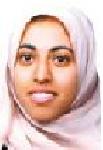 Nadia Al-Saqqaf
 - Since the early nineties, the civil society movement or so is termed has seen a significant rise in both number and activities. Today, there are more than 4700 civil society organizations of different specialties registered with the Ministry of Social Affairs. This is a huge number considering the short history of such a movement and low capacity of this country, apparently, almost half of these organizations are active while less than 10% of them have an actual impact on the society.
Unfortunately, many of these organizations have been used as means for attracting donor support for personal gain and not for the community interest. During my work as an activist I have come across numerous local organizations and have realized that their actual connection with and hence representation of the communities is non-existent. Many civil societies speak on behalf of the people and play the guardian role only as an attempt to attract donor support, without excreting the least of an effort to take part in the development of the society of live up to their themes and their claims.
The right to represent the people is not gained on the bases of how many times the community or word charity is mentioned in the organization�s title or mission statement. It is rather an award given by the people to the civil society organization after over years of hard work in community service.
A True civil society movement is a prime contributor in development process; in Theory, civil society organizations have the authority to question the government and its accountability to the people. Any organization has the right to even take the government to the court of law and question its policies in order to protect the people�s interest and the common good. Without the credibility granted by the people the civil society organization is nothing more than a private business founded on unethical grounds.
source: Yemen Times |
| |
|
Almotamar Net -
SANA'A,(Saba)- Yemen and the International Development Agency IDA is to hold a meeting by the mid of November in Washington.
During the meeting, the two sides will sign a loan agreement to finance the 5th fisheries project at a cost of $ 32 million.
The Deputy Minister of Planning and International Cooperation Abdullah Al-Shater said that the World Bank would contribute in the project with $25 million and the European Union with $7 million in the project.
|
| |
|
Almotamar Net - A source at the Ministry of Interior said it would launch an inquiry into the police attack against two journalists in Sanaa last Saturday. The Ministry stressed that the case was an �isolated incident and does not demonstrate a trend by police officers�.
However, this pledge did not satisfy the Yemeni Journalists Syndicate, which expressed its frustration with the government. The syndicate noted that �despite demands to the Ministry of Interior and the Office of the General Attorney to investigate regular attacks against journalists, no serious measures were taken by the authorities. This in turn, encouraged According to the Ministry of Interior, the investigation will only deal with the �circumstances of the attack� and will not necessarily take any measures against policemen themselves.
|
| |
|
 .
. - Eid Al Fitr
Muslims have two major celebrations in the year Eid Al Fitr and Eid Al dha . Both are called Eid (meaning celebration).
Eid Al-Fitr, or the Celebration of Breaking the Fast, marks the end of Ramadan. Ramadan is the month of fasting.
Eid Al-Fitr is the celebration that comes at the end of Ramadan. Ramadan is a month of fasting, every day from dawn until sunset. The Islamic Calendar follows the moon and so each year, the dates are shifted forwards by about eleven days in the normal calendar. Ramadan is the ninth month of the Muslim year, and is followed by Shawal. The first three days of Shawal are the Eid days.
This year, (2005) the first day of Eid will fall on 3 th of Novmber in most countries. The reason it differs from country to country is the calendar. It is a little bit complicated, but each month has either 29 or 30 days. On the 29th night of the month, people look for the new moon. If it is spotted, then he month has 29 days, and the next day is the start of a new month. If it is not spotted the month continues on for a 30th day, and then the new month starts. These days, astronomers can predict the months and phases of the moon very accurately, but it is still traditional for the moon to be spotted by someone. So, if the sky is overcast over an entire country, even if the moon is there, it can�t be seen and the month continues for one more day.
Eid Al-Fitr is all about celebrating the good things that we have received, God�s (Allah�s) bounty and our family and friends. Every household who can afford it must pay a form of tax in the days leading up to Eid. It is a very small amount, and is paid for each person in the family. Traditionally the tax was in the form of food, although most people now give the equivalent in money. The money or food is given to poor people, so that they can celebrate Eid, too. The tax is not collected by anyone, and no one is forced to pay it, but it is required as a religious act, and almost everyone pays.
Many people decorate their houses for Eid. This is rather an odd thing, since no-one is sure when Eid is, until the last minute, and so decorations are put up very late on the last day of the month.
Everyone has new clothes for Eid. The last few nights of Ramadan it is almost impossible to get into the shops, as everyone is buying their clothes. A complete outfit is normal, right down to the shoes, and even the headscarves for the women.
On the morning of Eid, everyone gets up very early to go to the prayers. These are special prayers, held only at Eid. They are held only in very big mosques, or in large open areas. They are held about 80 minutes after sunrise.
After the prayers everyone goes home to have breakfast and then the celebrations really begin. It isn�t common for children to receive gifts. Instead they receive money. The amount given is small, , but still they get plenty. Everyone who visits the children, or everyone whom they visit, gives then the gift of money. In a large extended family, with lots of friends, the children can end up with a small fortune!
Sometime around midmorning people start to go out visiting. They visit their relatives, neighbors and friends in the morning. At each visit special cakes are eaten, and the children receive their money. The visits are very short as there are plenty to make. Dinner is spent with family. The traditional meal varies from country to country, the only standard thing being the special cakes. Each day of the holiday is spent with a different branch of the family, so that everyone gets visited. In the evening the visits start up again. This goes on for three days, but money is normally only given to the children on the first two days.
In between visiting, people make trips out into the streets. Many streets have a sort of fair going, with music, dancing, fireworks, kids' games and much more. Here the children get to spend their money. They buy candy, soft drinks, toys and rides. Everyone has great fun, and the children are always disappointed when it is over. The adults, on the other hand, are usually worn out and glad of the rest!
|
| |
|
 .
. - W.H.O CALLS FOR MORE FUNDS FOR HEALTH TO AVOID 2ND WAVE OF DEATHS FROM PAKISTAN EARTHQUAKE
Funds for health have so far saved lives and reduced suffering
Geneva/Islamabad: Hundreds of thousands of people affected by the earthquake in Pakistan face the unnecessary risks of death, illness and further injury as winter approaches. People need shelter, safe drinking water and access to health care now and throughout the winter in order to survive.
The earthquake and aftershocks have killed over 53 000 people and injured an estimated 75 000, including many health staff. The latest available assessments show that 291 health facilities have been destroyed and 74 partially damaged of a total of 564 in the area. Less than half continue to operate.
The World Health Organization (WHO), with other health partners, is taking action and has already made a difference with the help of timely donations. Tens of thousands of people have had access to surgery, medicines, vaccination and other public health measures care.
To expand access to health care for the thousands who still need it now, to provide health care throughout the winter, and to prevent and respond to any outbreaks, WHO is appealing for a total of US$ 27.57 million, as part of the revised United Nations Appeal. So far, US$ 11 million has been pledged to WHO since 8 October.
"Without more help now, the second wave of deaths in Pakistan is coming. We cannot wait to see images of people freezing to death or dying of preventable disease before we act. With the money received so far, WHO, its partners and the Ministry of Health have made a difference to people's lives. The revised appeal will scale-up WHO's support," said Dr Ala Alwan, WHO Representative of the Director-General for Health Action in Crises.
|
| |
|
 Almotamar Net
 - Yemen and the sweeping majority of Muslims world-wide will celebrate `Eid Al-Fitr, which marks the end of the holy fasting month of Ramadan, on Thursday, November 3.
Yemen 's religious authority in Hodeida announced Tuesday, November 1, that Wednesday will be the last day of the dawn-to-dusk fasting month, and that `Eid Al-Fitr will fall on Thursday.
In Riyadh, the Saudi Judiciary Council announced that the new moon of Shawwal has not be sighted which means Ramadan will end Wednesday.
Following suit, the United Arab Emirates, Kuwait, Bahrain, Qatar, Jordan, Palestine, Yemen, Algeria, Sudan and Tunisia announced that the Muslim feast will fall on Thursday.
In Beirut, Dar al-Iftaa [the Sunni fatwa authority) said the new moon has not been sighted and Ramadan will end Wednesday.
Ayatollah Mohammad Hussein Fadlallah, the Shiite religious authority in Lebanon, had announced earlier that `Eid Al-Fitr will fall Thursday.
The Association of Muslim Scholars, the highest Sunni religious authority in Iraq, and the Sunni religious endowment authority announced Tuesday that Wednesday will be the last day of the holy fasting month.
`Eid in Europe
Turkey said that Wednesday will be the last day of Ramadan and `Eid Al-Fitr will begin on Thursday.
The Muslim minority in France will celebrate the Muslim feast on Thursday, according to the French Council for the Muslim Religion (CFCM).
The Muslim Council of Britain, the leading representative body of the minority, said the Muslim feast will fall on Thursday in the European country.
The Shura Mosque in Vienna, one of the main reference authorities for the Muslim minority in Austria, announced that Wednesday will be the last day of Ramadan.
In Slovakia, the Islamic Awqafs (endowment) society announced that `Eid Al-Fitr will begin on Thursday.
The German Muslim Committee for Moon Sighting announced Tuesday that the new moon of Shawwal has not be sighted and Ramadan will end Wednesday.
In Belgium, the Muslim minority representative body said Muslims in the European country will celebrate `Eid Al-Fitr on Thursday.
A member of the Council of Muftis in Russia said the Muslim feast will fall on Thursday.
In Albania, the Islamic Sheikdom announced that Wednesday will be the last day of the dawn-to-dusk fasting month.
The Federation of Social Organizations (ARRAID), the Muslim umbrella body in Ukraine, said the new moon has not been sighted and Ramadan will end Wednesday.
Also, the leader of the Muslim minority in Tatarstan announced that `Eid Al-Fitr will be celebrated on Thursday.
Indonesians United
For the first time in years, Indonesian Muslims will celebrate `Eid Al-Fitr on the same day.
The government of the world's most populous Muslim country announced that the Muslim feast will fall on Thursday.
The two biggest Muslim organizations, Nahdlatul Ulama and Muhammadiya, which usually stand different in deciding the moon sighting, made similar announcements.
Muhammadiyah usually marks Ramadan and `Eid Al-Fitr one day before NU.
Still to Sight
While some countries are still to sight the new moon, Libya was the only country to announce the end of the dawn-to-dusk fasting month, celebrating `Eid on Wednesday.
Malaysia, Oman, Morocco, Somalia, South Africa and Shiites in Iraq said they will sight the Shawwal moon on Wednesday.
Pakistan will sight the moon of the new month on Thursday.
Moon sighting is supposed to determine Arab lunar months. It has always been a controversial issue among Muslim countries, and even scholars seem at odds over the issue.
While one group of scholars believes Muslims in other regions and countries are to follow this sighting as long as these countries share one part of the night, another states that Muslims everywhere should abide by the lunar calendar of Saudi Arabia.
A third, however, disputes both views, arguing that Islam is against division and disunity, since Muslims, for instance, are not allowed to hold two congregational prayers in one mosque at the same time.
This group believes that the authority in charge of ascertaining the sighting of the moon in a given country (such as Egypt's Dar al-Iftaa) announces the sighting of the new moon, then Muslims in the country should all abide by this.
|
| |
|
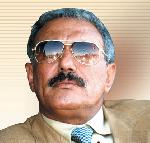 Almotamar Net
 - In his speech to the nation on the occasion of Eid Al-Fitr, President Ali Abdullah Saleh said on Wednesday that the Islam rejects all forms of extremism.
President Saleh affirmed that Islam is religion of "justice, mercy and tolerance," adding that the world now suffering from terrorism and its impacts on the peace, security and stability. "Terrorism has not religion or nationality. It is international epidemic in all countries," he said.
He called on the international community to gather efforts to rout out this epidemic.
President Saleh stated that Yemen has adopted democracy to realize justice, freedom and women's participation, and to protect human rights. He called on all to strengthen the democratic reality in the country through benefiting from previous experiences in order to pass negatives and reach wonderful future.
|
| |
|
Almotamar Net -
By Musatfa Nasar , Fatma Mottaher & Thuraya Dammaj.
The 22nd of May 1990 was really a turning point in the modern history of Yemen. It was the day on which Yemeni people had crowned their long standing struggle for the homeland�s reunification. Most importantly is that a new era of democracy , security and political stability was launched in the country.
The general referenda held in 1991 to approve the first constitution of the Yemeni single state was the milestone of democratic march in Yemen. The result was 89% in favor of the constitution.
The republic of Yemen�s constitution amended through general referenda organized 2001, stated that people is the source of power and they shall exercise it directly through general election and referenda and indirectly through the elected local councils. Thereby , political regime in Yemen is based on democracy�s principles , pluralism and multi-parties.
Yemenis went on bolstering democracy experience and have grown accustom with its practices . Three parliamentary elections held in the country so far in 1993, 1997and 2003. The first direct presidential election took place in 1999. First local council election arranged in 2001.
Yemenis of all political stripes are convinced that democracy is the ideal option for ruling and peaceful exchange of power. President of the republic Ali Abdullah Saleh frequently repeated that � democracy is the life�s boat for both of the rulers and peoples�. He said.
Yemeni politicians either of the ruling party or the opposition are very keen to exercise democracy in consistent with the constitution. The two sides become more familiar with democracy principles and both of them is quite a ware of the others role.
Mr. Sultan AL-Barakany ,the head of the ruling party�s parliamentary bloc , the People General Congress(PGC) says� our relation as a ruling party with the opposition is governed by the constitution and laws. It is regulated by the agreement on the goals and disagreement on the means�.
He went on saying� we are proud that our country become familiar with a new situation known as a ruling and opposition. No body can deny the positive political changes which have been taking place ever since the first Yemeni election conducted in 1993�.
Dr. Mansor Al-Zindany, Mp of the Yemeni Grouping for Reform , largest opposition party, says � there is no way for comparison between the situation before the unity and what happens now. In the past we used to resort to armament activities to protest to our opponents policy or to come to power but now we have abandoned those vulgar ways forever and embarked on democracy for 14 years�.
Some analysts and observers think that relation between regime and opposition in Yemen is in the right track. The opposition plays reasonable role in criticizing the government performance and suspending some of its decisions. In short , the government forced to adopt transparence measures and to embrace practical mechanisms for combating corruption.
The head of political division of the Yemeni Socialist Party, Mr. Abdul-Ghany Abdul-Kader says � democracy is the main guarantee for protecting the unity and releasing the peoples potentials to go on development.
He adds � relationship between opposition and ruling authority must be based on equivalent basis thus, sound and quiet dialogue should be prevailed apart from smearing and defaming but targeting national interest�.
The government provides the political parties with financial support in accordance with the law. 25% of the government subsidy distributed to the whole parties represented in the parliament, whereas 75% distributed to the parties according to the percentage of votes which the party obtained in the general election, with the exception of those parties which gained less than 5% of the total amount of votes.
Following the pluralism and multi-parties being adopted in the country , 46 of political parties were declared , however 22 out of them had taken part in the 1993 parliamentary election. Eight parties had managed to win parliamentarian representation at the time against five parties in the current parliament.
Sultan Al- Brarkani , said ; the main issue between regime and opposition is that we couldn�t get real democracy and regime without genuine opposition..
He added � democracy is a long build- up process and it has been adopted recently in Yemen , however if we have come up to 40 % or 50% of progression it is quite good..
|
| |
|
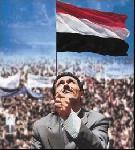 Almotamar Net
 - By Adnan Al-Sonwey.
Yemen perhaps, unlucky country both history and circumstances always seem to be as they are in rebellion against it in an attempt to divest it from its epithet �Arabia Flex� the surname it has deserved it now. � Commented�- one of the economists - about the Yemeni upheavals have taken place in spite of the horrible challenges
Yemen has already made a breakthrough in the economical and political fields since the country reunification in 1990. When the unity declared the country was chafed under overburden pile of economical , political and social problems.
Furthermore , the unity had entailed merging the Yemeni institutions and bodies what eventually gave rise to huge increasing in the civil service personnel as well the demand for services and infrastructure redoubled.
Thereby, the government had to face subtle financial troubles in order to cope up with those serious challenges. Particularly , restructuring the state institutions and ensuring great deal of jobs opportnities.
Thereupon , the government had to embark on structural adjustments program to reform the imbalances and bring the situation back into the right track in order to escape the country out of the total collapse.
Yemen has been carrying out a program of structural adjustments since 1995. It aims to bring about economical , financial and administrative reforms. The program has helped Yemen�s economy regaining its recovery.
The real growth rate in the (GDP) reached to (4.3%) in 2003, comparing to negative growth average came up to (2.3%) in 1994.
Thus , the rate of inflation has reduced gradually from (71%) in 1994 to reach at (13.6%) last year.
The deficit of the payment balance turned into surplus estimated at ($US 336) million dollar in 2003 , after long standing deficit record - it registered ($US463.1) million dollar in 1998.
Yemeni banking sector witnessed remarkable developments last year where currency�s offer increased with (30%) and current currency with (33.7%) of the total currency�s offer .
Based on banking and monetary indicators , the unified budget of trading banks totaling up to (YR536) billion rial in 2003 , comparing to (YR464) billion rial by the end of 2002.
Foreign exchange reserve in the Yemeni Central bank raised up from $US430 million dollar in 1994 , to come up to ($US3.5) billion dollar in 2001 and to reach at ($US6) billion dollar by the end of 2003, the highest sum the central bank of Yemen ever possesses so far.
Thus, the WB indicators showed up that poverty percentage has relatively reduced from(41.8% )in 1998 to (40.1%) in 2003.
As a result of the efforts exerted to rationalize the financial policies and boost the finance sources the state�s general revenue has grown with an average rate reached at (20.3%).
Eight of economical units were privatized last year in the light of restructuring the national economy and smoothing obstacles which hurdle the economic growth and diversity as well as market liberty. There are (37) of economical units were subjected to privatization where 60% out of them turned into private sector.
Several measures have been undertaken last year aimed at reforming and readjusting the administrative units system of the state.
The current government , formed following the parliamentary election in April 2003, included amount of structuring and renaming touched upon some ministries. In this context , seven of ministries and government�s bodies have been selected for restructuring in this year.
Around 22 of political parties are operating in Yemen nowadays in addition to more than (3l75) non-governmental organizations. There are also dozens of official , opposition and independence newspapers, magazines and bulletins are being published in the country.
Though democracy has been adopted recently three parliamentary elections were held in the country so far, moreover the presidential election in 1999 and local councils election in 2001, both of the two took place for the first time in Yemen.
With respect to legislative and legal domain several measures have been taken to restructure the concerned institutions. There are some (279) of legislative decrees and laws had been issued since the Unity, beside the executive laws and internal regulations in the various fields.
|
| |
|
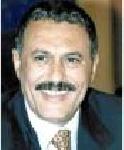 Almotamar Net
 - President Ali Abdullah Saleh flew this morning to Japan at the start of a tour that will also take him to Washington and Paris to discuss regional events, terrorism and economic cooperation.
Saleh, accompanied by several government ministers, told the state news agency before his departure that he was expected to "meet in Tokyo with Japanese Emperor Akihito and Prime Minister Junichiro Koizumi."
After Tokyo, Saleh said he will hold talks in Washington with President George W. Bush and in Paris with President Jacques Chirac, said SABA.
"We will discuss ways to strengthen bilateral ties ... as well as regional and international developments ... chiefly in Palestine, Iraq, Somalia and the African Horn," he was quoted as saying.
"We will also discuss anti-terrorism efforts and ways to consolidate security, stability and peace in our region and the world," he said.
"As for anti-terrorism, Yemen has achieved positive results in that field," he said.
|
| |
|
Almotamar Net - Al Bawaba - In his speech to the nation on the occasion of Eid Al-Fitr, Yemen's President Ali Abdullah Saleh said on Wednesday that the Islam rejects all forms of extremism.
According to SABA, President Saleh said that Islam is religion of "justice, mercy and tolerance," adding that the world now suffering from terrorism and its impacts on the peace, security and stability. "Terrorism has not religion or nationality. It is international epidemic in all countries," he said.
He called on the international community to gather efforts to rout out this epidemic.
President Saleh stated that Yemen has adopted democracy to realize justice, freedom and women's participation, and to protect human rights. He called on all to strengthen the democratic reality in the country through benefiting from previous experiences in order to pass negatives and reach wonderful future.
|
| |
|
Almotamar Net - Yemen has been chosen as the host for crucial talks of the United Nation�s Food and Agriculture Organization (FAO). The threat of Bird Flu and issue of water resources are expected to be high up on the list of issues to be discussed.
The conference aims to tackle challenges facing food and agriculture across the region, boosting technical assistance and improving the use of natural resources.
The talks next March are the 28th Regional Conference for the Near East region and will bring representatives from all the Arab nations to Sana�a.
Ministers from Iran, Turkey, Pakistan, Afghanistan, Cyprus and six countries of the former Soviet Union will also attend.
Hisham Al-Shamai, the FAO�s representative in Sana�a, said Yemen met all the requirements to hold such an important international conference.
�The conference is very important to discuss the policies of the organization and to help make them more effective,� Al-Shamai said.
The choice of Yemen as the host for the conference was approved by the members at the previous FAO regional meeting in Doha, Qatar.
Abu Baker Al-Qirbi, the Foreign Minister, said there was a high level of the cooperation between Yemen and FAO members and that everything possible would be done to ensure the conference was a success.
Abdul-Malik Al-Arashi, the Deputy Minister of Agriculture and Irrigation, said that government ministries were coordinating closely with each other to prepare for the talks.
He said Yemen greatly appreciated the help the FAO had given in setting up development projects across the country.
Nine other countries who hold observer seats in the organization including the United States, Ethiopia, France, Germany, the Vatican, Japan, the Netherlands, Palestine and the United Kingdom, will also take part.
Around 32 ministers and representatives from the FAO and the UN are also expected to attend.
Food safety has become a growing concern for countries in the Near East region, with recent outbreaks of Bird Flu and �Mad Cow�s Disease�, or Bovine Spongiform Encephalitis (BSE), in some poultry and meat exporting countries around the world.
Some countries in the region import nearly 70% of all their food, so disease and contamination are a vital issue.
Import bans on food from countries affected by Bird Flu and BSE help to prevent the spread of the epidemic, but also force countries to import food from alternative - and often more expensive - sources.
The last conference in 2004 tackled problems of scarce water resources and agricultural irrigation, one of the most important issues concerning the region.
Plans for technical assistance to help with the ever increasing demands on limited water supplies and policy on the management of watersheds were discussed.
Countries were able to share their different experiences and research on water management in agriculture at the conference, and regional workshops were organized to develop appropriate strategies for water-harvesting and flood management.
source:Yemen Observer
|
| |
|
 Almotamar Net
 - On his way to Japan, President Ali Abdullah Saleh
took a destination pause in the Thai capital Bangkok where he met
with Thai Minister of Foreign Affairs, Khantathi Suphamongkon
During the meeting, they discussed mutual relations between Yemen and Thailand and means of enhancing them. Talks also touched on developing trade cooperation in fisheries, air transportation and tourism. Suphamongkon briefed Saleh on the situation in north Thailand and the Thai Government's efforts to solve problems and reinforce national solidarity, asking the Yemeni President to mediate between Thailand and Malaysia to solve the dispute over the 131 Thai refugees. President Saleh pledged to play a role in normalizing ties between Thailand and Malaysia.
|
| |
|
 Almotamar Net
 - Minister of Electricity Abdu-Rahman Tarmom left
to Beijing on Saturday heading a delegation to participate in the 2nd
International Conference for Renewable Energy to be held on November 7-8.
The conference, in which a number of Arab and foreign countries would
participate, aims to generating extra development in participating countries
and highlighting energy role in development.
Tarmom stated to Saba that he would also discuss with his counterparts
from other countries ways to develop and activate mutual cooperation in
renewable energy which would help meet the demand for electricity. |
| |
|
 Almotamar Net
 - President Ali Abdullah Saleh is scheduled to
meet with the U.S. President George W. Bush at the White House on November
10, the White House said Saturday.
In a statement the White House announced that "President
Bush will welcome President Ali Abdullah Saleh of Yemen to the White House
on November 10.
"
"The two leaders will discuss a range of bilateral issues, including the
President's Freedom Agenda and cooperation on the war on terrorism."
President Saleh is due to arrive in the Japanese capital Tokyo in an official
visit as part of a tour that would also take him to the United States
and France.
" |
| |
|
Almotamar Net - Unusual destination for immigrants
Yemeni security sources revealed Saturday that coast guards seized 750 illegal immigrants, including 180 women and children, during the month of October only.
They said the majority of the immigrants carried Somali documents and a few came from Ethiopia and Eritrea.
The immigrants are mainly intercepted at the western shores of Yemen on the Red Sea after undergoing a dangerous voyage in usually rough seas packed in small dinghies, many of which capsize before reaching safe shores.
Journalist and social researcher Nizar Abbadi cited miserable living conditions, authoritarian rule, persecution and absence of safety and security as the main reasons for driving the immigrants to seek refuge in a poor country like Yemen.
"Yemen is among the poorest countries in the world, and yet it has become a strange destination for immigrants," Abbadi told United Press International. "And the scene is of one of the most terrible humanitarian tragedies that needs to be tackled and dealt with closely by the international community."
According to the U.N. High Commission for Refugees in Yemen, around 50,000 refugees have been registered with the U.N. organization, while unofficial figures estimate more than half a million unregistered immigrants are living illegally in the country.
The first batch of Somali refugees arrived in Yemen following the outbreak of the civil strife in Somalia in 1991. They increased gradually as the conflict in Somalia intensified and reached a climax in 2001, raising the annual average of incoming refugees to 14,000.
|
| |
|
 Almotamar Net
 - President Ali Abdulla Saleh arrived Tokyo today within his official tour which will take him to Japan, US and France.
Saleh will hold talks with Japanese Emperor Akihito and Japanese Prime Minister Junichiro Koizumi and a number of Japanese officials on bilateral relations.
|
| |
|
 Almotamar Net
 - The World Health Organization will organize in the Swiss capital, Geneva, an international conference in cooperation with the UN Food and Agriculture Organization, to discuss an international plan on fighting the bird flu disease.
The Cable News Network (CNN) said on Sunday that the conference would be attended by hundreds of health experts and will discuss granting economic aids to the poor countries to help them fight the disease.
|
| |
|
 Almotamar Net
 - Aden University is to host the Yemeni-Cuban Medical Conference during the period from 20th to 23rd November.
The conference is organized by the university in cooperation with the Cuban University for the Medical Science.
The conference will discuss aspects of the mutual cooperation ties between
the universities in both countries.
|
| |
|
 Almotamar Net
 - Yemen would host the 2ed conference for the Association of Shura Councils and Senates in Africa and Arab World presided by Chairman of of Yemeni Shura Council Abdul-Aziz
Abdul-Ghani.
The meeting aims at reinforcing and strengthening the Arab and African cooperation and building a united regional stance toward the international developments in order to participate in the
international security and peace.
Chairpersons and representatives of 18 Arab and African countries would take part in this conference which first took place in 2004.
It is expected that the conference would approve the association general secretariat's proposals over the basic and internal systems.
Moreover, it would discuss financial and administrative reports over the last period, and proposals over next year's budget.
In press remarks, Abdul-Gani highlighted importance of the conference which would come up with a number of solutions for the current Arab, African and international social and political issues.
The association's secretary-general Lifinos Asogy hailed Yemen for hosting the conference and its efforts in supporting the
association.
|
| |
|
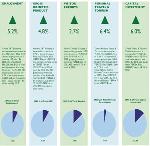 Almotamar Net
 - A report by Qabas International Economic Consultants (QIEC) revealed several signs for a healthier travel and tourism sector in Yemen as the flow of tourists has increased steadily in 2005, consequently placing Yemen in the second rank after UAE among all Arab countries in terms of tourism growth; a recent; whereas a second report by the World Travel & Tourism Council (WTTC) estimated that the travel and tourism sector in Yemen will generate more than YR 300 billion (USD 1.5 billion) of economic activity in 2005, and will grow three folds to a staggering YR one trillion by 2015.
The UK-based international organization said that Yemen will become the second fastest growing Arab country with a 5.9% annualized real growth rate in travel and tourism during (2006-2015) just ahead of Egypt with a nominal difference of 0.1%.
The high growth rate is partially attributed to the relative security in the last few years, compared to the late 1990s when kidnapping of foreign tourists was a phenomenon causing a drop in the number of tourists coming to the country.
The report gave hope by reiterating the tourism growth potentials in the country, which it viewed as mostly unexploited: �Yemen appears poised to regain its long-term level of growth forecast for Travel and Tourism after suffering some disappointing results in 2004 especially for Visitor Exports, which posted a significant loss for the year.� the report said.
Yemen in the Arab world
Although Yemen�s tourism share in the Arab world is relatively insignificant, the potential and possibilities in this sector will give it an edge in conditional if the country continues to enjoy good political stability and security.
While other countries, such as Egypt and the UAE, have almost reached saturated levels of tourism compelling them to face significant challenges to keep this momentum growing without massive transformations in their infrastructure, Yemen has a tourism industry that is at its infancy, but which will require massive investments particularly in the infrastructure and building human resources capability aspects.
The Arab countries� share of international tourism is among the least in the world. According to the report released by QIEC, in 2002, Arab countries altogether represented a mere 5.3 per cent of international tourism, However, Yemen�s growth prospects is expected to increase its share of tourism revenues in the Arab world, and potentially increase the overall share of Arab countries as a whole.
The World Tourism Organization described Yemen as �a hospitable and attractive tourism destination that is unique in its culture, civilization and diversity of terrain, and in featuring the coastal, sport, marine, and mountainous tourism attractions.�
Contribution to GDP
The WTTC report said that Yemen�s travel and tourism industry is expected to contribute 1.9% to Gross Domestic Product (GDP) in 2005 (YR 50.5 billion or USD 253.2 million), rising in nominal terms to YR 133.7 billion or USD 367.5 million (1.8% of total) by 2015. Hence the sector�s economic contribution (percent of total) should rise from 8.5% (YR 223.5 billion or USD 1,120.6 million) to 10.3% (YR 747.8 billion or USD 2,055.8 million) in this same period.
The report estimated that Yemen�s travel and tourism would provide 417,246 jobs in 2005, which constitutes 7.2% of total employment, or one in every 13.9 jobs. By 2015, this should total 688,223 jobs, 8.6% of total employment or one in every 11.6 jobs. The 96,431 industry jobs account for 1.7% of total employment in 2005 and are forecast to total 126,202 jobs or 1.6% of the total by 2015.
�In Yemen, exports make up a very important share of travel and tourism�s contribution to GDP.� the report noted. Of total Yemen exports, the sector is expected to generate 13% (YR 134 billion or USD 671 million) in 2005, increasing to YR 528 billion, or USD 1,452 million (11.7% of total), in 2015.
Major challenges ahead
According to the governmental National Information Center, the major challenges facing Yemen are due to the weak infrastructure which cannot meet the growing demand in the tourism sector; the lack of qualified human capital which aids in setting up the tourism industry and prepare the environment to become more tourism-friendly coupled with the lack of law enforcement particularly in regulating the carrying of weapons and lack of awareness of the importance of tourism are the most important challenges that lie ahead.
However, the Yemeni government is keen to address the importance of tourism and in fact called the year 2005, the year of tourism. Foreign Minister Dr. Abu Bakr Al-Qirbi told Asharq Al-Awsat regional daily in an interview published last week that the government is actively seeking foreign investments to develop the tourism sector.
�Tourism can be developed in Yemen, for there are areas that have better tourist attractions than the places GCC tourists� visit.� he said, noting that the revenues generated from tourism in Gulf countries could be matched and surpassed if the tourism industry in Yemen is developed properly.
Local tourism flourishing
Meanwhile, the level of local tourism has grown steadily in the last few years and in 2005 exceeded half a million tourists annually. Many of those tourists come from neighboring countries or are Yemenis residing abroad, while many are residents enjoying local tourism inside the country; mainly the residents of inland cities visiting coastal areas to enjoy the Yemeni beaches and the pleasant weather; for example hotel rooms in the port Aden are usually fully booked weeks before the Eid vacation, causing inconvenience for many travelers who end up in tents or are forced to pay excessive fees for accommodation as a result of the shortage in supply.
Despite the positive contribution of local tourism to the national economy, economic experts believe that it is yet to be taken full advantage of and regulated to benefit a larger portion of the community. By facilitating investments in the tourism sector, limiting bureaucracy in movement of vehicles and people from and to the country, local tourism could double or triple in the coming years.
The National Information Center predicts by 2010, there will be more than 711,000 local tourists, while the number of foreign tourists may rise to about 150,000.
|
| |
|
 Almotamar Net
 -
A personal memory by OLIVER MILES
Although I was an outsider, from the Foreign Office and not from the Aden Service, I had an insider�s view of the last six months of British rule in Aden thirty years ago. This was because the last High Commissioner, Sir Humphrey Trevelyan, decided that he wanted a private secretary from the Foreign Service, to which he himself had belonged. I was already in the country because the Foreign Office wanted one of their people to have some knowledge of it in readiness for the Embassy which would be accredited to the independent government.
Up to that point I had been serving in the so called Eastern Aden Protectorate (not that we ever gave it much protection) as assistant to the British Resident in Mukalla. The President, Jim Ellis, was in the fine Harold Ingrams tradition and had done his utmost to bring peace and prosperity to the area, without too much success. Although I heard the praises of Harold Ingrams as peacemaker sung around a camp fire on the plateau in what was then the tribal area, the fact is that the EAP remained in pretty much the state of tribal anarchy which had existed in Arabia since the beginning of history and earlier. For me, a young Arabist, it was a unique opportunity - rather as if an American diplomat coming to Europe was able to spend a little time with Robin Hood in the greenwood. The tribal game was still being played according to the old rules: you scored by killing a male member of the other tribe, and if you killed so many that the other side could not level the score even by wiping your side out, you could draw stumps. It was perhaps only later when I served in Saudi Arabia that I realised how astonishing it was that Ibn Saud had created a more or less unified and pacified Kingdom in what had been, as recently as the days of Doughty, "the fanatic Arabia".
Aden was another story, a Crown Colony and not a mere protectorate, and therefore equipped with at least the beginnings of institutions such as courts, unions and even at one time a Legislative Council, to say nothing of hotels, buses and drains. Mukalla had some outsiders, including the Sultan and his hangers on, but in Aden one sometimes wondered whether there were many indigenous Arabs among the races who came to create the modern city - for when the British arrived Aden was scarcely a village.
I do not know if Trevelyan grasped from the beginning that his real task would be just to get the British army and civilian officials out with the minimum bloodshed. I suspect he did, because he was extraordinarily acute and the minister who appointed him, George Brown, was of the school that saw no future at all in Britain�s presence in Arabia. At first, however, we had a wider agenda, seeking to provide a framework in which relatively democratic forces in Aden and our traditional friends in the upcountry states could work together in peace. Especially in Aden and the Western protectorate, officials had struggled long to build the Federation of South Arabia, and were extremely reluctant to accept that it was still-born. In addition, we continued to be preoccupied with the familiar forgotten tasks of colonial government; justice, health, economic development, and so on.
We both understood and to some extent sympathised with the wish to see the British gone, but it was hard for me not to feel bitter as the various groups and individuals committed to liberation, known as terrorists for short, continued to kill people largely because of the colour of their skins, such as my friend and contemporary Derek Rose who was murdered in an Aden street when his old car broke down. The decision that we were leaving had been taken and announced, so one might ask why our political and military problems remained as acute as they did. There were, I think, a number of answers to this question. One was that we were not believed; surely Aden was too precious for us to give it up? Another was that a record of violence against the British might turn out to be a valuable thing to have in one�s CV. Some of the "terrorists" were indeed terrorists, who believed in bloodshed as a necessary condition of political change. But the most important point was that the forces aligned against us, which we assumed to be more or less coherent, were in reality deeply divided, and we were caught in the cross fire between them. This became increasingly obvious towards the end, as we shall see.
Our position was a difficult one. Quite literally, the world was against us, as was demonstrated by the farcical and disgraceful visit of a United Nations Commission sent out to tell us how to solve our problems - it was scant consolation that an African and a Latin American, devout believers in the anti-imperialism which was the religion of the day, were nevertheless unable to adopt a sufficiently anti-British posture to avoid being run out of town by the "terrorists". Across the border in North Yemen the Egyptian Intelligence Service, involved along with the Egyptian army in the Yemen civil war, still had its tail up and was taking every opportunity to make life dangerous for us - again, scant consolation that they were seen off by the Yemenis only a few weeks later than ourselves. Within the territory, the levers of influence were melting away in our hands. For example, if a "terrorist" was arrested, we could only lock him up for a period which would end with our own departure, thus ever decreasing; in any case, detention by the British, with that valuable point on one�s CV, might be the best way to survive the desperate final struggle between the liberation organisations.
In desperation we resorted to some disreputable methods. Pressure was applied to detainees to get information, until the practice was busted by the International Red Cross. I was disgusted by the continuation of the practice of giving rifles to our friends up-country, which had once been a matter of honour, but had become a cheap bribe - neither moral nor prudent, dragons� teeth indeed. Were rough tactics used by the army? Certainly the reputation of the Argylls for dealing on the spot with anyone who hurt one of their soldiers - whether or not the reputation was based in fact - was understood in a tribal society and seemed to contribute to much lower casualty figures, both Arab and British, wherever the Argylls happened to be. Just after the Argylls retook Crater from the "terrorists" - apparently more by the power of the bagpipe than the gun - I was invited by their Adjutant to make a tour with him, I must admit with an armoured car in close attendance behind us. It was not as I expected, particularly when small Arab children came up to my friend the Major and offered him sweets. Surely he could not have stage managed it, only twenty-four hours after retaking the city?
Trevelyan, a veteran of the Indian Political Service and a former Ambassador in Moscow (and avid reader of Pushkin), was a truly great man, shrewd and kind, leader, manager and tactician. Some examples: relations between Government House and the military were traditionally tense, so on his second day in Aden Trevelyan overrode protocol and insisted on visiting the Commander in Chief in his headquarters; so simple the gesture, so great the benefit! He seems to have been the only official in the Foreign Office who understood that a clear decision from George Brown at breakfast was worth any amount of fuddled discussion later in the drinking day. On a larger issue, he successfully fought against London�s determination to set a date for final withdrawal, arguing that it would leave control of the end game entirely in the opposition�s hands. He was right, and at final departure, to the strains of "Fings Ain�t Wot They Used to Be", not a shot was fired. Only once did I, as his private secretary, have to fight him and win, when he was to give a George Medal to a bomb disposal expert; it had to be early in the morning for timetable reasons, and he thought it would not be the thing to serve champagne.
The end was a mystery. The Front for the Liberation of South Yemen, absurdly known as FLOSY, the darling of Cairo, of the United Nations and of a great part of the British Labour party, with its leaders like Makkawi and Asnag all ready to step into their ministerial offices, was blown away in a few weeks by a mysterious organisation known to us as the National Liberation Front - the Qawmiyin. Who were they? How did they do it? How was it that, when we eventually sat down with them for our hasty handover negotiations in Geneva, we recognised more than one face we had known in the federal army or the armed police, people of whose true purpose we had known nothing? The quotation has become hackneyed, but Trevelyan and I found it singularly apt:
Things fall apart; the centre cannot hold;
Mere anarchy is loosed upon the world...
The best lack all conviction, while the worst
Are full of passionate intensity.
...somewhere in the sands of the desert
A shape with lion body and the head of a man,
A gaze blank and pitiless as the sun,
Is moving its slow thighs, while all about it
Reel shadows of the indignant desert birds.
...what rough beast, its hour come round at last,
Slouches towards Bethlehem to be born?
December, 1997
|
| |
|
Almotamar Net -
Compiled by NAJLA ABU-TALEB
Sana�a is a �must�, however long the journey takes
La budd min Sana�a wa lau taal al-safr
From a pound of talk, an ounce of understanding
Min ratl hakya tafham wiqya
A foreigner should be well-behaved
Ya gharib kun adib
Look to your near neighbour rather than to your distant brother
Jaarak al-qarib wa la akhuk al-ba�id
Work like an ant and you�ll eat sugar
Kun namla wa takul sukr
Who dies today is safe from tomorrow's sin
Man maat al-yaum salim min dhanb bukra
My fist is in his mouth, his fist is in my eye (i.e. �six of one, half a dozen of the other�)
Yaddi fi fumuh wa yadduh fi �aini
A friend in time of need is a friend indeed
La sadiq illa fi waqt al-dhiq
A monkey in its mother�s eye is like a gazelle (i.e. love is blind)
Qird fi �ain ummuh ghazaal
If speech is of silver, silence is golden
Lau kan al-kalaam min fidha fa al-samt min dhahab
A bird in hand is worth ten in a tree
'Asfoor fil yadd wa la �ashra fi al-shajarah
Out of sight, out of mind
Ma ghaab �an al-nadhr ghaab �an al-khaatir
If you have honey, don�t lick the pot clean
Idha sahibak �asl la talhusuh kulluh
A white piastre for a black day
Al-qirsh al-abyad li al-yaum al-aswad
You play with a snake and call it a worm
Tal�ab bi hanash wa taquluh dudah
**************************************
source: British-Yemeni Society |
| |
|
 Almotamar Net
 - (AP) - Google Inc.'s Internet-leading search engine on Thursday will begin serving up the entire contents of books and government documents that aren't entangled in a copyright battle over how much material can be scanned and indexed from five major libraries.
The list of Google's so-called "public domain" works -- volumes no longer protected by copyright -- include Henry James novels, Civil War histories, Congressional acts and biographies of wealthy New Yorkers.
Google said the material represents the first large batch of public domain books and documents to be indexed in its search engine since the Mountain View-based company announced an ambitious library-scanning project late last year.
The program is designed to make more library material available through a few clicks of a computer mouse and attract more people to click on the highly profitable ads that Google displays on its Web site.
During the next several years, Google wants to create digital versions of millions of books stacked in the New York Public Library and four university libraries -- Stanford, Harvard, Michigan and Oxford.
Google declined to disclose how many books have been scanned from the libraries so far. The project is expected to require years to complete.
But a bitter copyright dispute is threatening to crimp Google's plans.
The Authors Guild and five major publishers are suing to prevent Google from scanning copyrighted material in the libraries without explicit permission.
Because it plans to show only snippets from copyrighted books, Google argues its scanning project constitutes "fair use" of the material.
Google postponed the scanning of copyrighted books in August to give writers and publishers more time to opt out of the program. The scanning of copyrighted material resumed this week, with an emphasis on books no longer in print.
|
| |
|
 Almotamar Net
 - (AP) -- In another time and place, college students wondering whether the campus cafe has any free seats, or their favorite corner of the library is occupied, would have to risk hoofing it over there.
But for today's student at the Massachusetts Institute of Technology, that kind of information is all just a click away.
MIT's newly upgraded wireless network -- extended this month to cover the entire school -- doesn't merely get you online in study halls, stairwells or any other spot on the 9.4 million square foot campus.
It also provides information on exactly how many people are logged on at any given location at any given time. It even reveals a user's identity if the individual has opted to make that data public.
MIT researchers did this by developing electronic maps that track across campus, day and night, the devices people use to connect to the network, whether they're laptops, wireless PDAs or even Wi-Fi equipped cell phones.
The maps were unveiled this week at the MIT Museum, where they are projected onto large Plexiglas rectangles that hang from the ceiling. They are also available online to network users, the data time-stamped and saved for up to 12 hours.
Red splotches on one map show the highest concentration of wireless users on campus. On another map, yellow dots with names written above them identify individual users, who pop up in different places depending where they're logged in.
"With these maps, you can see down to the room on campus how many people are logged on," said Carlo Ratti, director of the school's SENSEable City Laboratory, which created the maps. "You can even watch someone go from room to room if they have a handheld device that's connected."
Researchers use log files from the university's Internet service provider to construct the maps. The files indicate the number of users connected to each of MIT's more than 2,800 access points. The map that can pinpoint locations in rooms is 3-D, so researchers can even distinguish connectivity in multistoried buildings.
"Laptops and Wi-Fi are creating a revolutionary change in the way people work," Ratti said. The maps aim to "visualize these changes by monitoring the traffic on the wireless network and showing how people move around campus."
Some of the results so far aren't terribly surprising for students at the vanguard of tech innovation.
The maps show, for example, that the bulk of wireless users late at night and very early in the morning are logged on from their dorms. During the day, the higher concentration of users shifts to classrooms.
But researchers also found that study labs that once bustled with students are now nearly empty as people, no longer tethered to a phone line or network cable, move to cafes and nearby lounges, where food and comfy chairs are more inviting.
Researchers say this data can be used to better understand how wireless technology is changing campus life, and what that means for planning spaces and administering services.
The question has become, Ratti said, "If I can work anywhere, where do I want to work?"
Graduate student Sonya Huang, stands in front of a map of the MIT campus that shows the flow of wireless Internet users at the school."Many cities, including Philadelphia, are planning to go wireless. Something like our study will help them understand usage patterns and where best to invest," said researcher Andres Sevtsuk.
Sevtsuk likened the mapping project to a real-time census.
"Instead of waiting every year or every 10 years for data, you have new information every 15 minutes or so about the population of the campus," he said.
While every device connected to the campus network via Wi-Fi is visible on the constantly refreshed electronic maps, the identity of the users is confidential unless they volunteer to make it public.
Those students, faculty and staff who opt in are essentially agreeing to let others track them.
"This raises some serious privacy issues," Ratti said. "But where better than to work these concerns out but on a research campus?"
Rich Pell, a 21-year-old electrical engineering senior from Spartanburg, South Carolina, was less than enthusiastic about the new system's potential for people monitoring. He predicted not many fellow students would opt into that.
"I wouldn't want all my friends and professors tracking me all the time. I like my privacy," he said.
"I can't think of anyone who would think that's a good idea. Everyone wants to be out of contact now and then."
|
| |
|
Almotamar Net - More than 600 individuals representing a total of 185 families benefited from the special food parcel programme executed in Yemen by the UAE Red Crescent Society, RCS, as part of the gestures of President H.H. Sheikh Khalifa bin Zayed Al Nahyan during the holy month of Ramadan,WAM reported taday.
Commenting on the prgamme, Saleh Mohammed Al Mulla, RCS' Deputy Secretary General for Relief Affairs and Projects, praised the UAE President for the kind gesture. He also praised Abu Dhabi Crown Prince, Deputy Supreme Commander of the UAE Armed Forces for his continuous support and Deputy Prime Minister, Minister of State for Foreign Affairs and RCS Chairman for his follow-up and efforts in seeing to the success of the programme.
He pointed out that the RCS ensured the presence of its representative in the Palestinian refugee camps in Yemen to ensure the successful execution of the programme. He said the exact number of Palestinian families in the Yemeni capital, Sana'a, was identified with the help of the Palestinian Ambassador in Sana'a, adding that the latter's cooperation enabled the RCS to easily execute the programme with great efficiency.
Beneficiaries of the programme have expressed profound gratitude to the UAE President, Sheikh Mohammed and Sheikh Hamdan. They have also expressed gratitude to the UAE Government and people for the kind gesture.
|
| |
|
Almotamar Net - Oracle Energy Corp. announced today that it has been notified by Block 22 operator Yemen Mayfair Petroleum Corp. (YMPC) that good progress has been made on the drilling of the Beta-1 well. As of Sunday morning, November 6, 2005, a total depth of 1518 metres was reached and logs were run. Currently 9 5/8"casing is being set prior to commencement of drilling the prospective section down to 2500 metres. The well is designed to test the hydrocarbon potential of Upper Miocene reservoirs.
Oracle Energy Corp. holds a 15% participating interest in Block 22. Principals of YMPC were instrumental in the discovery of Yemen's first giant oil field in the mid-1980's, located in the Marib basin. Block 22, was awarded to YMPC in 1993. It encompasses 8,151 square kilometers within the Tihama Basin in the western region of the Republic of Yemen.
The information contained herein does not constitute an offer of securities for sale in the United States, United Kingdom, Canada, Japan or Australia.
The TSX Venture Exchange has not reviewed and does not accept responsibility for the contents of this news release.
Source: ccnmatthews
|
| |
|
Almotamar Net - TOKYO, Nov 07, (Saba) � President Ali Abdullah Saleh met here on Monday with a number of the Japanese parliament headed by the chairman of the Yemeni-Japanese Friendship parliament Assembly Masio Fokoda.
The meeting discussed the bilateral cooperative relations and the means of developing them.
President Saleh appreciated the Japanese support to strengthen the democracy and development and its important role in stabilizing peace in the region and the world.
The president stated that Yemen supports Japan to get the permanent membership in the International Security Council.
The meeting was attended by the Minister of State Abdullah Al-Bashiri, parliament member Motaher Alhejri, Yemeni Ambassador to Tokyo Ali Al-Saqaf and the Japanese Ambassador to Sana'a Yuichi Ishii.
|
| |
|
 Almotamar Net
 - Terrorism can be limited by reducing poverty, implementing strategic projects and creating new jobs, President Ali Abdullah Saleh stated on Monday at his meting with the Japanese Minister of Foreign Affaires Taro.
At the meeting, Saleh appreciated efforts exerted by Japan in supporting development and democracy in Yemen.
The meeting discussed the Yemeni efforts in economic development and combating terror, as well as the implementation and funding of a
number of strategic projects by Japan.
On the other hand, Saleh met with Tadashi Izawa vice-chairman of the Japan International Cooperation Agency (JICA).
Saleh spoke highly about the role played by the JICA in supporting development projects in Yemen.Izawa expressed his agency's willingness to fund and support projects of the development program in Yemen.
Meetings were attended by Minister of Planning and International Cooperation Ahmad Sofan, Minister of Foreign Affaires Dr Abu Baker
Al-Qirbi, Minister of State Abdullah Al-Bashiri, Yemeni Ambassador to Tokyo Ali Al-Saqaf and the Japanese Ambassador to Sana'a Yuichi Ishii.
|
| |
|
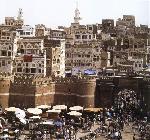 Almotamar Net
 - Sana�a is one of Yemen�s governates; it is situated at the center of the Yemeni plateau between two mountains in the Sana�a Basin. These mountains are the Nuqum and Ayban Mountains, and are on a height 2200 meters above sea level. Sana�a has a bright sun throughout the year except for a few weeks in the summer and spring, which are often cloudy. Generally, it is wonderfully fresh and moderate in summer and cold in winter. All districts and outskirts of Sana�a are mountainous.
Sana�a is considered one of the Islamic historical towns because it has the Old City of Sana�a that is a real miracle of old architecture. The old city of Sana�a is one of the most beautiful cities in Arabia and the Islamic World. The city is known by several names including the city of � Sam �. It is also said that the city was built by Shem, the son of Noah, following the flood.
It is also called � Azal � but the most common name is �Sana�a�, which is mentioned in a number of ancient Yemeni inscriptions, and means �the protected�.
In Sana�a there are more than 50 mosques, five with domes and many with minarets, the most important of which is the Great Mosque, built during the life of Prophet Mohammed and ordered by him in the Eighth Hegira year 630 AD.
There are many other mosques, which are not less beautiful or wonderful with respect to the style of minarets, domes and artistic embellishments. Sana�a has the highest mountain in Arabia; the mountain of the Prophet Shueib, which is 3766 meters above sea level.
It has also the most beautiful village Al-Hajara and the best quality of Yemeni coffee and grapes.
Tourist Area In Sana�a:
� Old Sana�a :
With its unique and marvelous architecture, Old Sana�a is in itself a living museum. The beauty of the city has inspired many writers, architects, poets, and even tourists. One cannot but imagine the talent and taste of the original architects of such a magnificent city.
The market is considered to be one of the significant components of the Arabic Islamic cities and the markets of old Sana�a are regarded as a living and rare example of this.
There are ten such markets, each specializing in a certain craft or merchandise such as the Cloth market, Grain market, Silk market, Raisins market, Cattle market, Thread market, Coffee Husk market, Caps market, Carpet market, Salt market, Brassware market, Silverware market, Firewood market, all of which are perfumed with the scents of the East.
There are about 15 steam baths in old Sana�a, which are a fundamental feature of the city, as baths are associated with cleanliness. It is said that the Persians introduced the baths.
Since 1984, the UNESCO has listed Old Sana�a among the international heritage cities as �World Heritage of Mankind�.
� Samsarah (Caravansaries):
In old Sana�a there were a number of inns (Khans), which were used to perform specific functions that were complementary to the business of the market, such as services of accommodation, storage, safekeeping of deposits and precious items.
Such facilities had a specific architectural style characterized by arches and terraces in the interior. The ground floor was usually used for camels and horses, there are even now samples of such brokerage inns. One of them is Al-Nahas Caravansary at the entrance of Salt Market, Bab Al-Yemen (Yemen Gate). This is now used as a center for the training of craftsmen and for the displaying of their products. Near by is another example called Samsarat Al-Mansour, which is presently a center artists whose medium is paint.
� Dhahr Valley :
Wadi Dhahr is located 14 km to the northwest of Sana�a and is considered to be the most important recreation area for the city of Sana�a. Here all kinds of fruit are grown. In the center of the Wadi perches Dar Al-Hajar (Rock Palace), a palace built on top of an enormous rock dating back to 1786 AD, and ordered by Imam Mansour Ali Bin Mehdi Abbas.
In addition, there are a number of ancient monuments scattered within the Wadi. Yemenis like to come with their families to this vantage point and gaze at the beautiful valley.
On Fridays tourists can witness traditional wedding dances in the plateau, visit the Palace and have small walking trips through the village.
� Al-Rawadha:
It is situated 8 km to the north of the city center. There is an ancient mosque in Al-Rawadha with artistically decorated minarets dating back to the 17th century. This mosque is called Imam Gasim Mosque. It also has rural clay houses made in the Sana�a style in addition to numerous vineyards.
Many people in Sana�a throughout history have gone to Al-Rawadha in order to relax, especially in the season of grape harvests. Another ancient landmark in this area is Al-Rawadha historical Palace, Which dates back to the early twentieth century and used to be one of the Palaces of Imam Yahya. It is now a hotel.
� Bait Baws:
A typical old village, Bait Baws is located 7 km to the south of Sana�a. Existing inscriptions found in the west of village show that the area was an important center in the ancient history of Yemen. The village is naturally fortified with only on entrance to the south.
� Haddah:
Lying about 8 kilometers from the city center, this region is continuously green because of its long trees of peanuts and other seasonal fruits. There are some old windmills, built during the Ottoman Empire�s rule of Yemen, which were driven by the force of water currents.
source: Yemen Times |
| |
|
Almotamar Net - Official sources said that Aden�s oil refinery had increased its annual production capacity for various oil derivative products this year, which could enable it to produce more than 5 million tons of petroleum products annually.
According to statistics by the refinery�s administration, daily production of the refinery increased to 120,000 barrels per day after going through a complete maintenance operation to raise its capacity to a maximum of 150,000 barrels per day.
The statistics revealed that the technical teams of the refinery carried out thorough maintenance work in the four major anchor points, each with a depth of 15.5 meters. The administration said that paint, electricity and other maintenance operations had facilitated the loading and unloading of international and local vessels, which could have a capacity up to 130 thousand metric tons.
Furthermore, the refinery�s facilities dealing with liquidated natural gas had also improved to enable the reception and treatment of more than 4,500 metric tons of gas daily.
source:NewsYemen
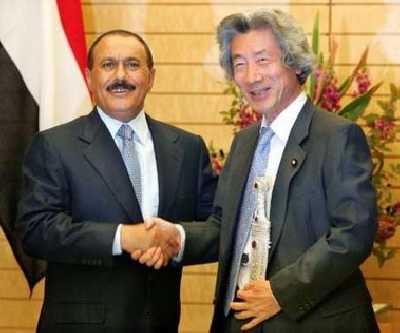
|
|
| |
|
Almotamar Net - President Ali Abdullah Saleh met today in Tokyo with the Japanese Prime Minister Junichiro Koizumi who welcomed him and said his visit to Japan would enhance friendly and cooperation relations between the two countries.
During the meeting, president Saleh discussed with Koizumi ways of strengthening the bilateral relations and aspects of common cooperation between Yemen and Japan in various fields that serve the common interests of the two nations.
The talks tackled also the economic and trade partnership between the two friendly countries and the Japanese support for development and democracy
in Yemen, in addition to the investment opportunities available in Yemen.
They discussed the possibility of establishing many Japanese factories for cars and electronics, especially in the Aden Free Zone to cover needs
of the Middle East and Africa region, in addition to exerted efforts to fight terrorism.
On the other hand, Saleh emphasized the importance of the Japanese role in pushing peace process in the region, in addition to the situations
in Palestine, Iraq, and the African Horn.
He highly appreciated what Japanese government did offer of aids for the development process in Yemen, confirming Yemen's care to institute good
and strong relations with the Japanese government and people.
Japanese Prime Minister confirmed his government interest to enhance and develop the bilateral relations and fields of cooperation with Yemen,
pointing out that Yemen had played important role to keeping regional stability and peace.
He showed Japan readiness to set up many vital projects including factories, electricity and water barriers and dams.
|
| |
|
 Almotamar Net
 - The French ambassador to Sana'a Alain Moureau presented on Sunday some gifts for the Care Center of Homeless Children in Sana'a.
Al-Saleh Social and Charitable Foundation runs the center in cooperation with the World Children Organization, a French non-governmental organization.
During his visit to the center, the French ambassador valuated efforts of the center to take care about street children, appreciating the role
of director of the French organization office in Yemen Emilie Vallet in this regard.
The center has been set up to receive homeless children. Currently, there are about 80 children benefit from the center services.
|
| |
|
 Almotamar Net- IRIN
 - - Yemen will be declared landmine-free in time for a March 2009 deadline, but only if the country�s Mine Action Centre (MAC) receives enough support to implement its second five-year plan, the MAC chairman said on Monday.
"We have a five-year plan, from 2005 to 2009, which aims to declare Yemen free of landmines by March 2009, said Col Mansour al-Ezzi, chairman of the MAC, which is financed mainly by the US government.
He added, however, that the target could only be met if the centre receives funding enough to reorganise its current structure and add new technical survey teams to its operations.
In 1979, more than one million landmines were planted along the border between the north and south of the divided country during conflicts preceding unification in 1990.
According to al-Ezzi, another 150,000 antipersonnel mines were planted during a 1994 civil war, when the southern half of the south Arabian nation attempted to secede from the north.
According to official figures, unexploded mines kill or injure between four and five civilians every month. Between 1998 and September 2005, the MAC recorded 5,316 mine victims, 2,916 of whom died as a result of their injuries. The majority of the rest were left permanently disabled.
Most victims are women, children, shepherds and travellers in rural areas.
In an effort to address the problem, the MAC is devoted to de-mining the four most heavily mined areas of the country. �We�re divided into teams for demining, unexploded ordnance, victim assistance and public awareness,� explained al-Ezzi.
Eight teams of dogs specially trained in mine detection are due to start surveying in the Addale and Ibb governorates next year.
Since 2004, the MAC has also offered job training and medical support, providing victims with prosthetic limbs, wheel chairs and hearing aids.
So far, the MAC�s mine-clearing operations have made considerable progress in ridding the country of the deadly devices.
"We�ve finished clearing mines from the high impact areas, and now we�re left with the medium and low impact areas," said al-Ezzi.
He added that more than 230 million square metres of the total affected area � estimated at 922 million square metres � had been cleared to date.
The MAC is due to sign an agreement with the Canadian government this week, whereby the latter will provide $200,000 for de-mining activities in the four governorates of Sana'a, Lahj, Al-Dhale'e and Ibb.
In October, the Japanese government contributed $520,000 to the centre�s efforts, while the French government provided it with euro 250,000 in June of last year.
Despite this largesse, however, Al-Ezzi said the centre still needs more support to meet the 2009 target date.
|
| |
|
Almotamar Net - Yemen and Japan expressed in a joint statement Tuesday
their desire to develop bilateral relations in different fields.
Japanese Prime Minister Jyunichiro Koizumi expressed his support for Yemen's
successful and continuous efforts in the fight against terrorism in collaboration
with the international community.
The two countries also expressed strong hope that further progress would
be made in the Middle East peace process, calling upon the international
community to encourage the Israelis and the Palestinians to make greater
efforts towards achieving a lasting peace.
They welcomed the approval of the draft constitution of Iraq in the recent
national referendum.
Yemen voiced its support for Japan's permanent membership in the Security
Council, saying the two countries shared the view that comprehensive reform
of the United Nations (UN) is important for the UN to address the new
conditions of the 21st century.
Below, you could read full text of the statement:
His Excellency Mr. Ali Abdullah Saleh, President of the Republic of Yemen,
visited Japan from November 6 to 8, 2005, at the invitation of the Government
of Japan.
This was the second visit of the President as the head of State of Yemen,
which follows his first visit as a guest of the Government of Japan in
March, 1999, and was a good occasion to further deepen and develop the
amicable relations between the two countries.
On November 7, President Saleh made a state call on His Majesty The Emperor.
President Saleh also held a meeting with Speaker of the House of Representatives
Mr. Yohei Kono.
On the same day, President Saleh and Prime Minister Mr. Jyunichiro Koizumi
held talks and discussed a variety of issues ranging from bilateral relations
to regional and international affairs.
President Saleh also met members of the Japanese Parliament, the President
of the Japan Bank for International Cooperation (JBIC) and others.
At all the meetings, both the Yemeni and Japanese sides confirmed their
willingness to further develop the friendly and cooperative relationship
between both the two countries and the peoples.
At the summit talks, both sides reaffirmed that the stability of Yemen
is critical to the stability of the Arabian Peninsula.
Both sides confirmed their commitment not only to strengthen the relations
in the traditional forms of cooperation but also to share information
and closely cooperate in such areas as poverty reduction, democratization
and prevention of terror, with the support of the international community
to eradicate poverty according as the Millennium Summit Declaration of
2000.
Both sides expressed their strong hope that further progress would be
made in the Middle East peace process and called upon the international
community to strengthen its political and economic support for the advancement
of the process and encouraged the Israelis and the Palestinians to make
greater efforts towards achieving a lasting peace.
The Yemeni side highly appreciated the involvement of Japan in the advancement
of the Middle East peace process and, in particular, Japan's assistance
to the Palestinians.
Both sides welcomed the approval of the draft constitution of Iraq in
the recent national referendum, as it represents a very significant step
in the development of the Iraq's political process, and expressed their
hope that this political process will lead to stable and united Iraq in
which all Iraqis of different religious and ethnic groups live in peace.
The Yemeni side highly appreciated Japan's humanitarian assistance to
Iraq and reconstruction assistance by the Self Defense Forces and Official
Development Assistance (ODA).
Both sides shared the view that comprehensive reform of the United Nations
(UN) is important for the UN to address the new conditions of the 21st
century. And both sides affirmed to cooperate toward realizing the reform
of the UN including the Security Council during the current session of
the General Assembly, recognizing that early reform of the Security Council
is an essential element of the overall effort to reform the UN.
President Saleh renewed Yemen's support for Japan's permanent membership
in the Security Council. Prime Minister Koizumi expressed deep gratitude
for the support.
Prime Minister Koizumi expressed his support for Yemen's successful and
continuous efforts in the fight against terrorism in collaboration with
the international community.
Both sides shared the view that Yemen's efforts to accelerate its poverty
reduction program and democratization will lead to the eradication of
the safe haven of terror and to the prevention of terrorism.
To that end, the Japanese side expressed its readiness to extend assistance
to achieve these goals.
Yemen welcomed Japan's decision to continue the fight against terrorism
through activities based upon the Anti-Terrorism Special Measures Law.
Both sides confirmed that non-proliferation of Weapons of Mass Destruction
(WMD) and their delivery means is essential for the peace and stability
of both the Middle Eastern and East Asian regions and the entire world.
Prime Minister Koizumi highly applauded Yemen's policies on economic reforms
and democratization under the leadership of President Saleh. The Japanese
side expressed its support to these efforts, and expressed its hope that
Yemen's economic reforms will improve the living standard of its people.
The Japanese side recognizes the importance of basic education, rural
water supply and health services and has proactively extended assistance
to these sectors in Yemen, through its ODA utilizing such schemes as Non-Project
Grant Aid and Grant Aid for Increase of Food Production (2KR).
The Japanese side expressed its readiness to further support Yemen's efforts
in these sectors.
In this connection, Japan International Cooperation Agency (JICA) will
undertake a development study to formulate a project for rural water supply
to cover designated areas in five governorates of Yemen and to improve
the capacities of the local water supply authorities. JICA will also enlarge
Japan Overseas Cooperation Volunteers (JOCV) dispatch program which was
resumed last July.
Furthermore, in view of the presidential election and local council elections
which will be held nationwide in 2006, the Japanese side has expressed
its readiness to consider assistance to the government of Yemen to further
accelerate the democratization process in Yemen.
The Japanese side also expressed its intention to consolidate the concept
of human security in Yemen, a concept which Japan takes the initiative
to promote to the entire world. The Japanese side stated that it has decided
to extend assistance toward the Yemen Executive Mine Action Center (YEMAC)
to support the activities for clearance of land mines.
While expressing deep appreciation for Japan's assistances to Yemen to
date, including debt relief, the Yemeni side explained the economic and
social challenges which the country is facing as a result of the reforms
made by the government of Yemen and asked for increased support from Japan.
Taking into consideration the aforementioned request from the Yemeni side,
both sides decided to hold a policy consultation on economic cooperation
around the first half of 2006 in Sana'a, in order to exchange views on
Japan's medium term aid policy toward Yemen as well as Yemen's needs in
the fields of democratization and preventive measures of terror.
In light of the level of ODA Japan has extended to Yemen, the Yemeni side
expressed its wish that Japan would substantially increase ODA as well
as to resume Yen loan to finance infrastructure projects.
Both sides referred to the importance of further promoting cultural and
people-to-people exchanges, and welcomed the participation of Yemeni officials
in the Japanese Language Program offered by the Government of Japan. Both
sides also welcomed the increased popularity of Yemen among Japanese people
as a result of Yemen's participation in World Exposition 2005 in Aichi
Prefecture as well as a documentary TV program in Japan on World Cultural
Heritage of Yemen and other activities.
President Saleh expressed its gratitude to the Japanese side for its hospitality
and extended an invitation to Prime Minister Koizumi to visit the Republic
of Yemen. Prime Minister Koizumi accepted this and expressed his gratitude
for the invitation.
|
| |
|
 Ebtihag Alkamal
 - Some politicians believe that democracy is based �only-on constitutional foundation and legal texts, so they claim that the absence of ideal experiences in democracy, freedoms, human rights means the failure of the political regime of the country.
Those people ignore that democratic and evolution change and the respect of human rights are not a production of legislative process only but production of political, social and cultural development ,and that process may takes long time.
As the change of the legislative infrastructure and its continuous improvement is a necessity for democratic development ,hence the influence in culture and minds of political leaders , the expansion of the political participation ground and upgrading the awareness of rights and democratic conduct occupy the same importance which the democratic legislations have.
The continuation in changing different institutions in the society to the same direction where the democratic process is moving at to create a generation believe in democracy and respect human rights, especially when we talk about Yemen �which spent decades under totalitarian and dictator regimes.
Although Yemeni democratic experience is short-about 15 years old- but it exposed that Yemeni socity is attempting to make this transformation achievable and becomes a final choice without return.
During the past fifteen years of the age of democracy in Yemen ,many political activities ,social ,economical , and cultural interaction took place which confirmed the democratic choice as a best choice for rapid development.
The country has witnessed three parliamentary elections , presidential election , local governance elections, two referendums , free journalism emerged and plurality as well.
President Ali Abdullah Saleh called political parties to expand women participation in policy and public life. He stressed in his speeches on women empowerment while hisarty (GPC) suggesting 10 percent representation in political decision-making. )
To achieve all that in underdevelopment country- like Yemen �during fifteen years is to be considered as.
To achieve all that in one of developing country- like Yemen �during fifteen years is to be considered as hopeful and progressive steps towards stable democracy in the country.
The critical question is : why we want Yemeni democracy to jump to remote distances in order to be on one line with western world �during 15 years only! Could democracy jump over realities of its society!? I do not think that.
|
| |
|
 Almotamar Net
 -
President Ali Abdullah Saleh is to head from Japan to the United States on November 9 to hold meetings with the US President George W. Bush and a number of senior officials in the US administration
over mutual relationships and regional and international issues.
Foreign Minister Abu-Bakr Al-Qerbi stated that this visit would gain a special importance to develop and broaden the political, economical and security relations, and reinforce cooperation in vocational training and anti-terror fight.
He pointed out that the US government highly considers Yemen's achievements in political stability and human rights which would result in the US support for development works in addition to improving military training performance.
|
| |
|
Almotamar Net -
The Cabinet in its weekly meeting on Tuesday approved
executive program of granting the concession right of block No. 18 to the Safir Petroleum Exploration Company instead of the US Oil hunt company.
The Cabinet also approved a by-law of Safir company and its capital and operation budget for the rest of the current year as well as the budget for the coming year.
The Cabinet confirmed it would finalize all legal measures to hand the block to Safir company.
All Yemeni, non-Yemeni workers and contactors who were working in the block with the US company will continue their jobs under the management of the new company of Safir upon their desire, the cabinet promised.
The Cabinet condemned remarks issued by the Hunt, describing them as damage for the national rights and sovereignty of the country.
|
| |
|
 Almotamar Net
 - (AP) - Scientists were counting down Tuesday for the blast off of a Russian booster rocket carrying a European-built probe aimed at exploring the hot, dense atmosphere around Venus.
The launch of the European Space Agency's Venus Express probe is planned for 0333 GMT Wednesday at the Russian-leased Baikonur cosmodrome in Kazakhstan.
Venus Express was originally scheduled to go up on October 26, but the launch was postponed after checks revealed problems with the thermal insulation in the upper stage of the Soyuz-Fregat rocket.
Once it separates from the rocket, scientists at ESA's mission control in Darmstadt, south of Frankfurt, plan to make contact with the probe.
"We've just had the pre-launch briefing and everything is in the green zone," said ESA spokeswoman Jocelyne Landeau. "Everything is ready for go."
The mission, Europe's first to Venus, will concentrate on the greenhouse effect around the planet and the permanent hurricane force winds that constantly encircle it.
In addition, instruments on the probe will try to find an indication as to whether Venus' many volcanoes are active.
"Venus is still a big mystery," Gerhard Schwehm, head of the planetary missions at ESA said Monday.
The probe will take 155 days, or roughly five months, to reach Venus.
It is expected to begin its experiments in early June.
|
| | | | | | | | | | | | | | | | | | | | | | | | | | | | | | | | | | | | | | | | | | | | | | | | | | | | | | | | | | | | | | | | | | | | | | | | | | | | | | | | | |

 President Saleh presides the weekly meeting of PGC