 Google Alerts Washington Post
 - Bulent Ecevit, 81, who was one of Turkey's most prominent politicians and spent a career of 50 years grappling with problems of the economy and of domestic and regional instability, died Nov. 5 in a hospital in Ankara, more than five months after suffering a debilitating stroke.
As prime minister on five separate occasions (once as head of a caretaker government) and as a longtime political activist and party leader, Mr. Ecevit played a vital role in the affairs of a country that was, particularly during the Cold War, an important strategic partner of the United States.
Among the unique characteristics of his country was that Turkey was the only member of the North Atlantic Treaty Organization with a majority-Muslim population.
By the standards of a nation poised culturally and geographically between East and West, Mr. Ecevit, a poet, writer and literary translator, was viewed as an urbane figure, liberal in outlook. Early in his political career, he joined the Republican People's Party, which was founded by Kemal Ataturk, the reformer known as the father of modern Turkey.
Over the years, turbulence and difficulties beset Mr. Ecevit's terms in office: Coalitions were difficult to build and to hold, and stable, durable government often appeared beyond reach. The currency was at times shaky; politics was not immune to violence. At one time, leaders of a coup banished Mr. Ecevit from politics.
He was hailed as an upright figure who was above the corruption that sometimes tarnished public life in Turkey. Disputes over how to combat corruption, however, roiled Turkish politics.
Among the actions that won internal support for governments that he headed was the order to intervene militarily in 1974 on behalf of Turkish interests on the troubled and disputed Mediterranean island of Cyprus.
This maneuver proved highly popular among his countrymen, and in recognition of it, they often called him the "Conqueror of Cyprus."
Early in 2002, while serving in what would become his last year as prime minister, Mr. Ecevit visited Washington. One aim was to confer with officials at the World Bank and International Monetary Fund to get help for a shaky economy.
He met with President Bush, who praised him as a U.S. friend and told him that he had been "steadfast in your support in the war against terror."
Bush also said the United States appreciated "some very tough decisions" that Mr. Ecevit had made in trying to sustain Turkey's fiscal health.
In office, Mr. Ecevit imposed rigorous and sometimes painful measures on the Turkish economy. These were seen as efforts to win foreign loans needed to keep the nation afloat and as ways to prepare Turkey for possible membership in the European Union.
"We appreciate your leadership when it comes to economic policy," Bush said.
At the time of his visit, Mr. Ecevit appeared in a television interview with journalist Jim Lehrer to express misgivings about the possibility of an invasion of Iraq.
"We wouldn't even think of a military action, because that would have extremely adverse results for Turkey. After all, we are on the borders. We have a common border with Iraq. And it's a very sensitive area geopolitically," Mr. Ecevit said. He expressed Turkish concern "that Iraq should not become a divided country."
Mr. Ecevit was born in Istanbul on May 28, 1925. His father was a physician and his mother a painter and teacher. He graduated from an American school in Istanbul and studied later in Ankara, London and at Harvard University. He worked as a press attache at Turkey's embassy in London and then returned home to write for the newspaper of the Republican People's Party.
A member of the group selected to bring new blood to the fading party, he was elected to the National Assembly in 1957.
He battled his way to party leadership and was recognized as an advocate of economic reform. In 1974, he became prime minister for the first time, heading a coalition government. In 2002, his health declined, and he lost office in November elections.

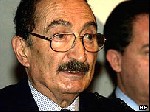
 Former Turkish Leader Bulent Ecevit, 81