 Almotamar.net Google News
 - BAGHDAD, Jan. 16 — More than 90 people were killed by bombs and bullets here today, as United Nations officials announced that more than 34,000 civilians were killed across the country last year and warned that the violence was “likely to continue” so long as Iraqis see the country’s justice system as ineffective or unfair.
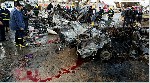
Two bombs exploded in quick succession today at Baghdad University as students were leaving classes, killing at least 60 people and wounding at least 110, Interior Ministry officials said. One of them was detonated by a suicide bomber and the other was placed in a car, but it was not clear in which order they were detonated.
The blasts left a score of minivans and other vehicles burnt and twisted. Reuters quoted its photographer on the scene as saying that cellphones on the victims rang repeatedly as the rescue and cleanup effort proceeded. The news agency also quoted an unnamed university official who said that most of the victims were female students waiting for rides in the vans.
At least 15 more people died and 70 were wounded by another pair of bombs in central Baghdad, in a market devoted to motorcycle and stereo shops that is not far from a Sunni mosque, officials said. The mosque was not believed to be the target.
And two members of an elite police bomb-disposal unit and two civilians were killed in the Karada neighborhood when a bomb, the second of a pair the officers were working to defuse, exploded there.
Gunmen in a minivan and on a motorcycle opened fire today on an outdoor market in a nearby Shiite neighborhood, killing at least 11 people, The Associated Press reported. News services gave conflicting accounts about whether that attack took place before or after the university bombing.
The American military announced today that four soldiers were killed on Monday by a roadside bomb while on patrol in Nineveh province in northern Iraq.
Today’s violence and the United Nations report’s chilling statistics on civilian deaths underscored the depth of the security problem facing American military officials as they prepare to deploy more troops, as part of the Bush administration’s new strategy for Iraq that for the first time makes the protection of civilians the war effort’s highest priority.
The military is engaged in discussions with the government led by Prime Minister Nuri Kamal al-Maliki to fashion a joint approach to securing Baghdad, using the roughly 20,000 new American troops that President Bush said last week would be dispatched to Iraq.
Mr. Maliki, who is said to have agreed to the American troop increase only reluctantly, said today that the Iraqi army would continue to build up its forces to prepare for “the withdrawal of the multinational forces from the cities, or the withdrawal of 50,000 American soldiers from Iraq.”
The 2006 casualty report by the United Nations Assistance Mission for Iraq was based on figures provided by from the Medico-Legal Institute in Baghdad and hospitals around the country. It estimated that 34,452 civilians died from violence in 2006 — an average of 94 a day — and that an additional 36,685 were wounded.
The Iraqi government, by contrast, released figures earlier this month putting the civilian death toll for 2006 at 12,357. A Health Department official today criticized the United Nations tally as “exaggerated,” news agencies reported. After an earlier U.N. report on civilian casualties, the government ordered morgues and hospitals to stop releasing information.
The White House spokesman, Tony Snow, told reporters in Washington today that “it’s 100 percent obvious that civilian casualty numbers are way too high.”
The U.N. report said that the level of violence appeared to have declined slightly toward the end of the year — 3,462 violent deaths were recorded for November and 2,914 for December, compared with 3,345 in September and 3,702 in October — although it noted that some provinces had not yet reported December figures.
The head of the mission, Gianni Magazzeni, told reporters that a cycle of revenge killings and reprisals had escalated in the absence of an effective and impartial justice system.
“If people don’t have a sense that justice is done, unfortunately this sectarian violence is likely to continue,” Mr. Magazzeni said. “Ensuring accountability would go a long way to help turning the tide.”
The report described a “growing sense of impunity for on-going human rights violations,” a development that it said “leads people to take the law into their hands and rely on actions by militias or criminal gangs.”
The report also said that Iraqi law enforcement agencies are ineffective and that militias and criminal gangs increasingly work in collusion with members of the official security forces or have infiltrated them.
The report was also critical of troops from the United States and its remaining coalition partners, whose operations it said “cause severe suffering to the local population.”
Saying that limitations on freedom of movement and lack of access to basic services affect a large part of the Iraqi population, the report called on coalition troops to “refrain from any excessive use of force.”
The authors of the report found that the killings in Iraq in 2006 were centered in Baghdad, where more than 16,000 civilian deaths from violence were recorded. They described the situation in the capital as “notably grave.”
“Unidentified bodies killed execution style are found in large numbers daily,” the report said.
Many of the bodies go unclaimed, because relatives who suspect police involvement in the deaths are afraid to obtain the necessary police approval to remove the remains. The Baghdad morgue is said to be shipping some 200 unclaimed bodies a week to Shiite cities in the south for burial, the report said.
Attributing the information to sources it did not name, the report said most of the killings and unclaimed bodies are found in six police precincts — three in Shiite areas of the city and three in Sunni areas.
Meanwhile, the report said, insurgents, including foreign terrorists, carry out large-scale attacks, usually through simultaneous bombings like those seen today in Baghdad. On top of that, killings by “criminal elements taking advantage of a law and order vacuum” in the capital are also on the rise.
Efforts to drive residents from their homes to win sectarian control of Baghdad neighborhoods have included large-scale attacks, kidnappings, killings and intimidation, the report said. Abductions in general are on the rise, and have involved deputy ministers and even the head of the Iraqi Red Crescent Society, who was grabbed by men wearing police uniforms and released after a ransom was paid.
The report noted that some parts of the country, notably in the Shiite-dominated south and in Kurdistan in the north, were “relatively safer.” But it also reported that some parts of those areas have recently become more violent, including the ethnically mixed northern cities of Mosul and Kirkuk.
Around the country, the report described a deteriorating situation for women and minorities, including Palestinians and Christians, and said that attacks on professional groups “continued unabated.”
Many of Iraq’s educated elite have fled the country. Prime Minister Maliki paid a visit to Baghdad University late last year to urge students and professors to stay despite the continued violence.
Last November, the Education Minister stepped down temporarily in protest after more than 100 people were kidnapped from a ministry office, in a daylight raid by gunmen driving official-looking vehicles. The United Nations report said that while nine Shiites who were among the victims were released immediately, 70 others were released only after being tortured by their captors, and a further 70 or so remain missing.
The question of just how many civilians have been killed since the 2003 invasion of Iraq has been hotly contested.
Speaking off the cuff during an official visit to Vienna in November, Iraq’s health minister, Ali al-Shimari, estimated that 150,000 Iraqis had been killed in violence since the war began.
Iraq Body Count, an independent group that monitors news reports of violence, has recorded the deaths of more than 52,000 Iraqi civilians, but notes that many go unreported.
The highest estimates of the civilian toll so far have come from a team of researchers from the Johns Hopkins Bloomberg School of Public Health. In a study published in The Lancet, a British medical journal, they estimated that 600,000 Iraqis had died from violence between March 2003 and July 2006, basing their analysis on a survey of 1,849 households in 47 neighborhoods across Iraq.

 90 Killed in Baghdad; U.N. Sets ’06 Toll Above 34,000