 almotamar.net google
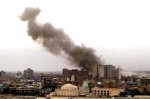
 - At least 102 people were killed and 215 wounded yesterday in the biggest attack so far this year in Iraq when a suicide truck bomb slammed into the central Baghdad district of Al-Sadriya, a security source said.
A suicide truck bomb exploded near the Sadriya market, in central Baghdad on the east bank of the Tigris River. "At least 102 people were killed and 215 wounded," the source said.
The blast sent a long plume of thick grey smoke up into the air just before dusk, a time when markets are usually crowded with shoppers out for food ahead of the night-time curfew.
A US Army helicopter crashed Friday in a hail of gunfire north of Baghdad, police and witnesses said the fourth lost in Iraq in the last two weeks.
The US command said two crew members were killed, and the top US general conceded that insurgent ground fire has become more effective.
An al-Qaeda-affiliated group claimed responsibility and said its fighters had "new ways" to attack American planes.
A brief US military statement gave no reason for the crash and did not identify the type of aircraft. A Pentagon official said it was an Apache attack helicopter, which carries two crew members.
The US military announced the deaths of six more troops in Iraq on Friday, including two killed by Sunni Arab insurgents in their stronghold of Al-Anbar province, west of the capital Baghdad.
A marine and a soldier died from wounds received due to "enemy action" during combat operations in Al-Anbar on Thursday, while another marine died from a heart attack in the province the same day, a statement said.
It corrected an earlier statement that had given the day of all three deaths as Friday.
Earlier, the US military announced the deaths of three soldiers in two separate traffic accidents on Thursday.
The official spoke on condition of anonymity because he was not authorised to release the information. Another Apache crashed Sunday during heavy fighting with a Shia cult near Najaf, also killing two soldiers.
Iraqi police and witnesses said the latest crash occurred about 7:30 am as two Apaches were flying along a well-established air route near Taji, a major US base about 18km north of Baghdad.
One helicopter was struck by heavy machine gunfire but continued flying, the witnesses said. The other helicopter banked sharply and flew back toward the source of fire, apparently to attack the target.
But that helicopter was also struck by ground fire, exploded in a ball of fire and crashed, the witnesses said. The other helicopter flew away, they said. The witnesses spoke on condition of anonymity, fearing for their own safety.
The United States has lost more than 50 helicopters in Iraq since May 2003, about half of them to hostile fire.
In fresh violence at least nine people were killed on Saturday in a series of attacks across Iraq, including six police commandos shot dead near the northern town of Samarra, security officials said.
A group of gunmen attacked a police checkpoint early in the day, killing six commandos and wounding another six, an official at a local police coordination centre told AFP.
The attack took place north of Samarra, which is 125km north of Baghdad, he said.
However, the loss of four helicopters since Jan. 20 has raised new questions about whether Iraqi insurgents are using more sophisticated weapons or whether US tactics need changing.
Three of the latest crashes involved Army helicopters two Apaches and one Black Hawk. The fourth was an OH-6A observation helicopter operated by the Blackwater USA security firm. All were believed shot down, and 20 Americans, including four civilian, died in the crashes.
In Washington, Gen. Peter Pace, chairman of the Joint Chiefs of Staff, acknowledged that insurgent ground fire in Iraq "has been more effective against our helicopters in the last couple of weeks."
But Pace said it was unclear whether "this is some kind of new tactics or techniques that we need to adjust to."
The Islamic State of Iraq, an al-Qaeda-linked group, claimed on Friday that it shot down the Apache near Taji in a statement posted on an extremist Web site.
"We tell the enemies of God that the airspace of the Islamic State in Iraq is prohibited to your aircraft just like its lands are," the statement said. "God has granted new ways for the soldiers of the State of Iraq to confront your aircraft."
Iraqi insurgents have used heavy machine guns, rocket-propelled grenades and shouldered-fired SA-7 anti-aircraft missiles throughout the Iraq conflict. US officials believe Iran is supplying Shia militias with new weapons including more powerful roadside bombs, Katysuha rockets and a newer class of rocket-propelled grenades.
Some of those weapons could have found their way into the hands of Sunni insurgents, who operate around Taji.
The US military relies heavily on helicopters to avoid roadside bombs and insurgent ambushes. Any new threat to helicopters would be a serious challenge to the military as it gears up for a major crackdown against Sunni insurgents and Shia militias in Baghdad.
Helicopters are always vulnerable to ground fire, said Stephen Trimble, Americas bureau chief for Jane's Defence Weekly. "A well-placed bullet can pretty much take down any helicopter," he said.
Protecting helicopters from attack is significantly more complicated than defending against roadside bombs, Trimble said.
"What you would do with a Humvee is up armour it," he said. But helicopters can't support a significant increase in weight. The US military is looking into technology that tracks and fires at rocket-propelled grenades, he said, but its use on helicopters is a long way off.
Apaches carry multiple high-tech defences, including long-range sensors, radar jammers and an infrared jammer for countering incoming missiles.
However, the Apaches, which were designed to fight the Soviet Union on the plains of central Europe, have proven vulnerable to intense ground fire.
During the 2003 invasion of Iraq, more than 30 Apaches had to break off an attack after suffering heavy damage in fighting with the Iraqi Republican Guard. One helicopter crashed but the two crew members survived.
Elsewhere, the US command said 18 insurgents were killed in fighting Thursday night and Friday after insurgents opened fire on the Americans from several positions in Ramadi, 115km west of Baghdad. No civilian or US casualties were reported, the military said.
Ramadi, the capital of the western province of Anbar where Sunni insurgents remain well-entrenched, has seen some of the bloodiest street battles of the war.
The US forces returned fire with machine guns, tanks and finally a missile, which struck the intended target, killing at least 15 insurgents.
On Saturday, a parked car bomb struck a commercial area south of Baghdad, killing one civilian and wounding eight, police said.
The explosion occurred just before 8 a.m. in Mahmoudiya, a predominantly Sunni city some 20 miles south of the capital, police said, giving the casualty toll. Some storefronts were damaged and four vehicles were set on fire.
Mahmoudiya is in an extremely violent region in Iraq in an area known as the "triangle of death" for the numerous attacks by insurgents.
Insurgents also renewed their attacks on Friday, prompting US forces to fire another missile that killed at least three attackers.
Also in Anbar, gunmen assassinated the Sunni chairman of the Fallujah City Council, Abbas Ali Hussein, an outspoken critic of al-Qaeda. He was the third council chairman assassinated in Fallujah this year as insurgents target Sunnis willing to cooperate with the US and its Iraqi partners.
The US military said six more troops died Thursday, two in fighting in Anbar province, one of an apparent heart attack and three in vehicle accidents.
The deaths raise to at least 3,092 the number of members of the US military who have died since the Iraq war started in March 2003, according to an Associated Press count. At least 2,480 died as a result of hostile action, according to the military's numbers.
In Baghdad, police said they found the bullet-riddled bodies of 23 people throughout the capital apparent victims of Shia or Sunni death squads. Three more bodies were found in Kut, southeast of Baghdad, and two in Mosul.

 Baghdad blast kills 102