 Almotamar.net Google News
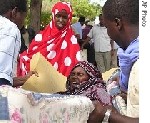
 - Sporadic shelling and gunfire shook Mogadishu on Friday as a massive exodus from the Somali capital gathered pace from a week of battles residents say has killed at least 30 people and probably far more. The United Nations said 321,000 people -- nearly a third of the city's population -- had fled since February in refugee scenes not seen in Somalia since the fall of a dictator in 1991.
Parts of the city looked like a ghost town of empty streets and shattered buildings. In provinces round Mogadishu, tens of thousands of refugees waited under trees or beside roads in what aid groups say is a looming humanitarian disaster.
At packed Mogadishu hospitals, bloodied patients screamed and doctors struggled to tend to scores of wounded after four days of clashes between troops and insurgents.
Soldiers blocked off roads to military bases after a suicide attacker blew himself up on Thursday at a former prison now used by the interim Somali government's Ethiopian military allies.
At least 21 people, mainly civilians, died in that blast and other fighting across the city on Thursday. Nine also died on Tuesday and Wednesday, though locals say the real death-toll -- including an unknown number of fighters -- must be much higher.
Residents hardened by 16 years of lawlessness say violence is getting worse in Mogadishu, where Islamist insurgents and some disgruntled Hawiye clan fighters are battling government forces and Ethiopian soldiers. African Union peacekeepers have failed to stem the violence, and have also been targeted.
Hundreds more Somalis were fleeing Mogadishu by foot, donkey, cart and vehicle on Friday, Reuters witnesses said.
President Abdullahi Yusuf tried to put a brave face on the situation. "I would say the problem of Somalia is slowly but surely ending," he said in Ethiopia where he was holding talks with Prime Minister Meles Zenawi.
Mogadishu residents say the latest fighting, which also saw rockets fired on a crowded market on Thursday, is as bad as four days of battles that killed 1,000 people at the end of March.
"MARTYRDOM OPERATION"
A little known Islamist group, calling itself the Young Mujahideen Movement in Somalia, claimed responsibility for the suicide blast. It said it used chemicals in the attack, though it was not possible to verify the authenticity of the Internet statement which referred to a "martyrdom operation".
The United Nations estimates there are 3,000 anti-government combatants, including foreign fighters, in Somalia. The Security Council will in June consider sending peacekeepers.
Yusuf vowed to hunt down gunmen loyal to an Islamist movement defying his government's attempt to establish central rule for the first time since the fall of dictator Mohamed Siad Barre in 1991.
Ethiopia's state news agency said Yusuf and Meles, in talks, "underscored the need to intensify terrorist mopping up operations in Mogadishu."
Islamist leader Sheikh Sharif Ahmed said dozens of Ethiopian soldiers had defected in Mogadishu and fled across the sea to Yemen -- but Somali officials denied that.
Ethiopia dismissed on Friday comments by the U.N. humanitarian coordinator for Somalia that its troops and the Somali interim government were not helping with access for aid.
"(Eric) Laroche's statement shows a surprising lack of understanding of the situation in and around Mogadishu and the difficulties for relief operations caused by car bombs, land mines and random rocket attacks by extremists and terrorists," spokesman Solomon Abebe said.
Oxfam urged Kenya to reopen its border to allow aid to cross and Somali asylum seekers to be screened.
"The approach of the rainy season makes the need for shelter material more pressing as families living under the trees are exposed to the scorching sun, heavy rains and the chilling nights," the U.N. refugee agency UNHCR said.
In the United States, an American man who travelled to Somalia to support Islamic rule there pleaded guilty to training with al Qaeda, officials said on Friday. Daniel Joseph Maldonado was arrested in Kenya in January after fleeing Somalia. (Additional reporting by Farah Roble in Mogadishu, Andrew Cawthorne and Guled Mohamed in Nairobi, Sami Aboudi in Dubai and Tsegaye Tadesse in Addis Ababa)

 Somali deaths mount, refugee exodus grows