 almotamar.net
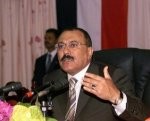
 - President Ali Abdullah Saleh affirmed that "The issues have become moving from centralization to decentralization and they will be realized in a bigger way when some constitutional amendments are done for the election of governors and heads of administrative units. Then the government task remains for planning, programming and supervision and follow-up so that the ministers will not change into executive managers and directors general. Their work will be planning, supervising and follow-up and the job will be left to executive managers in the governorates to work and bear the responsibility."
Receiving Tuesday the participants in the second conference of the association of senate, Shura and Equivalent councils in Africa and the Arab world (ASSECAA) president Saleh added that the governorate and the local authority are the parties that draw up budget of the governorate and they know concerns of the citizens due to their nearness to them and in turn they refer those concerns to the central government that it adopts. Some revenues, instead of coming from the central government, the governorate councils collect them and consequently that would achieve positive successes because the citizen will be the beneficiary, the president said. " They are in need of building a school, a mosque or building a water project or health centre for treatment of the sick and that made members of the local authority keen to collect revenues that were neglected and the c entrap government was not able to collect them," president Saleh said.
The president clarified that there is now competition among the governorates for collecting the revenues the law has empowered them for building projects while there are central revenues which are the specialization and central right of the state such as oil and minerals, customs and taxes and seaports. He said the local authority in Yemen consists of about 7 thousand leading members of decision makers participating in the development process and services and they are decision makers.
President Saleh said the one-party imposes its own vision without giving opportunity to others to express their ideas and we have adopted the political and party pluralism for seventeen years and will not back of from that." We have press freedom and we held three parliamentary session and two sessions for presidential and local elections that all were transparent and the world has witnessed that. Nevertheless we are working on conducting some constitutional amendments to establish the parliamentary bi-cameral system, an amendment on election of governors and heads of districts to limit centralization and expand the base of people's participation."
He said it is not acceptable to say that democracy in Yemen is imposed from outside and " we refuse to be imposed on us but rather we adopt it out of conviction, and we are not afraid of press as some were getting annoyed from articles and the press, the people get used to criticism in articles and there are positive aspects in the opposition press and some of them are negative but we adopt the positive side."
On the question of terror president Saleh said he had discussed it during his visits abroad and particularly with the United States of America in his recent visit. He added that he talked with them that the US, the UN Security Council permanent member states, the European Union, the Afro-American Union, Non-aligned organisation and the Islamic organisation should adopt the Arab peace initiative approved at Beirut summit and confirmed their adherence to it at the Riyadh summit. This initiative will work for the establishment of peace and extinguish many of fires burning in the region as a result of absence of international justice.
He said had the international legitimacy resolutions been implemented in a good way and the establishment of a Palestinian state beside Israel many of the deluded youth would have calmed down. This is what we adopt before the international community and we have submitted that with the American administration and the European Union. The international community should act in this frame and to accept establishment of the Palestinian state in accordance with the Arab initiative on borders of 1967.
President Saleh welcomed the participants in the ASSECAA conference in Sana'a wishing them success and more consultation and understanding service of international and regional security and peace.
On the other hand chairman of the Yemeni Shore Council, the chairman of the ASSECAA Abdulaziz Abdulghani thanked the president for meeting the participants in the conference and talked on meetings of the conference and the decisions they have taken that would enhance work of the ASSECAA including the grouping of businessmen in the states of the association in order to cooperate for trade exchange and investment opportunities in addition to formation of a peace committee from the Arab world and Africa in addition to decisions for strengthening political, cultural and youth cooperation and coordination and exchange of visits among the association member states.

 Electing governors eases the government task of planning and follow-up: President Sal